White Peony Root
- Chinese
- 白芍
- Pinyin
- Bai Shao
- Latin
- Radix Paeoniae Alba
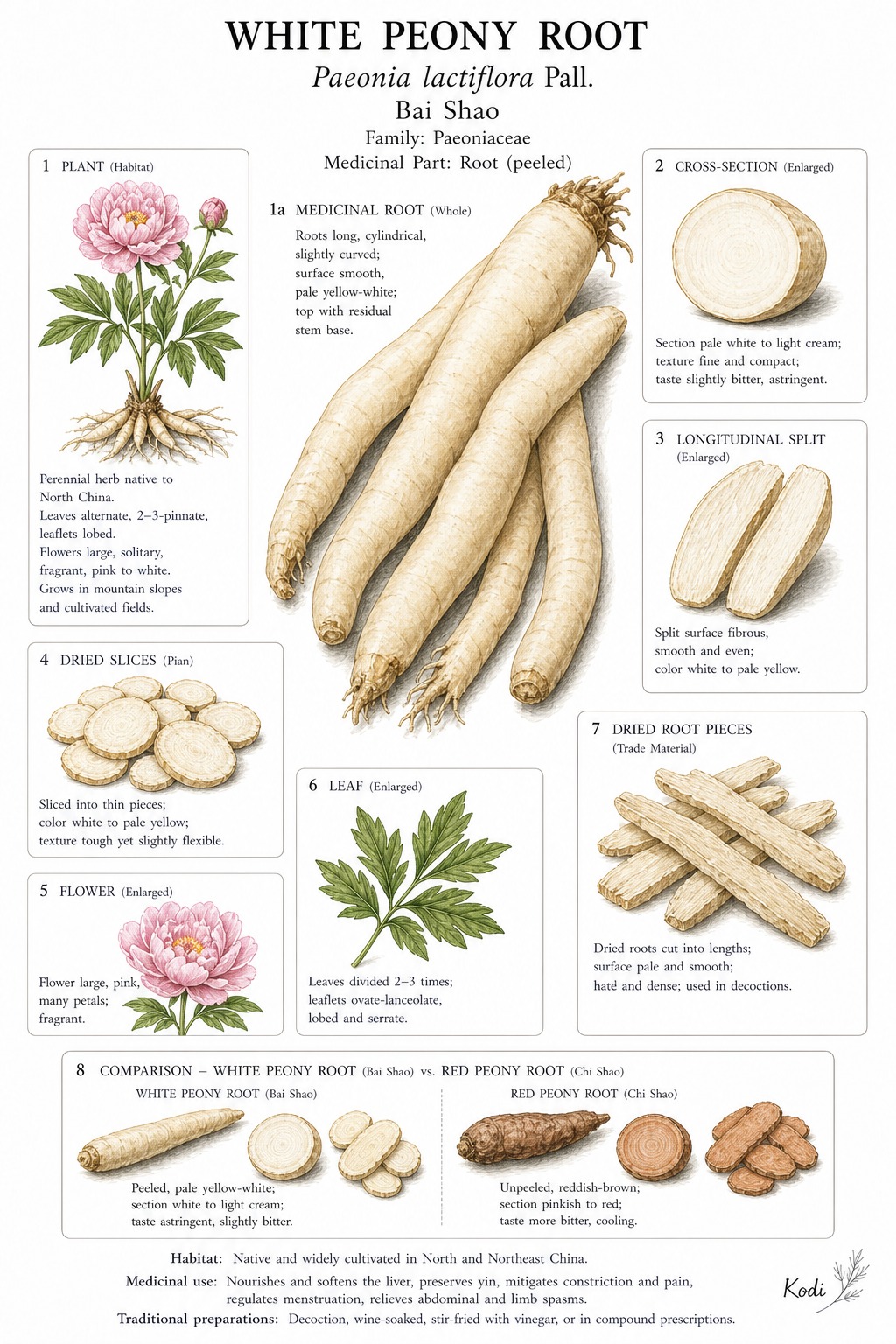
Known in TCM as Bai Shao (白芍), this bitter and sour, slightly cold herb enters the Liver and Spleen. Traditionally, it nourishes blood and preserves yin ... Bai Shao is one of the classic peony roots for blood deficiency, dizziness, dry eyes, and menstrual depletion patterns, most often applied for dysmenorrhea, abdominal pain, and menstrual irregularities. Modern research has identified Paeoniflorin among its active constituents.
Part used: Root
Also Known As
Latin: Radix Paeoniae Alba | Pinyin: Bai Shao | Chinese: 白芍
TCM Properties
- Taste
- bitter, sour
- Temperature
- slightly cold
- Channels
- Liver, Spleen
Traditional Use
Primary Actions
- Nourishes blood and preserves yin ... Bai Shao is one of the classic peony roots for blood deficiency, dizziness, dry eyes, and menstrual depletion patterns.
- Softens the Liver and relieves pain ... it is widely used for abdominal cramping, flank discomfort, and dysmenorrhea when tension, deficiency, or disharmony cause spasm-like pain.
- Moderates spasm and harmonizes the nutritive and defensive levels ... classical use includes sweating patterns, restless irritability, and formula work where yin preservation matters as much as simple pain relief.
Secondary Actions
- This page should stay clearly distinct from the already-live `red-peony-root` lane ... both are peony medicines, but Bai Shao nourishes and restrains more strongly while Chi Shao cools and moves more strongly.
- It also remains distinct from the paired `white-peony-root-2` record, which tracks the Hang Shao trade-form lane rather than the broader standard Bai Shao whole-root presentation.
Classic Formulas
- Shao Yao Gan Cao Tang ... classic pairing for acute spasm, cramping, and painful tension.
- Si Wu Tang ... foundational blood-nourishing formula where Bai Shao enriches blood and supports menstrual regulation.
- Xiao Yao San ... Liver-Spleen disharmony formula in which Bai Shao softens the Liver while preserving blood and yin.
Classical References
- Traditional materia medica describes Bai Shao as bitter, sour, and slightly cold, entering the Liver and Spleen to nourish blood, preserve yin, soften the Liver, and relieve pain.
- The standard teaching contrast with Chi Shao is fundamental ... Bai Shao focuses more on nourishment, restraint, and spasm relief than on vigorous blood movement.
Modern Research
Active Compounds
- Paeoniflorin ... the best known monoterpene glycoside in white peony pharmacology
- Albiflorin and oxypaeoniflorin ... key glycosides linked to immunologic and neuroprotective interest
- Gallic acid derivatives and related phenolics ... supportive antioxidant constituents in Paeonia lactiflora roots
- Total paeony glycosides ... widely studied extract fraction in modern translational research
Studied Effects
- A 2024 review summarized the ethnopharmacology, phytochemistry, pharmacology, pharmacokinetics, and quality-control issues of Paeonia lactiflora, giving the broadest modern overview for Bai Shao (PMID 39053710).
- A pharmacological review of bioactive constituents from Paeonia lactiflora and related peonies outlined anti-inflammatory, analgesic, immunoregulatory, and antispasmodic research themes relevant to white peony root use (PMID 27279421).
- A 2021 in vitro and in vivo study reported that Paeonia lactiflora root extract and its components reduced biomarkers of early atherosclerosis through anti-inflammatory and antioxidant mechanisms, showing why paeony extracts continue to draw cardiometabolic research interest beyond traditional gynecologic use (PMID 34679642).
PubMed References
- A review of the ethnopharmacology, phytochemistry, pharmacology, pharmacokinetics and quality control of Paeonia lactiflora Pall. (2024)
- A Pharmacological Review of Bioactive Constituents of Paeonia lactiflora Pallas and Paeonia veitchii Lynch. (2016)
- Paeonia lactiflora Root Extract and Its Components Reduce Biomarkers of Early Atherosclerosis via Anti-Inflammatory and Antioxidant Effects In Vitro and In Vivo. (2021)
Safety & Interactions
Contraindications
- Loose stool from cold-damp without blood deficiency
- Patterns dominated by severe food stagnation or phlegm accumulation rather than deficiency, spasm, or Liver-Spleen disharmony
Cautions
- Bai Shao is gentler than Chi Shao in terms of blood movement, but concentrated paeony extracts are not equivalent to ordinary decoction pieces.
- Because modern research often focuses on total glycosides or purified paeoniflorin, laboratory findings do not map perfectly onto crude-root use.
Conditions
- Dysmenorrhea Traditional ★★★★☆ JSON
- Abdominal Pain Traditional ★★★☆☆ JSON
- Menstrual Irregularities Traditional ★★★☆☆ JSON
- Spontaneous Sweating Traditional ★★☆☆☆ JSON
Frequently Asked Questions
What is White Peony Root used for?
White Peony Root is traditionally used to Nourishes blood and preserves yin ... Bai Shao is one of the classic peony roots for blood deficiency, dizziness, dry eyes, and menstrual depletion patterns., Softens the Liver and relieves pain ... it is widely used for abdominal cramping, flank discomfort, and dysmenorrhea when tension, deficiency, or disharmony cause spasm-like pain., Moderates spasm and harmonizes the nutritive and defensive levels ... classical use includes sweating patterns, restless irritability, and formula work where yin preservation matters as much as simple pain relief.. Research has investigated its effects on: A 2024 review summarized the ethnopharmacology, phytochemistry, pharmacology, pharmacokinetics, and quality-control issues of Paeonia lactiflora, giving the broadest modern overview for Bai Shao (PMID 39053710).; A pharmacological review of bioactive constituents from Paeonia lactiflora and related peonies outlined anti-inflammatory, analgesic, immunoregulatory, and antispasmodic research themes relevant to white peony root use (PMID 27279421)..
What are other names for White Peony Root?
White Peony Root is also known as Bai Shao Root, Paeoniae Radix Alba, Paeonia lactiflora Root. In TCM: 白芍 (Bai Shao); Radix Paeoniae Alba.
Is White Peony Root safe during pregnancy?
The safety of White Peony Root during pregnancy has not been established. Consult a qualified healthcare provider before use.
What are the contraindications for White Peony Root?
White Peony Root should not be used in: Loose stool from cold-damp without blood deficiency; Patterns dominated by severe food stagnation or phlegm accumulation rather than deficiency, spasm, or Liver-Spleen disharmony. Consult a qualified healthcare provider before use.