Tree Peony Bark
- Chinese
- 牡丹皮
- Pinyin
- Mu Dan Pi
- Latin
- Cortex Moutan
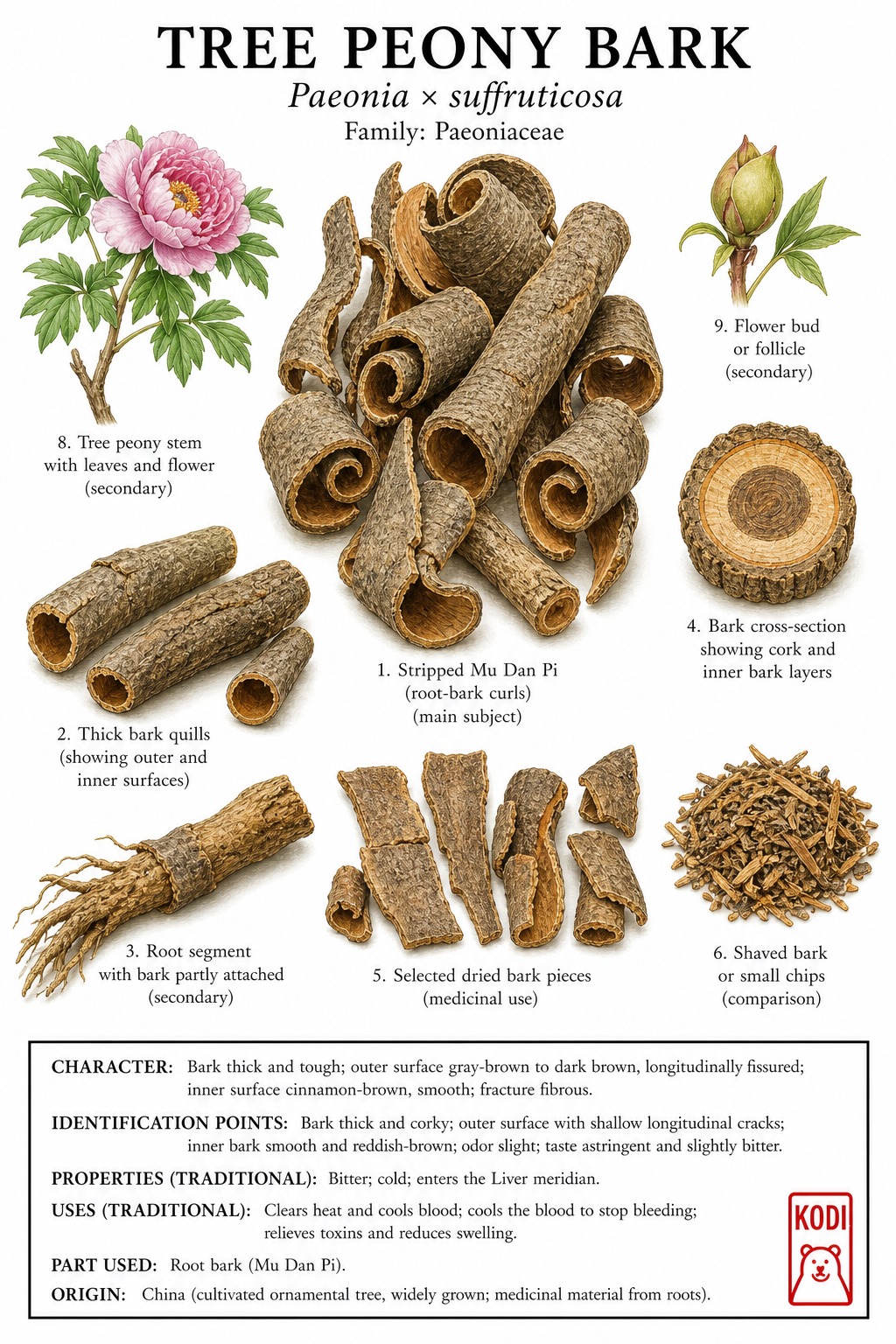
Known in TCM as Mu Dan Pi (牡丹皮), this bitter and acrid, slightly cold herb enters the Heart, Liver, and Kidney. Traditionally, it clears heat and cools the blood ... Mu Dan Pi is used for blood-heat patterns with fever, irritability, eruptive heat, or heat entering the blood level, most often applied for appendicitis, dysmenorrhea, and amenorrhea. Modern research has identified Paeonol among its active constituents.
Part used: Bark
Also Known As
Latin: Cortex Moutan | Pinyin: Mu Dan Pi | Chinese: 牡丹皮
TCM Properties
- Taste
- bitter, acrid
- Temperature
- slightly cold
- Channels
- Heart, Liver, Kidney
Traditional Use
Primary Actions
- Clears heat and cools the blood ... Mu Dan Pi is used for blood-heat patterns with fever, irritability, eruptive heat, or heat entering the blood level.
- Invigorates blood and dispels stasis ... it is selected for dysmenorrhea, amenorrhea, fixed pain, and accumulations where heat and stasis are intertwined.
- Clears deficiency heat ... tree peony bark is a classic lane for lingering low-grade heat, night sweating, and tidal sensations rooted in Yin depletion rather than in full excess.
Secondary Actions
- This page must stay root-bark-forward on Mu Dan Pi and should not be flattened into the already-live peony-root pages such as Bai Shao or Chi Shao.
- Its importance comes from doing two jobs at once ... it cools blood while still moving blood, which is why it appears in both heat and stasis formulas.
Classic Formulas
- Qing Hao Bie Jia Tang ... classic deficiency-heat formula where Mu Dan Pi helps cool blood-level heat without trapping the pathogen.
- Da Huang Mu Dan Tang ... the famous intestinal-abscess formula in which tree peony bark cools and moves blood while helping break acute inflammatory stasis.
- Gui Zhi Fu Ling Wan ... blood-stasis gynecologic strategy where Mu Dan Pi participates in moving and softening fixed accumulations.
Classical References
- Traditional herbology places Mu Dan Pi among the few herbs that cool blood while also moving it, making it especially valuable when heat and stasis coexist.
- The distinction from peony roots is fundamental ... Mu Dan Pi is the root bark of tree peony, not a duplicate form of Bai Shao or Chi Shao.
Modern Research
Active Compounds
- Paeonol ... the signature small molecule most often discussed in Moutan Cortex pharmacology
- Monoterpene glycosides and phenolic constituents ... supporting compounds across anti-inflammatory and vascular studies
- Polysaccharides from root bark ... a newer extract class highlighted in recent review literature
Studied Effects
- A 2023 comprehensive review focused specifically on the root bark of Paeonia x suffruticosa and summarized traditional uses, phytochemistry, pharmacology, and pharmacokinetics of Mu Dan Pi (PMID 36822345).
- A 2017 systematic review on Cortex Moutan covered origins, analytical methods, pharmacology, and safety, helping anchor the herb's broader modern evidence base (PMID 28590441).
- A 2026 review examined Moutan Cortex polysaccharides and their structure-activity relationships, showing that modern interest now extends beyond paeonol-centered discussions into more complex bioactive fractions (PMID 41482228).
PubMed References
- Traditional uses, phytochemistry, pharmacology, and pharmacokinetics of the root bark of Paeonia x suffruticosa andrews: A comprehensive review. (2023)
- Origins, Phytochemistry, Pharmacology, Analytical Methods and Safety of Cortex Moutan (Paeonia suffruticosa Andrew): A Systematic Review. (2017)
- Preparation methods, structural characteristics, bioactivities, and structure-activity relationships of polysaccharides from Moutan Cortex: A review. (2026)
Safety & Interactions
Contraindications
- Pregnancy without professional supervision
- Heavy active bleeding without a clear blood-stasis rationale
- Cold deficiency without heat or stasis
Cautions
- Mu Dan Pi both cools and moves blood, so it is not a neutral anti-inflammatory herb to use casually in depleted or actively bleeding patients.
- Its blood-moving aspect matters clinically even when modern readers focus only on paeonol or antioxidant headlines.
Drug Interactions
- Anticoagulant or antiplatelet drugs ... possible additive bleeding risk
Conditions
- Appendicitis Traditional ★★★☆☆ JSON
- Dysmenorrhea Traditional ★★★☆☆ JSON
- Amenorrhea Traditional ★★☆☆☆ JSON
- Night Sweats Traditional ★★★☆☆ JSON
Frequently Asked Questions
What is Tree Peony Bark used for?
Tree Peony Bark is traditionally used to Clears heat and cools the blood ... Mu Dan Pi is used for blood-heat patterns with fever, irritability, eruptive heat, or heat entering the blood level., Invigorates blood and dispels stasis ... it is selected for dysmenorrhea, amenorrhea, fixed pain, and accumulations where heat and stasis are intertwined., Clears deficiency heat ... tree peony bark is a classic lane for lingering low-grade heat, night sweating, and tidal sensations rooted in Yin depletion rather than in full excess.. Research has investigated its effects on: A 2023 comprehensive review focused specifically on the root bark of Paeonia x suffruticosa and summarized traditional uses, phytochemistry, pharmacology, and pharmacokinetics of Mu Dan Pi (PMID 36822345).; A 2017 systematic review on Cortex Moutan covered origins, analytical methods, pharmacology, and safety, helping anchor the herb's broader modern evidence base (PMID 28590441)..
What are other names for Tree Peony Bark?
Tree Peony Bark is also known as Mu Dan Pi, Moutan cortex, Tree peony root bark. In TCM: 牡丹皮 (Mu Dan Pi); Cortex Moutan.
Is Tree Peony Bark safe during pregnancy?
Tree Peony Bark is not recommended during pregnancy.
What are the contraindications for Tree Peony Bark?
Tree Peony Bark should not be used in: Pregnancy without professional supervision; Heavy active bleeding without a clear blood-stasis rationale; Cold deficiency without heat or stasis. Consult a qualified healthcare provider before use.
Does Tree Peony Bark interact with any medications?
Tree Peony Bark may interact with: Anticoagulant or antiplatelet drugs ... possible additive bleeding risk. Always inform your healthcare provider of any herbal supplements you are taking.