Tortoise Plastron
- Chinese
- 龟板
- Pinyin
- Gui Ban
- Latin
- Plastrum Testudinis
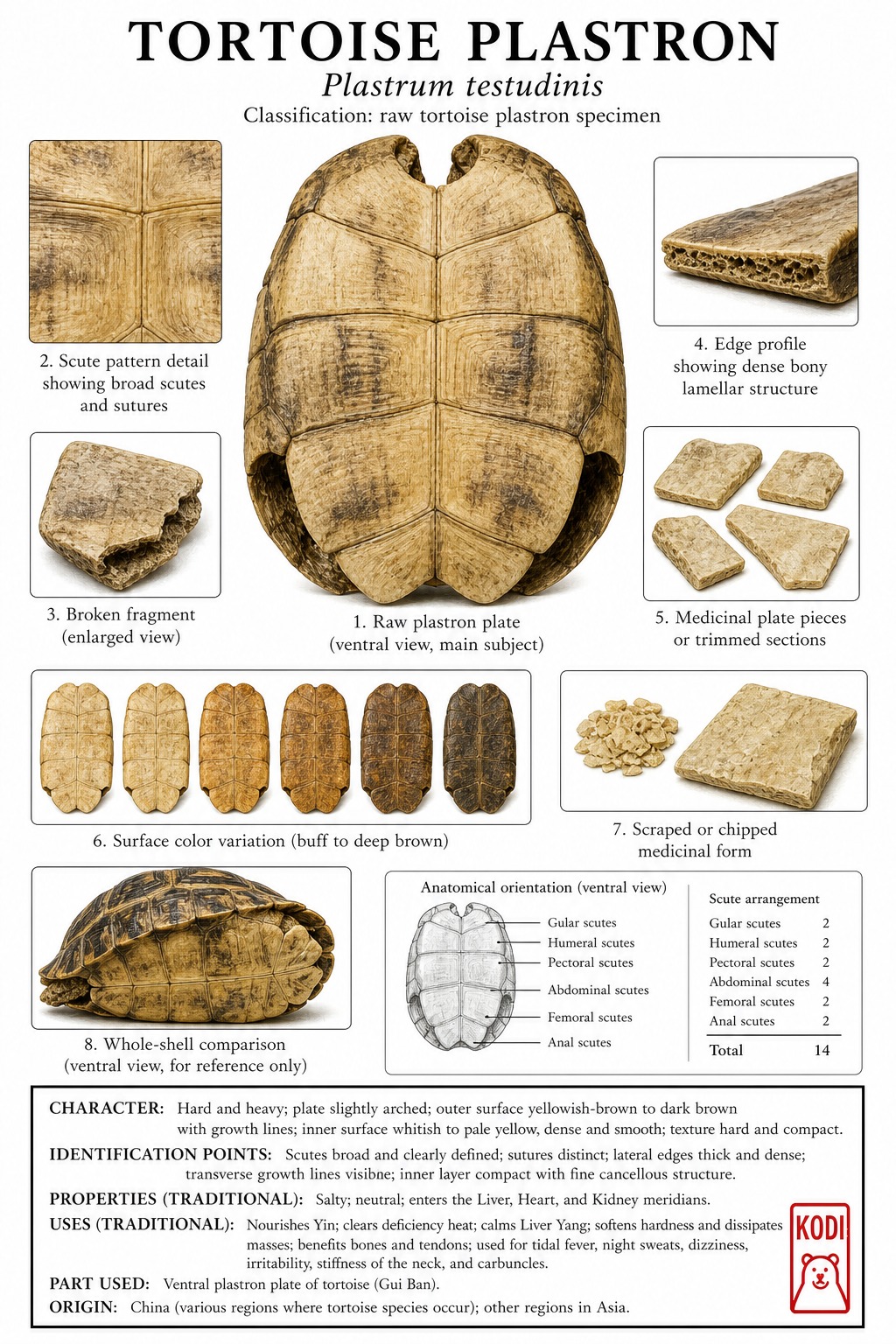
Known in TCM as Gui Ban (龟板), this salty and sweet, cool herb enters the Heart, Kidney, and Liver. Traditionally, it nourishes Yin and anchors rising Yang ... raw Gui Ban is used for chronic deficiency patterns with tidal heat, dizziness, bone steaming, and restless depletion, most often applied for low back pain, dizziness, and night sweats. Modern research has identified Collagen among its active constituents.
Part used: Plastron
Also Known As
Latin: Plastrum Testudinis | Pinyin: Gui Ban | Chinese: 龟板
TCM Properties
- Taste
- salty, sweet
- Temperature
- cool
- Channels
- Heart, Kidney, Liver
Traditional Use
Primary Actions
- Nourishes Yin and anchors rising Yang ... raw Gui Ban is used for chronic deficiency patterns with tidal heat, dizziness, bone steaming, and restless depletion.
- Strengthens bone and fills marrow ... classical use extends to weak low back and knees, developmental weakness, and long-standing structural depletion.
- Supports blood and stabilizes deep deficiency patterns ... tortoise plastron is also used when Chong and Ren weakness, deficiency heat, and constitutional exhaustion appear together.
Secondary Actions
- This page should stay distinct from `prepared-tortoise-plastron` ... the raw plastron record preserves the colder, more specimen-forward Gui Ban lane rather than the pharmacy-prepared version.
- It also must remain separate from `tortoise-shell` and from the softshell-turtle `Bie Jia` family ... shell-derived Yin medicinals are related, but they are not interchangeable.
Classic Formulas
- Da Bu Yin Wan ... the classic Kidney-Yin and deficiency-heat formula where Gui Ban helps cool bone steaming while supporting deep depletion.
- Da Ding Feng Zhu ... tortoise plastron enriches Yin and extinguishes internal wind in severe chronic deficiency patterns.
- Zuo Gui Wan and related essence-tonifying strategies ... Gui Ban or its gelatin derivatives are selected when marrow and structural support are central.
Classical References
- Materia medica tradition describes Gui Ban as nourishing Yin, suppressing Yang, strengthening bone, and benefiting chronic deficiency states.
- Its heavy descending nature explains why it appears in long-cook formulas for deep deficiency rather than in quick symptomatic treatment.
Modern Research
Active Compounds
- Collagen peptides and gelatin-like protein fractions ... major constituents discussed in plastron extract studies
- Mineral-rich bone matrix fractions ... relevant to the classic bone-strengthening lane
- Amino acids and small bioactive extract constituents ... explored in osteogenic and neurodifferentiation research
Studied Effects
- A 2021 study found that Plastrum testudinis extract suppressed osteoclast differentiation through NF-κB pathway effects and improved senile osteoporosis outcomes in preclinical work (PMID 33974944).
- A 2019 study reported that Plastrum Testudinis extracts promoted proliferation and osteogenic differentiation of rat bone-marrow mesenchymal stem cells, closely matching the traditional bone-strengthening lane of Gui Ban (PMID 30984279).
- A 2020 study found that Plastrum Testudinis extracts promoted neural stem-cell differentiation into dopaminergic neurons, showing that modern research interest extends beyond skeletal use alone (PMID 32382312).
PubMed References
- Plastrum testudinis extract suppresses osteoclast differentiation via the NF-κB signaling pathway and ameliorates senile osteoporosis. (2021)
- Effect of Plastrum Testudinis Extracts on the Proliferation and Osteogenic Differentiation of rBMSCs by Regulating p38 MAPK-Related Genes. (2019)
- Plastrum Testudinis Extracts Promote NSC Differentiation into Dopaminergic Neuron by Regulating the Interaction of TET1 and FoxA2. (2020)
Safety & Interactions
Contraindications
- Spleen or Stomach deficiency with poor digestion of heavy rich substances
- Exterior excess or damp accumulation without clear Yin deficiency
Cautions
- Raw Gui Ban is heavy, rich, and slow-acting ... it is not a casual short-term supplement.
- Animal-source identification matters because tortoise plastron, broader tortoise-shell material, and softshell turtle shell occupy different clinical lanes.
Conditions
- Low Back Pain Traditional ★★★☆☆ JSON
- Dizziness Traditional ★★★☆☆ JSON
- Night Sweats Traditional ★★★☆☆ JSON
- Osteoporosis Research ★★☆☆☆ JSON
Frequently Asked Questions
What is Tortoise Plastron used for?
Tortoise Plastron is traditionally used to Nourishes Yin and anchors rising Yang ... raw Gui Ban is used for chronic deficiency patterns with tidal heat, dizziness, bone steaming, and restless depletion., Strengthens bone and fills marrow ... classical use extends to weak low back and knees, developmental weakness, and long-standing structural depletion., Supports blood and stabilizes deep deficiency patterns ... tortoise plastron is also used when Chong and Ren weakness, deficiency heat, and constitutional exhaustion appear together.. Research has investigated its effects on: A 2021 study found that Plastrum testudinis extract suppressed osteoclast differentiation through NF-κB pathway effects and improved senile osteoporosis outcomes in preclinical work (PMID 33974944).; A 2019 study reported that Plastrum Testudinis extracts promoted proliferation and osteogenic differentiation of rat bone-marrow mesenchymal stem cells, closely matching the traditional bone-strengthening lane of Gui Ban (PMID 30984279)..
What are other names for Tortoise Plastron?
Tortoise Plastron is also known as Gui Ban, Raw tortoise plastron, Plastrum Testudinis. In TCM: 龟板 (Gui Ban); Plastrum Testudinis.
Is Tortoise Plastron safe during pregnancy?
The safety of Tortoise Plastron during pregnancy has not been established. Consult a qualified healthcare provider before use.
What are the contraindications for Tortoise Plastron?
Tortoise Plastron should not be used in: Spleen or Stomach deficiency with poor digestion of heavy rich substances; Exterior excess or damp accumulation without clear Yin deficiency. Consult a qualified healthcare provider before use.