Rhizome of Oriental Waterplantain
- Pinyin
- Ze Xie
- Latin
- Rhizoma Alismatis
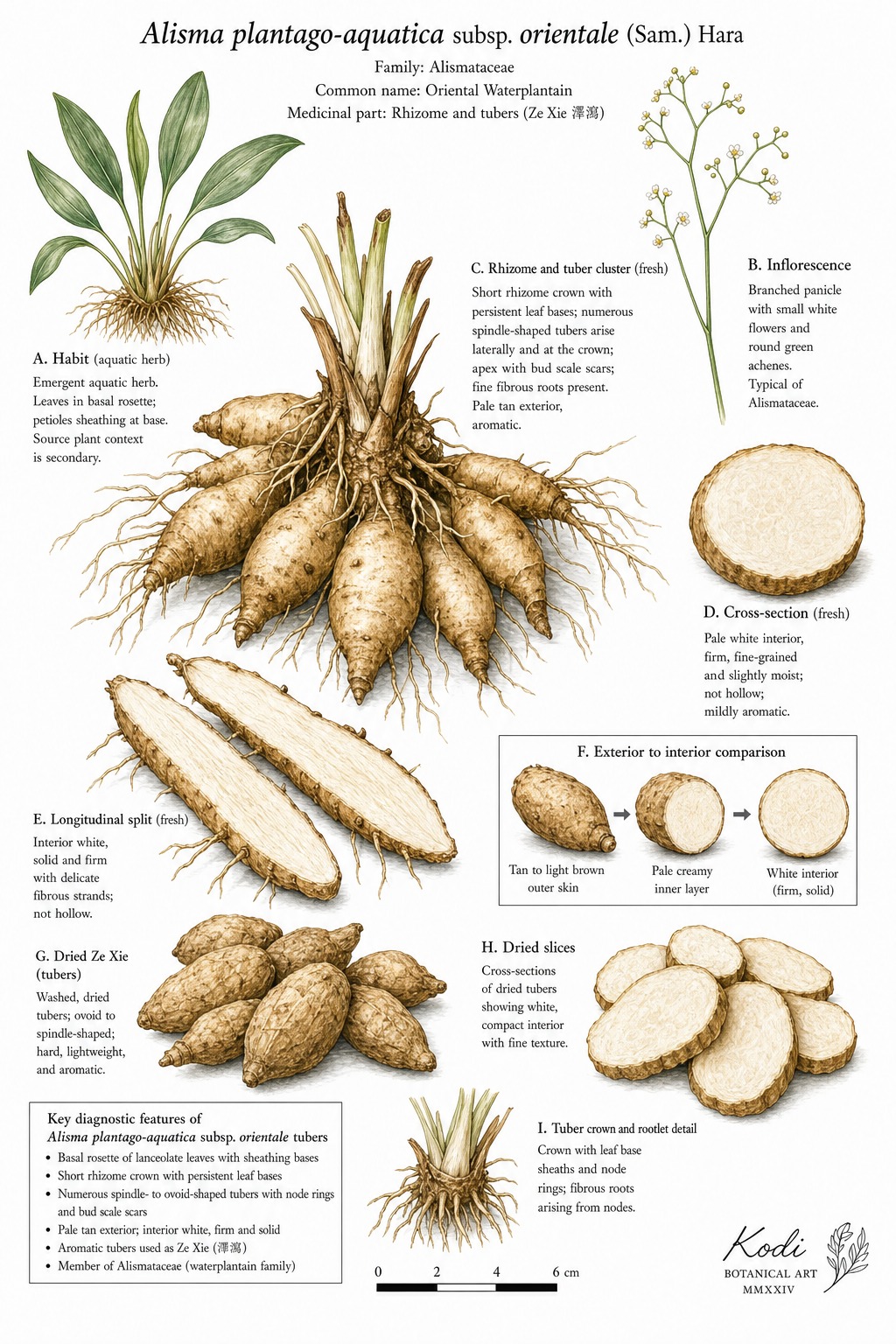
This sweet and bland, cold herb enters the Kidney and Bladder. Traditionally, it promotes urination and leaches out dampness ... Ze Xie is a classic herb for edema, inhibited urination, and water retention patterns, most often applied for edema, urinary tract infection, and dizziness. Modern research has identified Protostane-type among its active constituents.
Part used: Rhizome
Also Known As
Latin: Rhizoma Alismatis | Pinyin: Ze Xie
TCM Properties
- Taste
- sweet, bland
- Temperature
- cold
- Channels
- Kidney, Bladder
Traditional Use
Primary Actions
- Promotes urination and leaches out dampness ... Ze Xie is a classic herb for edema, inhibited urination, and water retention patterns.
- Drains damp-heat from the lower burner ... it is used for painful or turbid urination and damp-heat accumulation affecting the urinary tract.
- Drains ministerial fire and descends turbid dampness ... traditional use extends to dizziness or head heaviness when phlegm-damp and lower-burner turbidity are part of the pattern.
Secondary Actions
- This page follows the accepted Alisma orientale medicinal tuber lane rather than a generic pond-plant description.
- Ze Xie is often used alongside richer tonics to prevent cloying stagnation, which helps explain its place in both drainage and balancing formulas.
Classic Formulas
- Wu Ling San ... classic formula for water retention, edema, and urinary difficulty in which Ze Xie is the leading draining herb.
- Zhu Ling Tang ... used when fluid damage and urinary irritation coexist, with Ze Xie helping to open water pathways.
- Liu Wei Di Huang Wan ... Ze Xie drains excess turbidity and balances the richer tonic ingredients in a famous Kidney-yin formula.
Classical References
- Traditional herbology describes Ze Xie as sweet, bland, and cold, entering the Kidney and Bladder to promote urination and drain dampness.
- Its classic personality is downward-draining and non-tonifying, even when it appears inside large tonic formulas.
Modern Research
Active Compounds
- Protostane-type triterpenes such as alisol derivatives ... the best-known modern actives in Ze Xie research
- Sesquiterpenes and related terpenoids ... supportive constituents in metabolic and anti-inflammatory investigation
- Polysaccharides and broader aqueous fractions ... additional modern research targets
Studied Effects
- A 2014 review summarized the traditional uses, phytochemistry, pharmacology, toxicology, and quality control of Alisma orientale, giving a broad modern frame for Ze Xie (PMID 25446590).
- A 2017 review on Rhizoma Alismatis emphasized ethnomedicinal use, phytochemistry, pharmacology, and toxicology, reinforcing the herb's dual identity as a diuretic and metabolic research subject (PMID 28662316).
- A 2025 systematic review and meta-analysis of rodent studies found that Alismatis Rhizoma extracts affected glucose and lipid metabolism, showing how far modern research has expanded beyond the classic urination lane (PMID 40825387).
PubMed References
- Traditional uses, phytochemistry, pharmacology, toxicology and quality control of Alisma orientale (Sam.) Juzep: a review. (2014)
- Therapeutic potential of Rhizoma Alismatis: a review on ethnomedicinal application, phytochemistry, pharmacology, and toxicology. (2017)
- Effects and potential mechanisms of Alismatis Rhizoma extracts on glucose and lipid metabolism: A systematic review and meta-analysis of rodent studies. (2025)
Safety & Interactions
Contraindications
- Kidney deficiency with frequent clear urination and no damp-heat or water retention
- Fluid depletion without retained dampness
Cautions
- Ze Xie promotes urination strongly enough to be a poor choice for people who are already dried out or depleted.
- Most metabolic and lipid-related modern evidence remains preclinical and should not be mistaken for simple self-treatment guidance.
Conditions
Frequently Asked Questions
What is Rhizome of Oriental Waterplantain used for?
Rhizome of Oriental Waterplantain is traditionally used to Promotes urination and leaches out dampness ... Ze Xie is a classic herb for edema, inhibited urination, and water retention patterns., Drains damp-heat from the lower burner ... it is used for painful or turbid urination and damp-heat accumulation affecting the urinary tract., Drains ministerial fire and descends turbid dampness ... traditional use extends to dizziness or head heaviness when phlegm-damp and lower-burner turbidity are part of the pattern.. Research has investigated its effects on: A 2014 review summarized the traditional uses, phytochemistry, pharmacology, toxicology, and quality control of Alisma orientale, giving a broad modern frame for Ze Xie (PMID 25446590).; A 2017 review on Rhizoma Alismatis emphasized ethnomedicinal use, phytochemistry, pharmacology, and toxicology, reinforcing the herb's dual identity as a diuretic and metabolic research subject (PMID 28662316)..
What are other names for Rhizome of Oriental Waterplantain?
Rhizome of Oriental Waterplantain is also known as Ze Xie, Alisma orientale Tuber, Rhizoma Alismatis. In TCM: Rhizoma Alismatis.
Is Rhizome of Oriental Waterplantain safe during pregnancy?
The safety of Rhizome of Oriental Waterplantain during pregnancy has not been established. Consult a qualified healthcare provider before use.
What are the contraindications for Rhizome of Oriental Waterplantain?
Rhizome of Oriental Waterplantain should not be used in: Kidney deficiency with frequent clear urination and no damp-heat or water retention; Fluid depletion without retained dampness. Consult a qualified healthcare provider before use.