Rhizome of Largehead Atractylodes
- Pinyin
- Bai Zhu
- Latin
- Rhizoma Atractylodis Macrocephalae
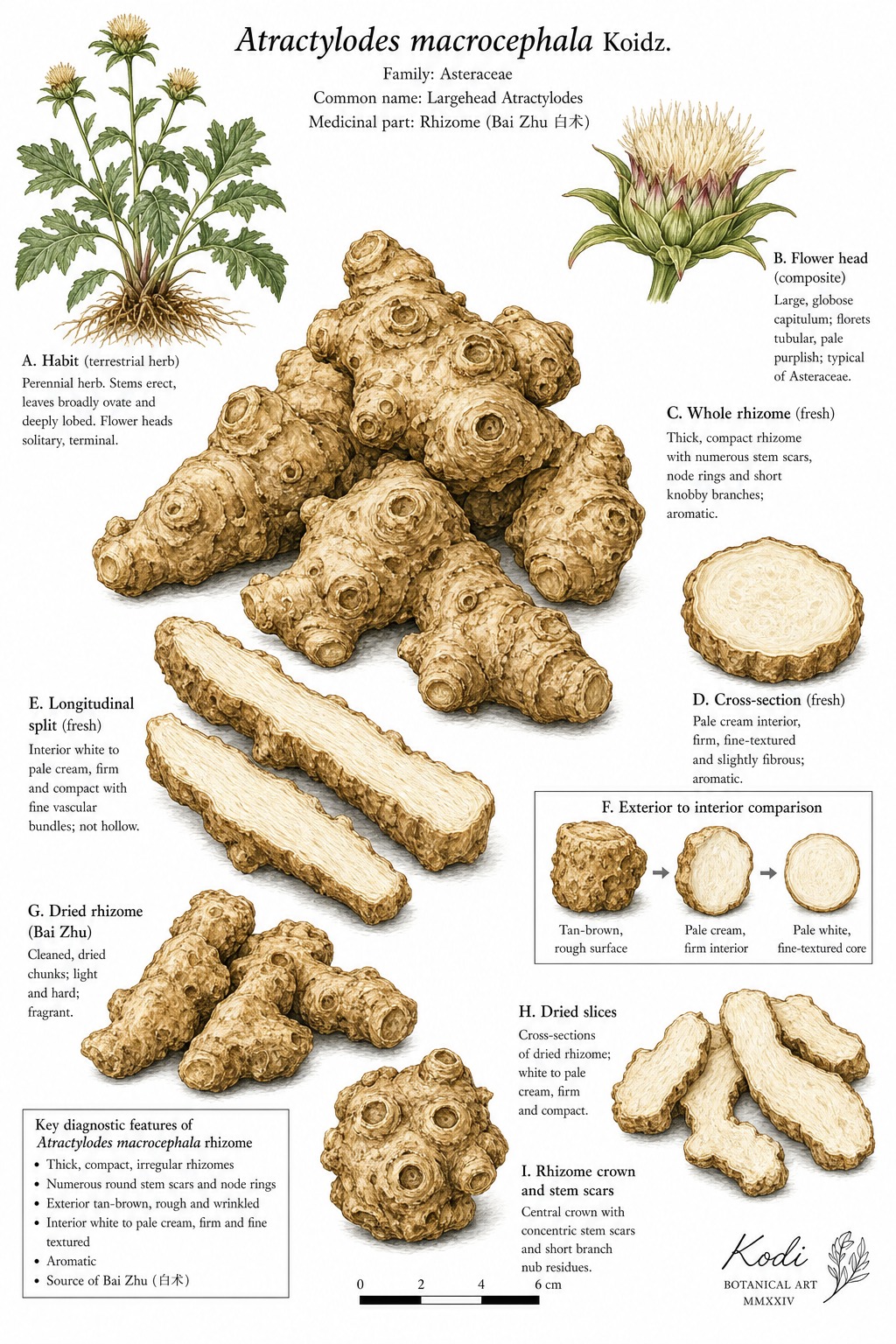
This bitter and sweet, warm herb enters the Spleen and Stomach. Traditionally, it strengthens Spleen qi and dries dampness ... Bai Zhu is a core herb for poor appetite, loose stool, fatigue, abdominal distension, and dampness burdening the middle burner, most often applied for poor appetite, diarrhea, and edema. Modern research has identified Atractylenolides among its active constituents.
Part used: Rhizome
Also Known As
Latin: Rhizoma Atractylodis Macrocephalae | Pinyin: Bai Zhu
TCM Properties
- Taste
- bitter, sweet
- Temperature
- warm
- Channels
- Spleen, Stomach
Traditional Use
Primary Actions
- Strengthens Spleen qi and dries dampness ... Bai Zhu is a core herb for poor appetite, loose stool, fatigue, abdominal distension, and dampness burdening the middle burner.
- Promotes water metabolism and reduces edema ... it is especially useful when Spleen weakness allows dampness and swelling to accumulate.
- Stabilizes the exterior and stops spontaneous sweating ... classic use also extends to restless fetus patterns and weak protective qi that cannot hold the surface.
Secondary Actions
- This page should stay distinct from the darker, slimmer, more dispersing `rhizome-of-swordlike-atractylodes` / Cang Zhu sibling ... Bai Zhu is the gentler tonifying damp-drying Atractylodes lane.
- Bai Zhu is frequently paired with Fu Ling, Shan Yao, or Huang Qi when digestion, fluids, and defensive qi all need support.
Classic Formulas
- Shen Ling Bai Zhu San ... foundational Spleen-tonifying formula for chronic loose stool, poor appetite, and damp-related weakness.
- Si Jun Zi Tang and related qi-tonic formulas ... Bai Zhu supports the middle burner and helps prevent tonics from becoming too cloying.
- Yu Ping Feng San ... classic use when weak protective qi leads to spontaneous sweating and poor resistance.
Classical References
- Traditional herbology describes Bai Zhu as bitter, sweet, and warm, entering the Spleen and Stomach to tonify qi, dry dampness, stop sweating, and calm the fetus.
- Its longstanding importance comes from doing two jobs at once ... rebuilding weak digestion while also draining the dampness that weakness creates.
Modern Research
Active Compounds
- Atractylenolides I, II, and III ... the best-known sesquiterpenoid markers of Bai Zhu
- Polysaccharides from Atractylodes macrocephala ... major modern research fraction for immune and gut effects
- Volatile oils and lactone-rich aromatic fractions ... supportive constituents in pharmacology studies
Studied Effects
- A 2025 comprehensive review summarized the traditional uses, phytochemistry, and pharmacology of Atractylodes macrocephala, reinforcing Bai Zhu's importance as a major Spleen-supporting rhizome in modern research (PMID 39473269).
- A 2022 review focused on polysaccharides from Atractylodes macrocephala, highlighting why Bai Zhu research often centers on gut, immune, and anti-inflammatory bioactivity rather than only aroma chemistry (PMID 35760256).
- A 2023 review examined Bai Zhu as a candidate natural agent for bone-mass regulation, showing how modern study has expanded beyond its classic digestive lane (PMID 37268258).
PubMed References
- The Rhizome of Atractylodes macrocephala Koidz.: A Comprehensive Review on the Traditional Uses, Phytochemistry and Pharmacology. (2025)
- Isolation, structure and bioactivity of polysaccharides from Atractylodes macrocephala: A review. (2022)
- Potential application of Atractylodes macrocephala Koidz. as a natural drug for bone mass regulation: A review. (2023)
Safety & Interactions
Contraindications
- Yin deficiency dryness or fluid depletion without dampness
- Strong heat patterns without weak digestion or damp accumulation
Cautions
- Bai Zhu is warm and drying enough to worsen thirst or dryness if used when fluids are already depleted.
- Concentrated extracts and purified compounds are not interchangeable with ordinary crude-herb dosing.
Conditions
- Poor Appetite Traditional ★★★★☆ JSON
- Diarrhea Traditional ★★★★☆ JSON
- Edema Traditional ★★★☆☆ JSON
- Spontaneous Sweating Traditional ★★☆☆☆ JSON
Frequently Asked Questions
What is Rhizome of Largehead Atractylodes used for?
Rhizome of Largehead Atractylodes is traditionally used to Strengthens Spleen qi and dries dampness ... Bai Zhu is a core herb for poor appetite, loose stool, fatigue, abdominal distension, and dampness burdening the middle burner., Promotes water metabolism and reduces edema ... it is especially useful when Spleen weakness allows dampness and swelling to accumulate., Stabilizes the exterior and stops spontaneous sweating ... classic use also extends to restless fetus patterns and weak protective qi that cannot hold the surface.. Research has investigated its effects on: A 2025 comprehensive review summarized the traditional uses, phytochemistry, and pharmacology of Atractylodes macrocephala, reinforcing Bai Zhu's importance as a major Spleen-supporting rhizome in modern research (PMID 39473269).; A 2022 review focused on polysaccharides from Atractylodes macrocephala, highlighting why Bai Zhu research often centers on gut, immune, and anti-inflammatory bioactivity rather than only aroma chemistry (PMID 35760256)..
What are other names for Rhizome of Largehead Atractylodes?
Rhizome of Largehead Atractylodes is also known as Bai Zhu, White Atractylodes, Atractylodes macrocephala Rhizome. In TCM: Rhizoma Atractylodis Macrocephalae.
Is Rhizome of Largehead Atractylodes safe during pregnancy?
The safety of Rhizome of Largehead Atractylodes during pregnancy has not been established. Consult a qualified healthcare provider before use.
What are the contraindications for Rhizome of Largehead Atractylodes?
Rhizome of Largehead Atractylodes should not be used in: Yin deficiency dryness or fluid depletion without dampness; Strong heat patterns without weak digestion or damp accumulation. Consult a qualified healthcare provider before use.