Rhizome of Heartleaf Drynaria
- Pinyin
- Gu Sui Bu
- Latin
- Rhizoma Drynariae
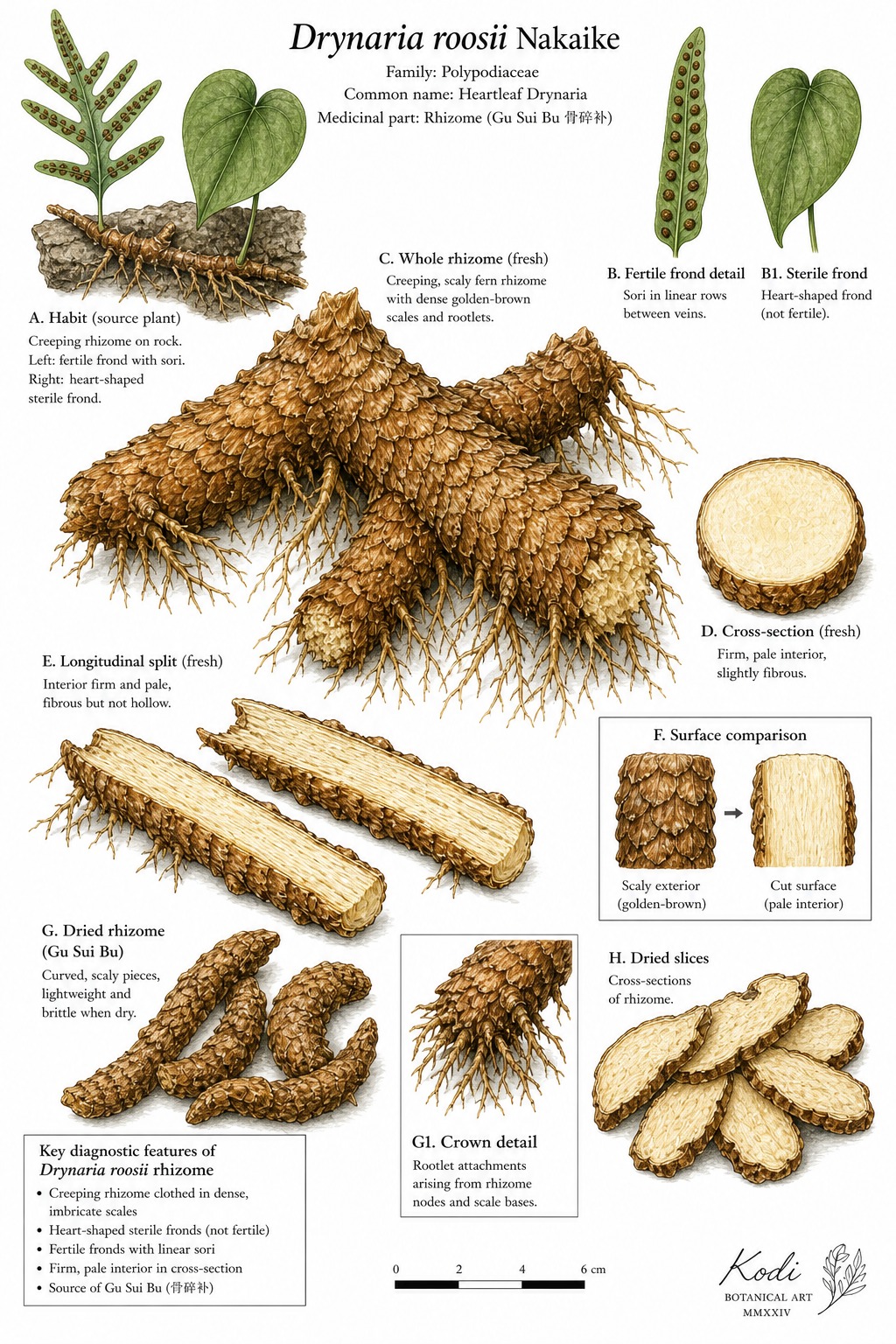
This bitter, warm herb enters the Liver and Kidney. Traditionally, it tonifies the Liver and Kidney and strengthens bones ... Gu Sui Bu is classically used for weak low back and knees, sore sinews, loose teeth, and chronic deficiency affecting the skeleton, most often applied for traumatic injury, low back pain, and joint pain. Modern research has identified Total among its active constituents.
Part used: Rhizome
Also Known As
Latin: Rhizoma Drynariae | Pinyin: Gu Sui Bu
TCM Properties
- Taste
- bitter
- Temperature
- warm
- Channels
- Liver, Kidney
Traditional Use
Primary Actions
- Tonifies the Liver and Kidney and strengthens bones ... Gu Sui Bu is classically used for weak low back and knees, sore sinews, loose teeth, and chronic deficiency affecting the skeleton.
- Mends sinews and reconnects injured bone ... it is a signature herb for fractures, traumatic injury, and slow recovery after damage to bone or tendon.
- Supports Kidney-deficiency patterns that show up in the teeth and lower body ... traditional use extends to tooth looseness, tinnitus, and weakness after overwork when depletion underlies the presentation.
Secondary Actions
- This page should stay on the accepted Drynaria roosii medicinal rhizome lane rather than drifting into generic ornamental-fern discussion.
- Gu Sui Bu is regularly paired with Xu Duan, Du Zhong, or Zi Ran Tong when the treatment goal is both movement and structural repair.
Classic Formulas
- Gu Sui Bu with Xu Duan and Du Zhong ... classic bone-and-sinew support strategy for chronic weakness or post-traumatic recovery.
- Trauma formulas pairing Gu Sui Bu with Zi Ran Tong, Ru Xiang, or Mo Yao ... used when fractures, bruising, and pain all need attention together.
- Kidney-deficiency low-back combinations with Niu Xi or Bu Gu Zhi ... traditional approach when soreness, weakness, and poor structural recovery predominate.
Classical References
- Traditional materia medica describes Gu Sui Bu as bitter and warm, entering the Liver and Kidney to reconnect injured bones and strengthen the lower back and knees.
- The herb's name literally points toward mending broken bones, which is why it remains a signature traumatology tonic rather than a generic anti-inflammatory fern.
Modern Research
Active Compounds
- Total flavonoids of Drynaria roosii ... the best-known modern active fraction in Gu Sui Bu research
- Naringin and related flavonoids ... repeatedly linked with osteoblast and bone-mineralization investigation
- Phenolic compounds and exosome-like nanovesicle cargo ... emerging bioactive fractions under study
Studied Effects
- A 2026 systematic review and meta-analysis found that Rhizoma Drynariae extracts improved bone-density and trabecular outcomes across rat osteoporosis models, giving modern support to the herb's classic bone-repair reputation (PMID 41850642).
- A 2019 ovariectomized-mouse study reported anti-osteoporotic and anti-adipogenic effects from water extract of Drynaria roosii, reinforcing the bone-focused modern research lane (PMID 31443447).
- A 2026 study found that Drynaria roosii-derived exosome-like nanovesicles promoted alveolar socket healing through calcium-signaling pathways, extending current interest in Gu Sui Bu toward tissue-regeneration science (PMID 42163262).
PubMed References
- Efficacy of Rhizoma Drynariae (Drynaria roosii Nakaike) extracts in treating osteoporosis in rat models: A systematic review and meta-analysis. (2026)
- Anti-Osteoporotic and Anti-Adipogenic Effects of the Water Extract of Drynaria roosii Nakaike in Ovariectomized Mice Fed a High-Fat Diet. (2019)
- Drynaria roosii-derived exosome-like nanovesicles promote alveolar socket healing via activation of ITPR3-mediated calcium flux. (2026)
Safety & Interactions
Contraindications
- Yin deficiency heat without trauma, bone weakness, or Kidney-deficiency context
- Use based on vague pain alone without a clear injury or deficiency pattern
Cautions
- Persistent fracture pain, dental loosening, or chronic low-back weakness still warrant proper diagnosis rather than self-treatment alone.
- Most modern evidence remains preclinical and bone-model focused rather than large human clinical trials.
Conditions
- Traumatic Injury Traditional ★★★★☆ JSON
- Low Back Pain Traditional ★★★★☆ JSON
- Joint Pain Traditional ★★★☆☆ JSON
- Toothache Traditional ★★☆☆☆ JSON
Frequently Asked Questions
What is Rhizome of Heartleaf Drynaria used for?
Rhizome of Heartleaf Drynaria is traditionally used to Tonifies the Liver and Kidney and strengthens bones ... Gu Sui Bu is classically used for weak low back and knees, sore sinews, loose teeth, and chronic deficiency affecting the skeleton., Mends sinews and reconnects injured bone ... it is a signature herb for fractures, traumatic injury, and slow recovery after damage to bone or tendon., Supports Kidney-deficiency patterns that show up in the teeth and lower body ... traditional use extends to tooth looseness, tinnitus, and weakness after overwork when depletion underlies the presentation.. Research has investigated its effects on: A 2026 systematic review and meta-analysis found that Rhizoma Drynariae extracts improved bone-density and trabecular outcomes across rat osteoporosis models, giving modern support to the herb's classic bone-repair reputation (PMID 41850642).; A 2019 ovariectomized-mouse study reported anti-osteoporotic and anti-adipogenic effects from water extract of Drynaria roosii, reinforcing the bone-focused modern research lane (PMID 31443447)..
What are other names for Rhizome of Heartleaf Drynaria?
Rhizome of Heartleaf Drynaria is also known as Drynaria Rhizome, Gu Sui Bu, Drynaria roosii Rhizome. In TCM: Rhizoma Drynariae.
Is Rhizome of Heartleaf Drynaria safe during pregnancy?
The safety of Rhizome of Heartleaf Drynaria during pregnancy has not been established. Consult a qualified healthcare provider before use.
What are the contraindications for Rhizome of Heartleaf Drynaria?
Rhizome of Heartleaf Drynaria should not be used in: Yin deficiency heat without trauma, bone weakness, or Kidney-deficiency context; Use based on vague pain alone without a clear injury or deficiency pattern. Consult a qualified healthcare provider before use.