Rhizome of Common Anamarrhena
- Chinese
- 知母
- Pinyin
- Zhi Mu
- Latin
- Rhizoma Anemarrhenae
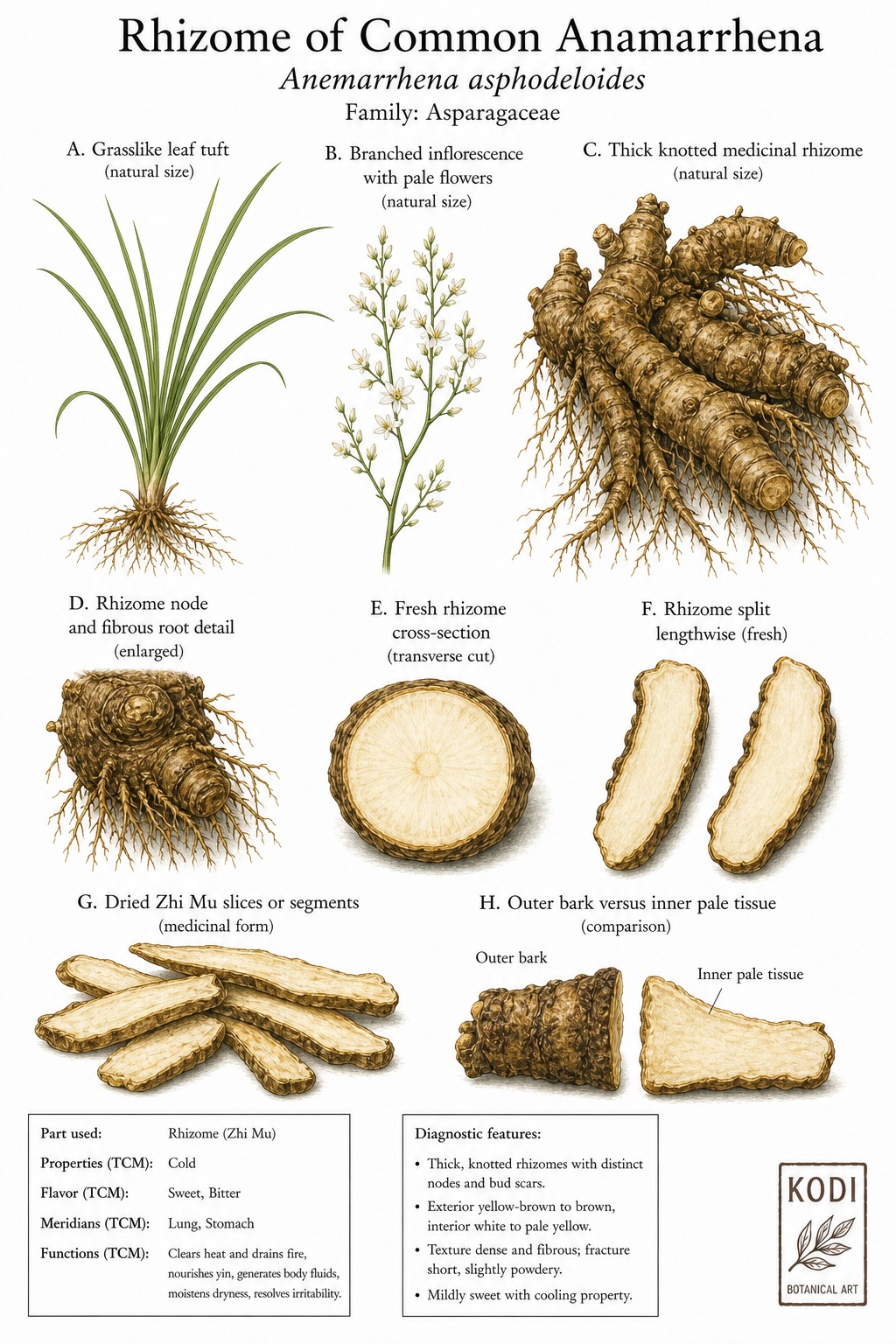
Known in TCM as Zhi Mu (知母), this bitter and sweet, cold herb enters the Lung, Stomach, and Kidney. Traditionally, it clears heat and drains fire ... Zhi Mu treats high fever, vexation, intense thirst, Lung heat, and Stomach fire with dryness or irritability, most often applied for fever, dry cough, and night sweats. Modern research has identified Timosaponin among its active constituents.
Part used: Rhizome
Also Known As
Latin: Rhizoma Anemarrhenae | Pinyin: Zhi Mu | Chinese: 知母
TCM Properties
- Taste
- bitter, sweet
- Temperature
- cold
- Channels
- Lung, Stomach, Kidney
Traditional Use
Primary Actions
- Clears heat and drains fire ... Zhi Mu treats high fever, vexation, intense thirst, Lung heat, and Stomach fire with dryness or irritability.
- Enriches yin and moistens dryness ... it is used for dry cough, wasting-thirst patterns, and fluid injury when heat has scorched the yin.
- Clears deficiency heat ... classical use extends to steaming-bone fever, night sweats, and irritability from yin deficiency.
Secondary Actions
- Zhi Mu is one of the better examples of a herb that is strongly cold but still protects and enriches fluid rather than simply draining.
- Its classical pairing with Huang Bai is central ... together they clear deficiency fire from the lower burner more effectively than either alone.
Classic Formulas
- Bai Hu Tang ... major qi-level heat formula where Zhi Mu clears heat and protects fluids.
- Zhi Bai Di Huang Wan ... classic deficiency-fire formula pairing Zhi Mu with Huang Bai on a Liu Wei Di Huang Wan base.
- Er Mu combinations with Bei Mu or Zhe Bei Mu ... traditional strategy for Lung heat, phlegm, and dryness together.
Classical References
- Traditional materia medica describes Zhi Mu as bitter, sweet, and cold, entering the Lung, Stomach, and Kidney to clear heat, enrich yin, and moisten dryness.
- Its yin-protecting coldness is what keeps it distinct from harsher bitter-cold fire-draining herbs.
Modern Research
Active Compounds
- Timosaponin AIII and related steroidal saponins ... the best-known modern Zhi Mu compounds
- Mangiferin and xanthone derivatives ... important antioxidant and metabolic research constituents
- Polysaccharides ... increasingly studied fractions in metabolic and immunologic work
Studied Effects
- A 2023 review summarized the botany, ethnopharmacology, phytochemistry, pharmacology, toxicology, and quality of Anemarrhena asphodeloides Bunge, providing a strong modern anchor for Zhi Mu (PMID 36330891).
- A 2020 review focused on the pharmacology, pharmacokinetics, and toxicity of timosaponin AIII, one of the key Zhi Mu saponins studied in inflammation and cancer-related research (PMID 32581782).
- A 2024 review of Anemarrhena polysaccharides highlighted ongoing interest in inflammatory, diabetic, and bone-related applications, expanding the modern picture beyond the classic saponin focus (PMID 39476924).
PubMed References
- A review of the botany, ethnopharmacology, phytochemistry, pharmacology, toxicology and quality of Anemarrhena asphodeloides Bunge. (2023)
- Pharmacological Activity, Pharmacokinetics, and Toxicity of Timosaponin AIII, a Natural Product Isolated From Anemarrhena asphodeloides Bunge: A Review. (2020)
- Advances in the study of polysaccharides from Anemarrhena asphodeloides Bge.: A review. (2024)
Safety & Interactions
Contraindications
- Spleen deficiency with loose stool
- Cold deficiency without heat or dryness
Cautions
- Zhi Mu is cold and can burden weak digestion if used outside true heat or yin-deficiency patterns.
- Because it both clears heat and nourishes fluids, it is stronger than simple food-grade cooling herbs and still needs pattern-based use.
Conditions
- Fever Traditional ★★★★☆ JSON
- Dry Cough Traditional ★★★☆☆ JSON
- Night Sweats Traditional ★★★☆☆ JSON
- Type 2 Diabetes Research ★★☆☆☆ JSON
Frequently Asked Questions
What is Rhizome of Common Anamarrhena used for?
Rhizome of Common Anamarrhena is traditionally used to Clears heat and drains fire ... Zhi Mu treats high fever, vexation, intense thirst, Lung heat, and Stomach fire with dryness or irritability., Enriches yin and moistens dryness ... it is used for dry cough, wasting-thirst patterns, and fluid injury when heat has scorched the yin., Clears deficiency heat ... classical use extends to steaming-bone fever, night sweats, and irritability from yin deficiency.. Research has investigated its effects on: A 2023 review summarized the botany, ethnopharmacology, phytochemistry, pharmacology, toxicology, and quality of Anemarrhena asphodeloides Bunge, providing a strong modern anchor for Zhi Mu (PMID 36330891).; A 2020 review focused on the pharmacology, pharmacokinetics, and toxicity of timosaponin AIII, one of the key Zhi Mu saponins studied in inflammation and cancer-related research (PMID 32581782)..
What are other names for Rhizome of Common Anamarrhena?
Rhizome of Common Anamarrhena is also known as Anemarrhena Rhizome, Zhimu, Anemarrhena asphodeloides Rhizome. In TCM: 知母 (Zhi Mu); Rhizoma Anemarrhenae.
Is Rhizome of Common Anamarrhena safe during pregnancy?
The safety of Rhizome of Common Anamarrhena during pregnancy has not been established. Consult a qualified healthcare provider before use.
What are the contraindications for Rhizome of Common Anamarrhena?
Rhizome of Common Anamarrhena should not be used in: Spleen deficiency with loose stool; Cold deficiency without heat or dryness. Consult a qualified healthcare provider before use.