Prepared Rehmannia Root
- Chinese
- 熟地黄
- Pinyin
- Shu Di Huang
- Latin
- Radix Rehmanniae Praeparata
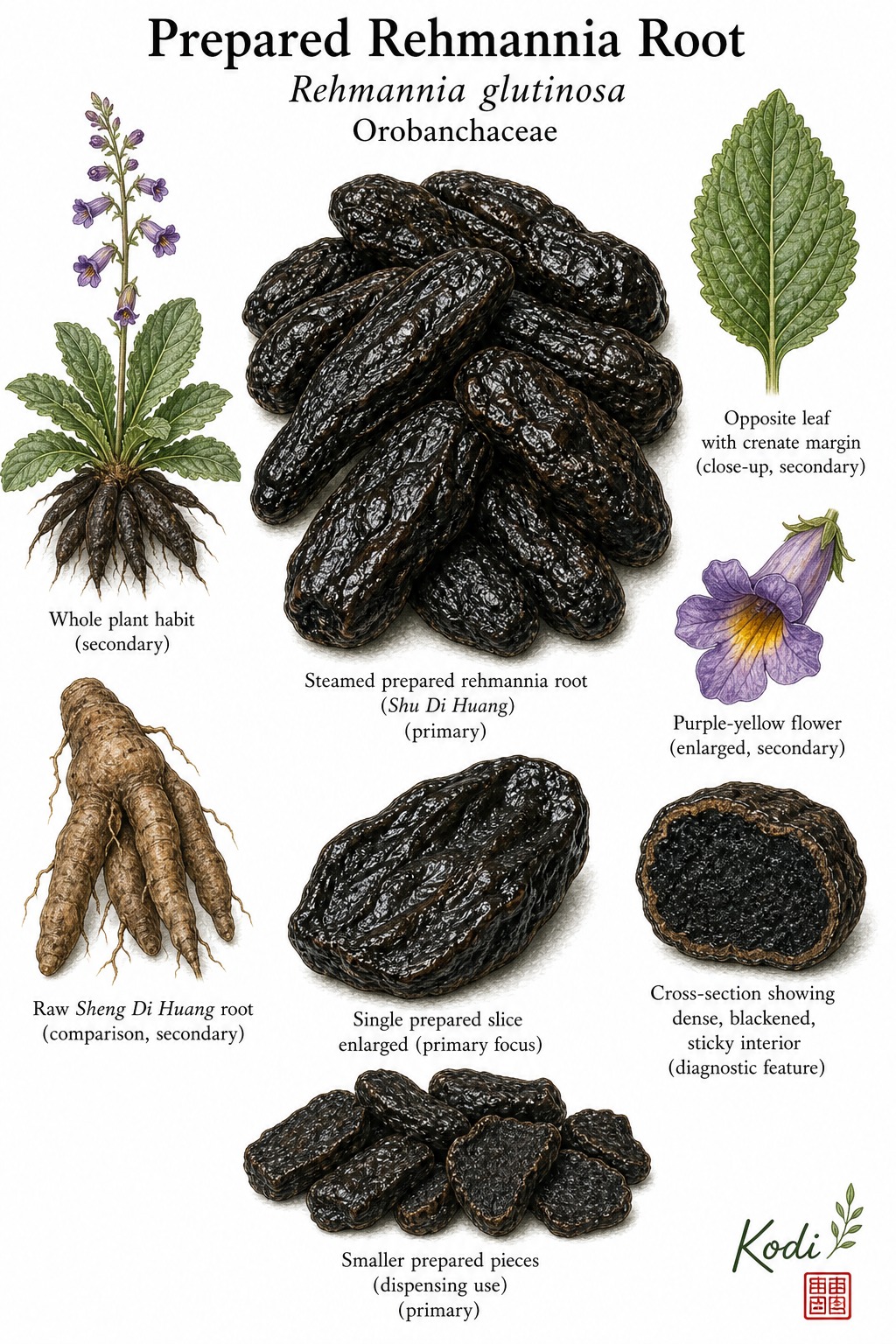
Known in TCM as Shu Di Huang (熟地黄), this sweet, slightly warm herb enters the Heart, Kidney, and Liver. Traditionally, it nourishes blood and enriches Yin ... Shu Di Huang is the classic processed Rehmannia lane for dizziness, pallor, scant menses, palpitations, and deficiency patterns rooted in blood and essence depletion, most often applied for dizziness, tinnitus, and menstrual irregularities. Modern research has identified Iridoid among its active constituents.
Part used: Root
Also Known As
Latin: Radix Rehmanniae Praeparata | Pinyin: Shu Di Huang | Chinese: 熟地黄
TCM Properties
- Taste
- sweet
- Temperature
- slightly warm
- Channels
- Heart, Kidney, Liver
Traditional Use
Primary Actions
- Nourishes blood and enriches Yin ... Shu Di Huang is the classic processed Rehmannia lane for dizziness, pallor, scant menses, palpitations, and deficiency patterns rooted in blood and essence depletion.
- Tonifies Kidney essence and fills the marrow ... it is used for tinnitus, weak low back, premature aging patterns, and reproductive depletion when essence is insufficient.
- Supports menstrual and constitutional rebuilding ... traditional use includes irregular menses, infertility-pattern deficiency, and recovery from chronic depletion.
Secondary Actions
- Compared with raw Sheng Di Huang, Shu Di Huang is darker, richer, less cooling, and far more tonic ... the direction shifts from clearing heat and cooling blood toward rebuilding blood, Yin, and essence.
- Its dense, cloying nature is therapeutically useful but also explains why it can burden weak digestion.
Classic Formulas
- Si Wu Tang ... classic blood-nourishing formula where Shu Di Huang is the chief enriching herb.
- Liu Wei Di Huang Wan ... foundational Kidney-Yin formula built around Shu Di Huang.
- Zuo Gui Wan ... essence-and-marrow rebuilding formula for deep Kidney depletion.
- Gui Shao Di Huang Wan ... gynecologic blood-and-Kidney formula extending the Shu Di Huang tradition.
Classical References
- Traditional processing texts emphasize repeated steaming and drying to transform raw Di Huang into the richer tonic Shu Di Huang form.
- Materia medica teaching consistently assigns Shu Di Huang to blood, Yin, and essence depletion rather than the blood-heat and fluid-injury lane of raw Sheng Di Huang.
- Shu Di Huang is one of the defining examples of how paozhi can change an herb's direction rather than merely making it easier to tolerate.
Modern Research
Active Compounds
- Iridoid glycosides such as catalpol-related compounds ... markedly altered by steam processing
- Monosaccharides and oligosaccharides ... enriched or transformed during repeated processing
- Phenethyl alcohol glycosides and other secondary metabolites ... shifted by hydrolysis and heating
- Polysaccharides ... major tonic fractions studied in processed Rehmannia research
Studied Effects
- A 2011 metabolite study showed that traditional processing strongly changes the composition of Rehmannia glutinosa roots through hydrolysis, giving modern chemical support to the classical raw-versus-prepared distinction (PMID 21532190).
- A 2019 historical and pharmacological review traced Rehmannia root processing traditions and compared immunostimulatory effects across processed and unprocessed products (PMID 31279866).
- Prepared Rehmannia showed neuroprotective effects in an Alzheimer's disease mouse model through insulin-signaling and microbiota-related pathways, offering modern support for the tonic processed form rather than the raw cooling herb (PMID 36843923).
PubMed References
- Traditional processing strongly affects metabolite composition by hydrolysis in Rehmannia glutinosa roots. (2011)
- Historical and pharmacological studies on rehmannia root processing- Trends in usage and comparison of the immunostimulatory effects of its products with or without steam processing and pretreatment with liquor. (2019)
- Radix Rehmanniae Praeparata (Shu Dihuang) exerts neuroprotective effects on ICV-STZ-induced Alzheimer's disease mice through modulation of INSR/IRS-1/AKT/GSK-3β signaling pathway and intestinal microbiota. (2023)
Safety & Interactions
Contraindications
- Spleen deficiency with dampness, bloating, or loose stool
- Marked phlegm-damp encumbrance without clear blood or Yin deficiency
Cautions
- Shu Di Huang is dense and cloying, so it can worsen abdominal fullness, poor appetite, or diarrhea in weak digestion.
- Processed Rehmannia is not interchangeable with raw Sheng Di Huang ... the therapeutic direction is fundamentally different.
Conditions
Frequently Asked Questions
What is Prepared Rehmannia Root used for?
Prepared Rehmannia Root is traditionally used to Nourishes blood and enriches Yin ... Shu Di Huang is the classic processed Rehmannia lane for dizziness, pallor, scant menses, palpitations, and deficiency patterns rooted in blood and essence depletion., Tonifies Kidney essence and fills the marrow ... it is used for tinnitus, weak low back, premature aging patterns, and reproductive depletion when essence is insufficient., Supports menstrual and constitutional rebuilding ... traditional use includes irregular menses, infertility-pattern deficiency, and recovery from chronic depletion.. Research has investigated its effects on: A 2011 metabolite study showed that traditional processing strongly changes the composition of Rehmannia glutinosa roots through hydrolysis, giving modern chemical support to the classical raw-versus-prepared distinction (PMID 21532190).; A 2019 historical and pharmacological review traced Rehmannia root processing traditions and compared immunostimulatory effects across processed and unprocessed products (PMID 31279866)..
What are other names for Prepared Rehmannia Root?
Prepared Rehmannia Root is also known as Cooked Rehmannia, Steamed Rehmannia, Rehmannia. In TCM: 熟地黄 (Shu Di Huang); Radix Rehmanniae Praeparata.
Is Prepared Rehmannia Root safe during pregnancy?
The safety of Prepared Rehmannia Root during pregnancy has not been established. Consult a qualified healthcare provider before use.
What are the contraindications for Prepared Rehmannia Root?
Prepared Rehmannia Root should not be used in: Spleen deficiency with dampness, bloating, or loose stool; Marked phlegm-damp encumbrance without clear blood or Yin deficiency. Consult a qualified healthcare provider before use.