Wild Carrot Fruit
- Chinese
- 南鹤虱
- Pinyin
- Nan He Shi
- Latin
- Fructus Carotae
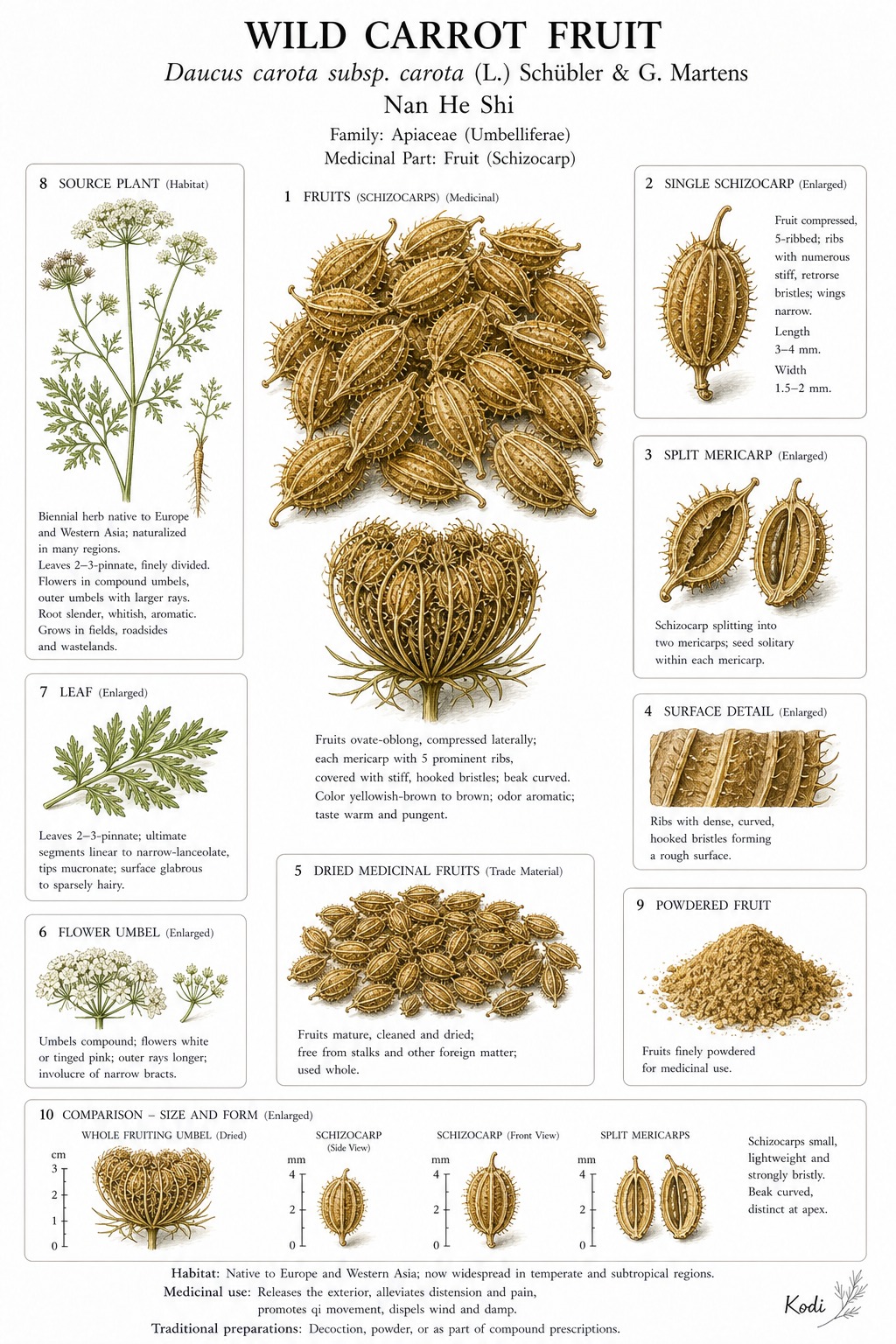
Known in TCM as Nan He Shi (南鹤虱), this bitter and acrid, neutral herb enters the Spleen and Stomach. Traditionally, it kills parasites ... Nan He Shi is a southern `He Shi` lane used mainly for worm accumulation with abdominal discomfort, anal itching, or poor appetite, most often applied for intestinal parasites, abdominal pain, and indigestion. Modern research has identified Elemicin among its active constituents.
Part used: Fruit
Also Known As
Latin: Fructus Carotae | Pinyin: Nan He Shi | Chinese: 南鹤虱
TCM Properties
- Taste
- bitter, acrid
- Temperature
- neutral
- Channels
- Spleen, Stomach
Traditional Use
Primary Actions
- Kills parasites ... Nan He Shi is a southern `He Shi` lane used mainly for worm accumulation with abdominal discomfort, anal itching, or poor appetite.
- Reduces food accumulation and relieves abdominal pain ... especially when stagnant food and intestinal irritation overlap with parasite patterns.
- Keeps the fruit-forward wild-carrot identity ... the medicinal material is the dried mature fruit of Daucus carota and not the edible carrot root.
Secondary Actions
- This page should not be flattened into northern `He Shi` lanes, because southern `Nan He Shi` is a substitute tradition tied specifically to wild carrot fruit rather than to identical source material.
- Although it belongs to the same broad anti-parasite category, it is a comparatively small, slightly toxic, and more specialized medicinal rather than a general digestive tonic.
Classic Formulas
- Anti-parasite powders with Bing Lang, Shi Jun Zi, or Ku Lian Pi ... common logic when worms, distension, and poor appetite travel together.
- Accumulation-relieving combinations with Shan Zha or Mai Ya ... used when food stagnation and worm irritation coexist.
- Small household or regional decoction traditions for abdominal pain from parasites ... a narrower use lane than the better-known mainstream anti-helminthic herbs.
Classical References
- Hong Kong Department of Health monograph material identifies Nan He Shi as the dried mature fruit of Daucus carota, bitter and acrid in flavor, neutral in nature, slightly toxic, and entering the Spleen and Stomach to kill parasites and resolve accumulation.
- Traditional usage also preserves the important distinction that `Nan He Shi` is not simply interchangeable with every other `He Shi` source in commerce.
Modern Research
Active Compounds
- Elemicin and methylisoeugenol ... notable volatile constituents discussed in wild-carrot essential-oil studies
- Carotol and related terpenoid fractions ... common markers in Daucus carota volatile chemistry
- Phenolic and flavonoid compounds ... broader antioxidant constituents reviewed across wild carrot literature
- Seed and fruit essential-oil fractions ... the main focus of much antimicrobial and bioactivity work
Studied Effects
- A 2024 review of wild carrot summarized phytochemical and pharmacological research, while emphasizing that better designed preclinical and clinical trials are still needed before human medicinal claims can be considered established (PMID 38202401).
- A 2007 study identified elemicin and methylisoeugenol as antibacterial components of Daucus carota essential oil against Campylobacter jejuni, illustrating why the fruit and seed lane attracts antimicrobial interest (PMID 17685629).
- A 2013 analysis of wild Tunisian Daucus carota seed essential oils showed meaningful variation in chemical composition and antimicrobial activity across populations, underscoring that bioactivity claims depend heavily on chemotype and source (PMID 24327447).
PubMed References
- The Wild Carrot (Daucus carota): A Phytochemical and Pharmacological Review. (2024)
- (E)-Methylisoeugenol and elemicin: antibacterial components of Daucus carota L. essential oil against Campylobacter jejuni. (2007)
- Variation of the chemical composition and antimicrobial activity of the essential oils of natural populations of Tunisian Daucus carota L. (Apiaceae). (2013)
Safety & Interactions
Contraindications
- Pregnancy without professional supervision
- Marked deficiency without parasite or accumulation signs
Cautions
- Traditional references describe Nan He Shi as slightly toxic, so this is not a casual kitchen-seed remedy.
- Wild carrot fruit, carrot root, and commercial carrot-seed oils are not interchangeable in dose, chemistry, or intended use.
Conditions
- Intestinal Parasites Traditional ★★★★☆ JSON
- Abdominal Pain Traditional ★★☆☆☆ JSON
- Indigestion Traditional ★★☆☆☆ JSON
- Poor Appetite Traditional ★★☆☆☆ JSON
Frequently Asked Questions
What is Wild Carrot Fruit used for?
Wild Carrot Fruit is traditionally used to Kills parasites ... Nan He Shi is a southern `He Shi` lane used mainly for worm accumulation with abdominal discomfort, anal itching, or poor appetite., Reduces food accumulation and relieves abdominal pain ... especially when stagnant food and intestinal irritation overlap with parasite patterns., Keeps the fruit-forward wild-carrot identity ... the medicinal material is the dried mature fruit of Daucus carota and not the edible carrot root.. Research has investigated its effects on: A 2024 review of wild carrot summarized phytochemical and pharmacological research, while emphasizing that better designed preclinical and clinical trials are still needed before human medicinal claims can be considered established (PMID 38202401).; A 2007 study identified elemicin and methylisoeugenol as antibacterial components of Daucus carota essential oil against Campylobacter jejuni, illustrating why the fruit and seed lane attracts antimicrobial interest (PMID 17685629)..
What are other names for Wild Carrot Fruit?
Wild Carrot Fruit is also known as Nan He Shi, Southern He Shi, Daucus carota Fruit. In TCM: 南鹤虱 (Nan He Shi); Fructus Carotae.
Is Wild Carrot Fruit safe during pregnancy?
The safety of Wild Carrot Fruit during pregnancy has not been established. Consult a qualified healthcare provider before use.
What are the contraindications for Wild Carrot Fruit?
Wild Carrot Fruit should not be used in: Pregnancy without professional supervision; Marked deficiency without parasite or accumulation signs. Consult a qualified healthcare provider before use.