Wild Buckwheat Rhizome
- Chinese
- 金荞麦
- Pinyin
- Jin Qiao Mai
- Latin
- Rhizoma Fagopyri Cymosi
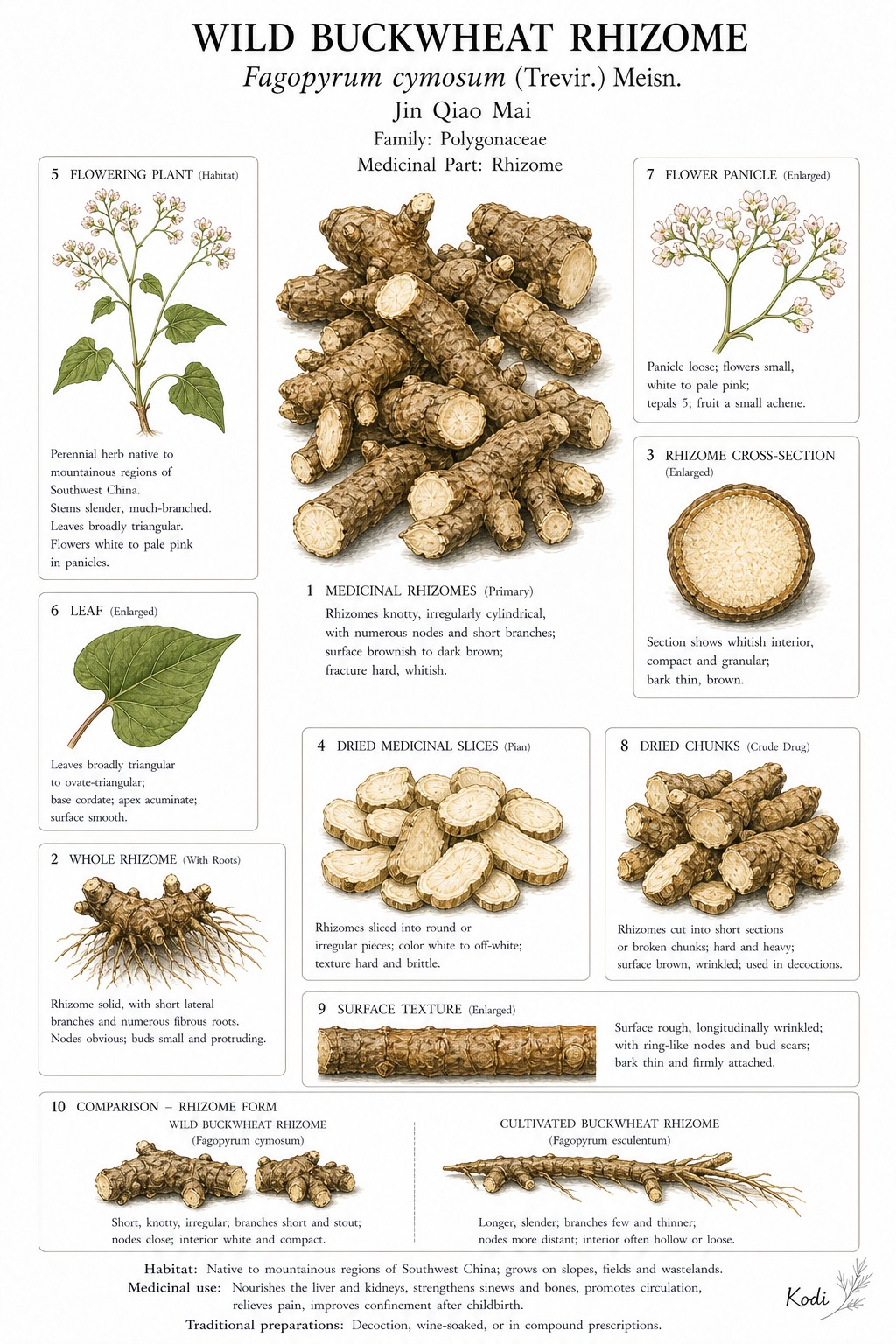
Known in TCM as Jin Qiao Mai (金荞麦), this slightly acrid and astringent, cool herb enters the Lung. Traditionally, it clears heat and resolves toxicity ... Jin Qiao Mai is used for sore throat, lung abscess-type presentations, dysentery, and other hot toxic conditions with swelling or suppuration, most often applied for sore throat, abscess, and dysentery. Modern research has identified Flavonoids among its active constituents.
Part used: Rhizome
Also Known As
Latin: Rhizoma Fagopyri Cymosi | Pinyin: Jin Qiao Mai | Chinese: 金荞麦
TCM Properties
- Taste
- slightly acrid, astringent
- Temperature
- cool
- Channels
- Lung
Traditional Use
Primary Actions
- Clears heat and resolves toxicity ... Jin Qiao Mai is used for sore throat, lung abscess-type presentations, dysentery, and other hot toxic conditions with swelling or suppuration.
- Invigorates blood and reduces swelling ... traditional use extends to traumatic injury, painful masses, and inflamed tissue where heat and stasis combine.
- Expels wind and eliminates dampness ... it also appears in painful-obstruction and chronic inflammatory patterns when toxin, dampness, and blood stasis overlap.
Secondary Actions
- This page stays rhizome-forward and should not be read as a food buckwheat grain record ... the medicinal lane is the underground part of Fagopyrum cymosum.
- Regional materia medica also describe a Spleen-supporting and damp-resolving side to Jin Qiao Mai, but the defining identity remains heat-toxin clearing with blood-moving support.
Classic Formulas
- Heat-toxin and lung-abscess combinations with Yu Xing Cao, Pu Gong Ying, or Jie Geng ... common clinical logic when throat and Lung inflammation predominate.
- Blood-stasis and traumatic-injury prescriptions ... used when swelling, pain, and lingering inflammation travel together.
- Damp-heat dysentery and painful-obstruction adaptations ... reflecting the herb's mixed toxin-clearing, blood-moving, and damp-resolving profile.
Classical References
- Modern Chinese materia medica describes Jin Qiao Mai as cool, slightly acrid, and astringent, entering the Lung to clear heat, remove toxicity, move blood, and reduce swelling.
- Traditional indications commonly include throat swelling, pulmonary suppuration, dysentery, traumatic pain, and certain external toxic swellings.
Modern Research
Active Compounds
- Flavonoids such as rutin, quercetin derivatives, and related polyphenols ... major constituents discussed in Fagopyrum cymosum research
- Procyanidins and tannin-rich fractions ... contributors to anti-inflammatory and mucosal-protective interest
- Phenolic acids and antioxidant compounds ... supportive constituents in broad pharmacologic reviews
- Polysaccharide fractions ... additional components explored in immune and gut-focused work
Studied Effects
- A 2017 study reported anti-inflammatory effects of Fagopyrum cymosum in an ulcerative-colitis model, supporting traditional toxin-clearing and bowel-inflammatory use while remaining preclinical (PMID 29201175).
- A 2013 rat study found anti-arthritic activity from an ethanol extract of Fagopyrum cymosum, which fits the herb's traditional painful-obstruction and swelling-reduction lane (PMID 23675837).
- A 2012 study reported that Fagopyrum cymosum extract protected against acute lung injury in rats, offering a plausible modern correlate for respiratory and suppurative-use traditions (PMID 23019909).
PubMed References
- Anti-inflammatory effects of Fagopyrum cymosum administered as a potential drug for ulcerative colitis. (2017)
- Anti-arthritic activity of ethanol extract of Fagopyrum cymosum with adjuvant-induced arthritis in rats. (2013)
- Protective effect of Fagopyrum cymosum on acute lung injury induced by oleic acid in rats. (2012)
Safety & Interactions
Contraindications
- Cold deficiency without heat, toxin, or inflammatory swelling
- Marked qi and blood deficiency without stasis or damp-heat features
Cautions
- Most indexed evidence for Jin Qiao Mai remains preclinical and should not be treated as proof for self-treatment of serious infection or inflammatory bowel disease.
- Commerce can blur wild buckwheat rhizome with non-medicinal buckwheat foods, so correct identity matters.
Conditions
- Sore Throat Traditional ★★★☆☆ JSON
- Abscess Traditional ★★★☆☆ JSON
- Dysentery Traditional ★★☆☆☆ JSON
- Traumatic Injury Traditional ★★☆☆☆ JSON
Frequently Asked Questions
What is Wild Buckwheat Rhizome used for?
Wild Buckwheat Rhizome is traditionally used to Clears heat and resolves toxicity ... Jin Qiao Mai is used for sore throat, lung abscess-type presentations, dysentery, and other hot toxic conditions with swelling or suppuration., Invigorates blood and reduces swelling ... traditional use extends to traumatic injury, painful masses, and inflamed tissue where heat and stasis combine., Expels wind and eliminates dampness ... it also appears in painful-obstruction and chronic inflammatory patterns when toxin, dampness, and blood stasis overlap.. Research has investigated its effects on: A 2017 study reported anti-inflammatory effects of Fagopyrum cymosum in an ulcerative-colitis model, supporting traditional toxin-clearing and bowel-inflammatory use while remaining preclinical (PMID 29201175).; A 2013 rat study found anti-arthritic activity from an ethanol extract of Fagopyrum cymosum, which fits the herb's traditional painful-obstruction and swelling-reduction lane (PMID 23675837)..
What are other names for Wild Buckwheat Rhizome?
Wild Buckwheat Rhizome is also known as Jin Qiao Mai, Golden Buckwheat Rhizome, Fagopyrum cymosum Rhizome. In TCM: 金荞麦 (Jin Qiao Mai); Rhizoma Fagopyri Cymosi.
Is Wild Buckwheat Rhizome safe during pregnancy?
The safety of Wild Buckwheat Rhizome during pregnancy has not been established. Consult a qualified healthcare provider before use.
What are the contraindications for Wild Buckwheat Rhizome?
Wild Buckwheat Rhizome should not be used in: Cold deficiency without heat, toxin, or inflammatory swelling; Marked qi and blood deficiency without stasis or damp-heat features. Consult a qualified healthcare provider before use.