Hang White Peony Root
- Chinese
- 杭芍
- Pinyin
- Hang Shao
- Latin
- Radix Paeoniae Alba
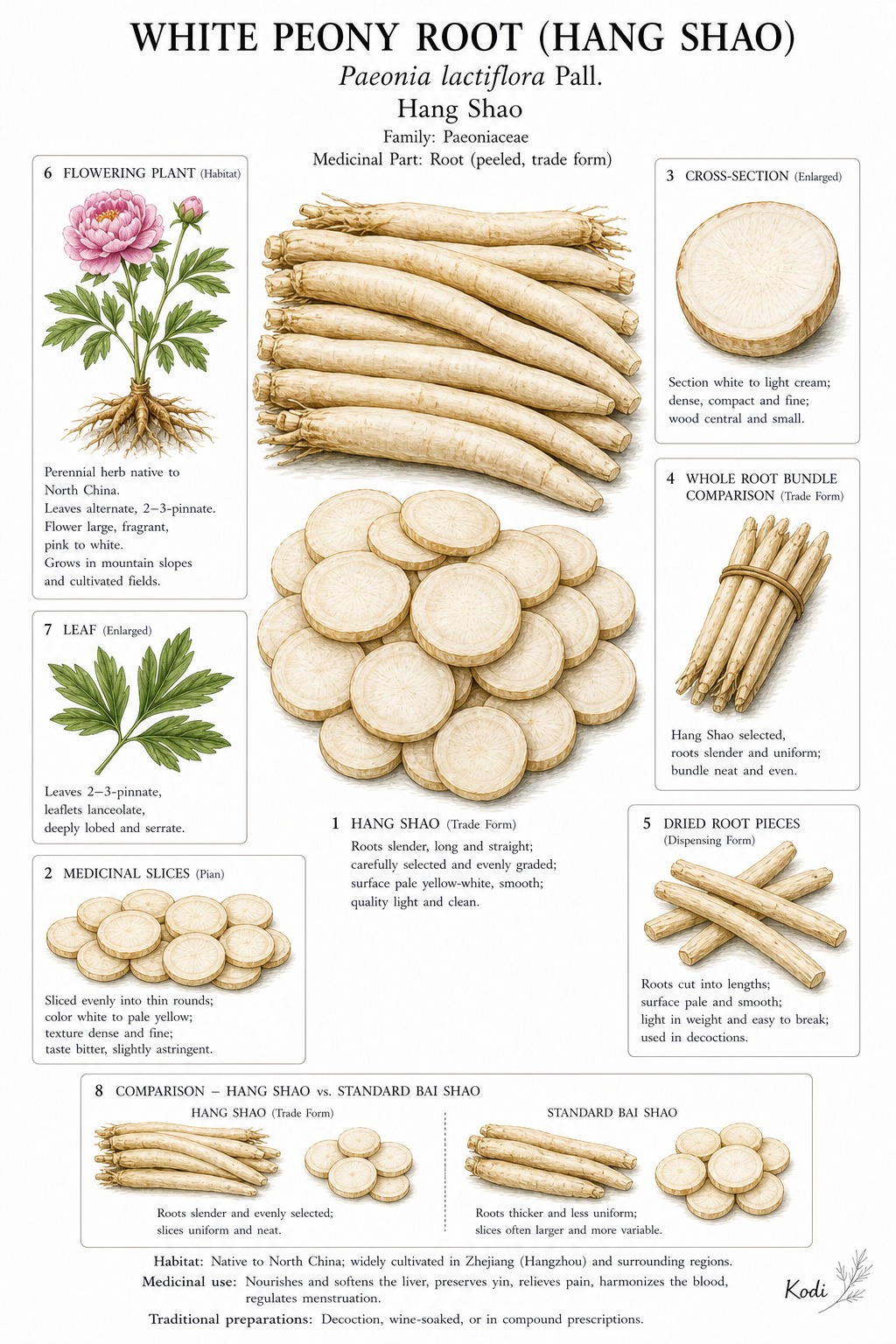
Known in TCM as Hang Shao (杭芍), this bitter and sour, slightly cold herb enters the Liver and Spleen. Traditionally, it nourishes blood and preserves yin ... Hang Shao follows the same Bai Shao medicinal direction of replenishing blood and softening deficiency dryness or menstrual depletion, most often applied for dysmenorrhea, abdominal pain, and menstrual irregularities. Modern research has identified Paeoniflorin among its active constituents.
Part used: Root
Also Known As
Latin: Radix Paeoniae Alba | Pinyin: Hang Shao | Chinese: 杭芍
TCM Properties
- Taste
- bitter, sour
- Temperature
- slightly cold
- Channels
- Liver, Spleen
Traditional Use
Primary Actions
- Nourishes blood and preserves yin ... Hang Shao follows the same Bai Shao medicinal direction of replenishing blood and softening deficiency dryness or menstrual depletion.
- Softens the Liver and relieves pain ... it is used for cramping abdominal pain, dysmenorrhea, flank tension, and formula patterns where a selected white peony trade form is dispensed.
- Moderates spasm and helps harmonize nutritive and defensive qi ... the classical therapeutic lane remains the same as Bai Shao even though the commercial presentation is slimmer selected roots and neat slices.
Secondary Actions
- This page exists to preserve a real trade-form distinction and should not be collapsed into `white-peony-root`, even though both belong to the Bai Shao family and share the same source species.
- Hang Shao is better understood as a commerce and dispensing lane than as a different plant or a different fundamental therapeutic category.
Classic Formulas
- Shao Yao Gan Cao Tang ... classic spasm-relieving formula logic that still applies when Hang Shao is the pharmacy grade on hand.
- Si Wu Tang and related blood-nourishing prescriptions ... the same menstrual and blood-deficiency direction carried by standard Bai Shao.
- Xiao Yao San or Gui Zhi Tang style formula work ... contexts that depend on peony's ability to preserve yin while moderating tension and disharmony.
Classical References
- Traditional teaching treats Hang Shao as a white-peony trade lane within the Bai Shao family rather than as a separate materia medica category.
- Its functions remain centered on nourishing blood, softening the Liver, relieving pain, and moderating spasm.
Modern Research
Active Compounds
- Paeoniflorin ... the major reference compound in white peony pharmacology and quality control
- Albiflorin and oxypaeoniflorin ... core monoterpene glycosides in Paeonia lactiflora roots
- Polyphenolic and tannin-related fractions ... supportive antioxidant constituents
- Total paeony glycosides ... common extract fraction in contemporary studies
Studied Effects
- A 2024 review summarized ethnopharmacology, phytochemistry, pharmacology, and quality control of Paeonia lactiflora, which applies directly to the Hang Shao trade lane as a selected Bai Shao presentation (PMID 39053710).
- A 2016 review of Paeonia lactiflora constituents described anti-inflammatory, analgesic, immunoregulatory, and antispasmodic pathways that help explain why white peony remains so important in formula work (PMID 27279421).
- A 2021 study found that Paeonia lactiflora root extract and its components reduced biomarkers of early atherosclerosis through anti-inflammatory and antioxidant effects, illustrating the broader modern interest in white peony chemistry beyond its classical trade-grade distinctions (PMID 34679642).
PubMed References
- A review of the ethnopharmacology, phytochemistry, pharmacology, pharmacokinetics and quality control of Paeonia lactiflora Pall. (2024)
- A Pharmacological Review of Bioactive Constituents of Paeonia lactiflora Pallas and Paeonia veitchii Lynch. (2016)
- Paeonia lactiflora Root Extract and Its Components Reduce Biomarkers of Early Atherosclerosis via Anti-Inflammatory and Antioxidant Effects In Vitro and In Vivo. (2021)
Safety & Interactions
Contraindications
- Loose stool from cold-damp without blood deficiency
- Patterns dominated by severe phlegm accumulation or food stagnation rather than deficiency, pain, or spasm
Cautions
- The trade-form distinction does not create a different safety profile ... concentrated extracts and purified paeony glycosides still differ from crude-root use.
- Users should not infer that Hang Shao is stronger or safer simply because the slices are selected or visually cleaner.
Conditions
- Dysmenorrhea Traditional ★★★★☆ JSON
- Abdominal Pain Traditional ★★★☆☆ JSON
- Menstrual Irregularities Traditional ★★★☆☆ JSON
- Spontaneous Sweating Traditional ★★☆☆☆ JSON
Frequently Asked Questions
What is Hang White Peony Root used for?
Hang White Peony Root is traditionally used to Nourishes blood and preserves yin ... Hang Shao follows the same Bai Shao medicinal direction of replenishing blood and softening deficiency dryness or menstrual depletion., Softens the Liver and relieves pain ... it is used for cramping abdominal pain, dysmenorrhea, flank tension, and formula patterns where a selected white peony trade form is dispensed., Moderates spasm and helps harmonize nutritive and defensive qi ... the classical therapeutic lane remains the same as Bai Shao even though the commercial presentation is slimmer selected roots and neat slices.. Research has investigated its effects on: A 2024 review summarized ethnopharmacology, phytochemistry, pharmacology, and quality control of Paeonia lactiflora, which applies directly to the Hang Shao trade lane as a selected Bai Shao presentation (PMID 39053710).; A 2016 review of Paeonia lactiflora constituents described anti-inflammatory, analgesic, immunoregulatory, and antispasmodic pathways that help explain why white peony remains so important in formula work (PMID 27279421)..
What are other names for Hang White Peony Root?
Hang White Peony Root is also known as Hang Shao, Selected White Peony Root, Trade-Form Bai Shao. In TCM: 杭芍 (Hang Shao); Radix Paeoniae Alba.
Is Hang White Peony Root safe during pregnancy?
The safety of Hang White Peony Root during pregnancy has not been established. Consult a qualified healthcare provider before use.
What are the contraindications for Hang White Peony Root?
Hang White Peony Root should not be used in: Loose stool from cold-damp without blood deficiency; Patterns dominated by severe phlegm accumulation or food stagnation rather than deficiency, pain, or spasm. Consult a qualified healthcare provider before use.