White Mustard Seed
- Chinese
- 白芥子
- Pinyin
- Bai Jie Zi
- Latin
- Semen Sinapis Albae
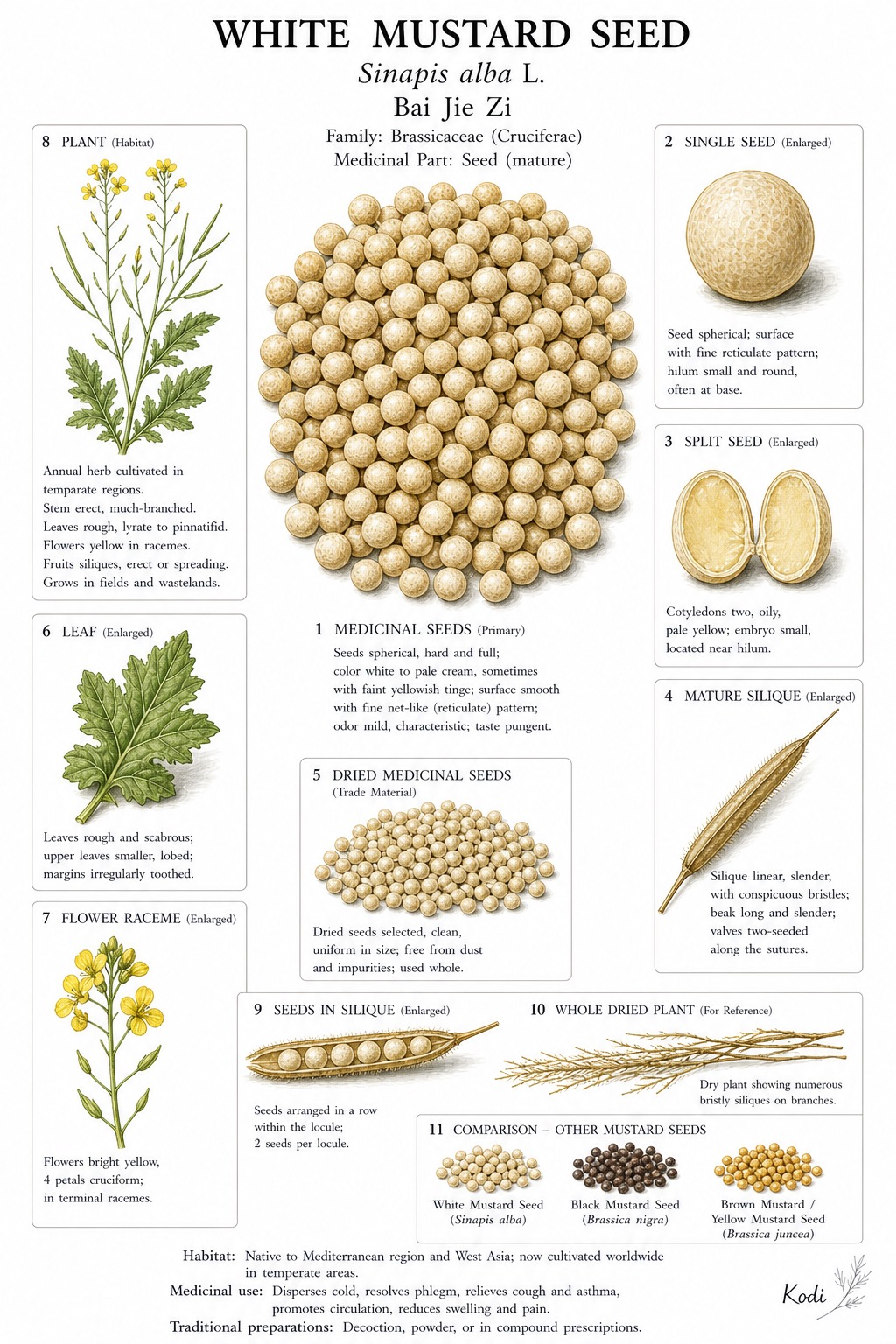
Known in TCM as Bai Jie Zi (白芥子), this acrid, warm herb enters the Lung and Stomach. Traditionally, it warms the Lung and expels cold-phlegm ... Bai Jie Zi is used for cough, wheezing, chest fullness, and difficult sputum when cold and damp obstruct the Lung, most often applied for cough, wheezing, and joint pain. Modern research has identified Sinalbin among its active constituents.
Part used: Seed
Also Known As
Latin: Semen Sinapis Albae | Pinyin: Bai Jie Zi | Chinese: 白芥子
TCM Properties
- Taste
- acrid
- Temperature
- warm
- Channels
- Lung, Stomach
Traditional Use
Primary Actions
- Warms the Lung and expels cold-phlegm ... Bai Jie Zi is used for cough, wheezing, chest fullness, and difficult sputum when cold and damp obstruct the Lung.
- Regulates qi and dissipates nodules ... classical use extends to phlegm masses, scrofulous swelling, and focal hardness where cold-phlegm binds in the tissues.
- Unblocks the channels and relieves pain ... especially through topical plasters or powders used on cold-damp painful obstruction, numbness, and swollen joints.
Secondary Actions
- This page keeps the specific white-seed lane and should not be flattened into the shorter already-live `mustard-seed` record, even though both refer to the same Bai Jie Zi medicinal family.
- Internal use commonly favors stir-baked seed, while raw seed is more likely to be discussed for topical application because prolonged skin contact can irritate or blister.
Classic Formulas
- San Zi Yang Qin Tang ... classic three-seed formula in which Bai Jie Zi warms and transforms cold-phlegm in the chest.
- Bai Jie Zi San and related topical plasters ... traditional external-use logic for cold-phlegm nodules and channel obstruction.
- Pairings with Su Zi and Lai Fu Zi ... common strategy when cough, copious sputum, and chest oppression arise from phlegm-damp and qi stagnation.
Classical References
- Traditional materia medica describes Bai Jie Zi as acrid and warm, entering the Lung and Stomach to warm the Lung, regulate qi, scatter phlegm, and open the channels.
- The herb is consistently framed as a cold-phlegm and nodule-dispersing seed rather than as a gentle food-like mustard condiment.
Modern Research
Active Compounds
- Sinalbin and related glucosinolates ... major characteristic constituents of white mustard seed
- Isothiocyanate breakdown products ... central to modern antimicrobial, pungent, and irritant pharmacology discussion
- Sinapine and phenolic compounds ... supportive antioxidant and bioactivity markers
- Fixed oils and fatty-acid fractions ... relevant to both nutrition and topical-use chemistry
Studied Effects
- A 2023 review of Sinapis Semen summarized its phytochemistry, pharmacology, toxicity, analytical methods, and pharmacokinetics, giving the best modern overview for Bai Jie Zi as a medicinal seed rather than just a food spice (PMID 37124205).
- A 2021 toxicological review of biologically active compounds in mustard seeds highlighted both therapeutic interest and the real irritant potential of glucosinolate-derived products, which fits the herb's traditional caution around strong topical use (PMID 34574199).
- A preclinical study reported that allyl-isothiocyanate-rich mustard seed powder inhibited bladder-cancer growth and invasion, illustrating modern anticancer interest while remaining far removed from routine traditional dosing logic (PMID 20889681).
PubMed References
- Sinapis Semen: A review on phytochemistry, pharmacology, toxicity, analytical methods and pharmacokinetics. (2023)
- Biologically Active Compounds in Mustard Seeds: A Toxicological Perspective. (2021)
- Allyl isothiocyanate-rich mustard seed powder inhibits bladder cancer growth and muscle invasion. (2010)
Safety & Interactions
Contraindications
- Dry cough from Lung yin deficiency
- Heat patterns without cold-phlegm
- Damaged or highly sensitive skin when considering topical application
Cautions
- Raw seed and topical plasters can cause skin irritation or blistering with prolonged contact.
- Because Bai Jie Zi is warming and dispersing, overuse may aggravate dryness, qi depletion, or mouth-throat irritation in susceptible patients.
Conditions
- Cough Traditional ★★★☆☆ JSON
- Wheezing Traditional ★★★☆☆ JSON
- Joint Pain Traditional ★★☆☆☆ JSON
- Phlegm Accumulation Traditional ★★☆☆☆ JSON
Frequently Asked Questions
What is White Mustard Seed used for?
White Mustard Seed is traditionally used to Warms the Lung and expels cold-phlegm ... Bai Jie Zi is used for cough, wheezing, chest fullness, and difficult sputum when cold and damp obstruct the Lung., Regulates qi and dissipates nodules ... classical use extends to phlegm masses, scrofulous swelling, and focal hardness where cold-phlegm binds in the tissues., Unblocks the channels and relieves pain ... especially through topical plasters or powders used on cold-damp painful obstruction, numbness, and swollen joints.. Research has investigated its effects on: A 2023 review of Sinapis Semen summarized its phytochemistry, pharmacology, toxicity, analytical methods, and pharmacokinetics, giving the best modern overview for Bai Jie Zi as a medicinal seed rather than just a food spice (PMID 37124205).; A 2021 toxicological review of biologically active compounds in mustard seeds highlighted both therapeutic interest and the real irritant potential of glucosinolate-derived products, which fits the herb's traditional caution around strong topical use (PMID 34574199)..
What are other names for White Mustard Seed?
White Mustard Seed is also known as Bai Jie Zi, Sinapis alba Seed, White Sinapis Seed. In TCM: 白芥子 (Bai Jie Zi); Semen Sinapis Albae.
Is White Mustard Seed safe during pregnancy?
The safety of White Mustard Seed during pregnancy has not been established. Consult a qualified healthcare provider before use.
What are the contraindications for White Mustard Seed?
White Mustard Seed should not be used in: Dry cough from Lung yin deficiency; Heat patterns without cold-phlegm; Damaged or highly sensitive skin when considering topical application. Consult a qualified healthcare provider before use.