White Mulberry Root Bark
- Chinese
- 桑白皮
- Pinyin
- Sang Bai Pi
- Latin
- Cortex Mori
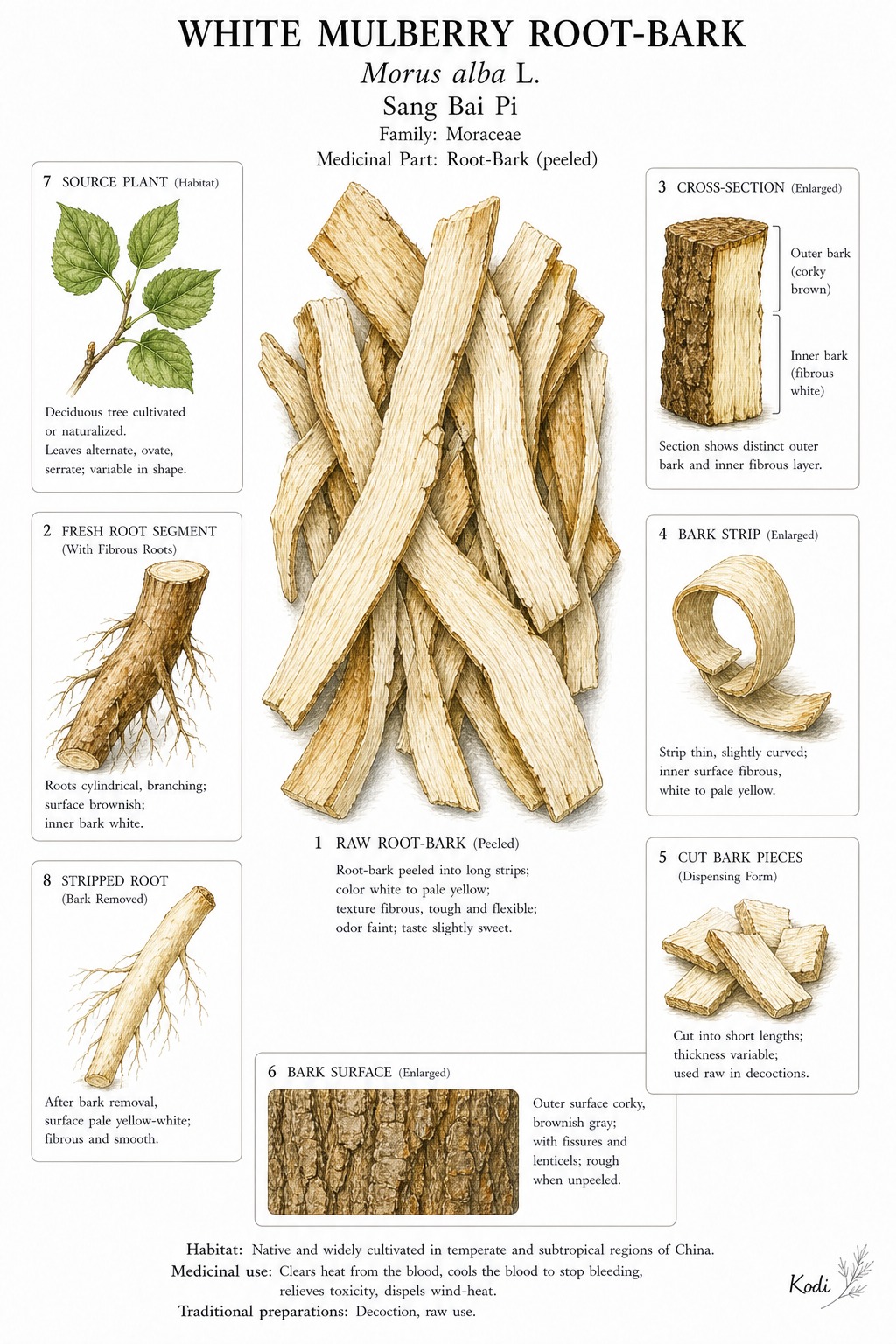
Known in TCM as Sang Bai Pi (桑白皮), this sweet, cold herb enters the Lung. Traditionally, it drains Lung heat and directs rebellious Lung qi downward ... raw Sang Bai Pi is a classic herb for cough, panting, wheezing, and thick hot sputum, most often applied for wheezing, asthma, and cough. Modern research has identified Prenylated among its active constituents.
Part used: Bark
Also Known As
Latin: Cortex Mori | Pinyin: Sang Bai Pi | Chinese: 桑白皮
TCM Properties
- Taste
- sweet
- Temperature
- cold
- Channels
- Lung
Traditional Use
Primary Actions
- Drains Lung heat and directs rebellious Lung qi downward ... raw Sang Bai Pi is a classic herb for cough, panting, wheezing, and thick hot sputum.
- Promotes urination and reduces edema ... it is used when upper-burner heat or Lung obstruction interferes with water movement and swelling develops.
- Keeps the colder, more direct raw-bark lane ... compared with prepared bark, this form is understood as less moderated and more clearly heat-draining.
Secondary Actions
- This page should stay distinct from the already-live `prepared-root-bark-white-mulberry` sibling ... both are Sang Bai Pi, but this lane follows the raw peeled root bark rather than the toasted prepared form.
- The medicinal focus is on the root bark and its downward Lung action, not on mulberry leaf, fruit, or general Morus alba nutrition.
Classic Formulas
- Xie Bai San ... the defining Lung-heat wheezing formula centered on Sang Bai Pi.
- Ding Chuan Tang ... common formula context when descending Lung qi and calming wheeze are both treatment priorities.
- Modified cough and edema prescriptions ... raw Sang Bai Pi is often chosen when stronger heat-clearing is preferred over the gentler prepared bark.
Classical References
- Materia medica texts describe Sang Bai Pi as entering the Lung to drain heat, calm wheezing, and promote urination for edema.
- Traditional teaching also distinguishes raw from prepared bark, with the raw form retaining a colder and more direct heat-clearing profile.
Modern Research
Active Compounds
- Prenylated flavonoids such as kuwanon G and morusin ... signature root-bark constituents with anti-inflammatory and anti-allergic interest
- Mulberroside-related phenolics and stilbenoids ... important compounds discussed across Morus alba medicinal-part reviews
- Polysaccharides and antioxidant phenolics ... supportive components in broader mulberry pharmacology
- Root-bark flavonoid fractions ... relevant to respiratory and airway-inflammation research
Studied Effects
- A 2024 overview of different medicinal parts of Morus alba summarized the chemistry and pharmacology of Mori Cortex, supporting its long-standing respiratory and anti-inflammatory relevance within the mulberry materia medica (PMID 38694910).
- A 2011 mouse asthma-model study found that Cortex Mori Radicis extract showed antiasthmatic effects linked to regulatory T-cell enhancement and suppression of Th2 cytokines, fitting the herb's traditional wheezing lane while remaining preclinical (PMID 21875661).
- A 2014 study on kuwanon G isolated from Morus alba root bark reported reduced allergic airway responses in an ovalbumin model, adding a plausible modern correlate for Sang Bai Pi's classic descending-Lung use (PMID 25116225).
PubMed References
- Comprehensive overview of different medicinal parts from Morus alba L.: chemical compositions and pharmacological activities. (2024)
- Cortex Mori Radicis extract exerts antiasthmatic effects via enhancement of CD4(+)CD25(+)Foxp3(+) regulatory T cells and inhibition of Th2 cytokines in a mouse asthma model. (2011)
- Effect of Kuwanon G isolated from the root bark of Morus alba on ovalbumin-induced allergic response in a mouse model of asthma. (2014)
Safety & Interactions
Contraindications
- Cold-pattern cough or wheezing without heat
- Frequent urination or dehydration from deficiency patterns without edema
Cautions
- Raw Sang Bai Pi is colder and more draining than the prepared form, so it is a poor fit for dry weak cough without heat signs.
- Patients should not assume mulberry fruit, leaf, and root-bark products are clinically interchangeable.
Drug Interactions
- Diuretics ... theoretical additive fluid and electrolyte effects may matter in sensitive patients
Conditions
Frequently Asked Questions
What is White Mulberry Root Bark used for?
White Mulberry Root Bark is traditionally used to Drains Lung heat and directs rebellious Lung qi downward ... raw Sang Bai Pi is a classic herb for cough, panting, wheezing, and thick hot sputum., Promotes urination and reduces edema ... it is used when upper-burner heat or Lung obstruction interferes with water movement and swelling develops., Keeps the colder, more direct raw-bark lane ... compared with prepared bark, this form is understood as less moderated and more clearly heat-draining.. Research has investigated its effects on: A 2024 overview of different medicinal parts of Morus alba summarized the chemistry and pharmacology of Mori Cortex, supporting its long-standing respiratory and anti-inflammatory relevance within the mulberry materia medica (PMID 38694910).; A 2011 mouse asthma-model study found that Cortex Mori Radicis extract showed antiasthmatic effects linked to regulatory T-cell enhancement and suppression of Th2 cytokines, fitting the herb's traditional wheezing lane while remaining preclinical (PMID 21875661)..
What are other names for White Mulberry Root Bark?
White Mulberry Root Bark is also known as Raw Sang Bai Pi, Mori Cortex, Mulberry Root Bark. In TCM: 桑白皮 (Sang Bai Pi); Cortex Mori.
Is White Mulberry Root Bark safe during pregnancy?
The safety of White Mulberry Root Bark during pregnancy has not been established. Consult a qualified healthcare provider before use.
What are the contraindications for White Mulberry Root Bark?
White Mulberry Root Bark should not be used in: Cold-pattern cough or wheezing without heat; Frequent urination or dehydration from deficiency patterns without edema. Consult a qualified healthcare provider before use.
Does White Mulberry Root Bark interact with any medications?
White Mulberry Root Bark may interact with: Diuretics ... theoretical additive fluid and electrolyte effects may matter in sensitive patients. Always inform your healthcare provider of any herbal supplements you are taking.