Wheat Seed
- Chinese
- 小麦
- Pinyin
- Xiao Mai
- Latin
- Semen Tritici Aestivi
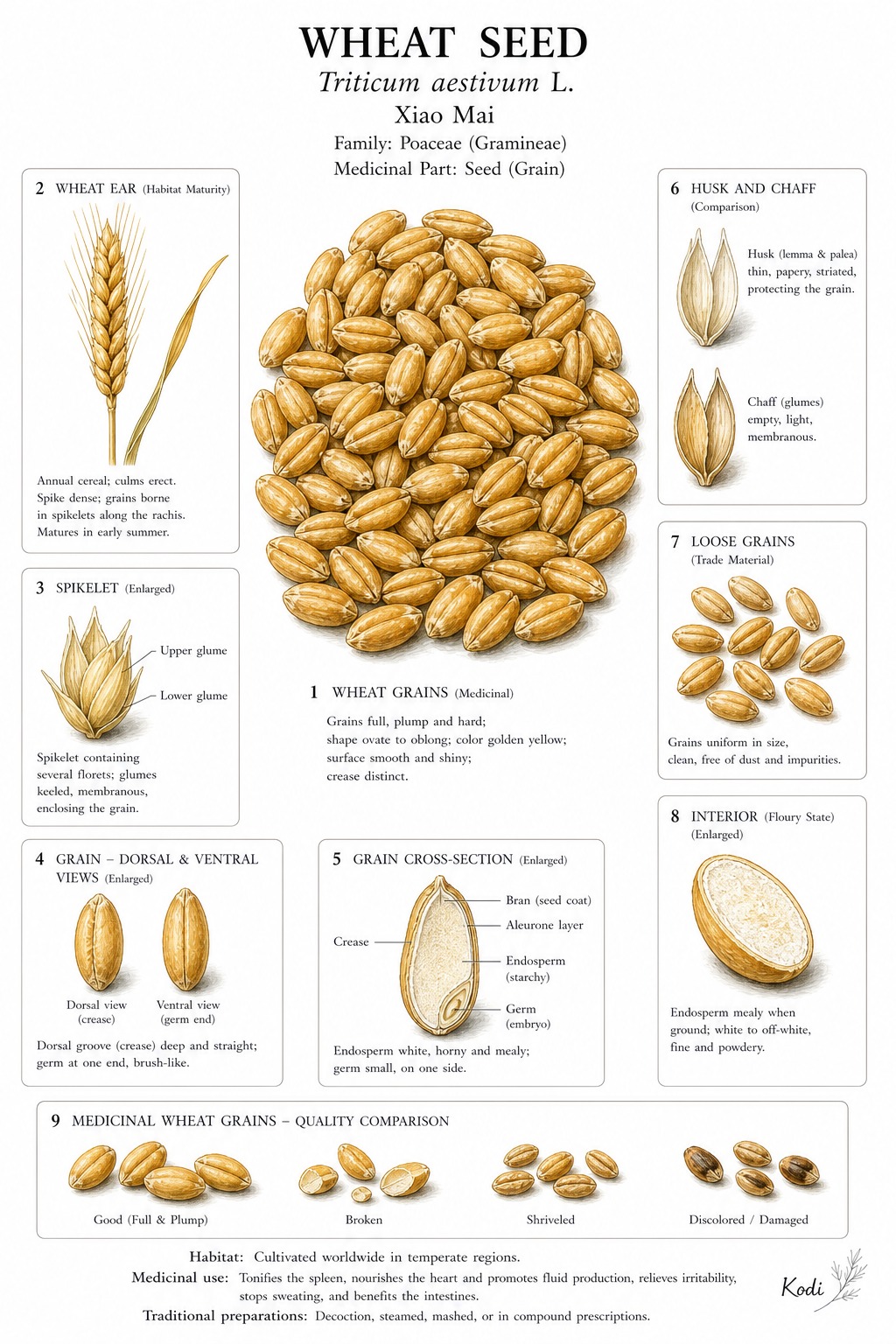
Known in TCM as Xiao Mai (小麦), this sweet, cool herb enters the Heart and Spleen. Traditionally, it nourishes the Heart and eases irritability ... ordinary Xiao Mai appears in formula and food-medicine settings for emotional fragility, restlessness, and post-illness vexation, most often applied for insomnia, anxiety, and palpitations. Modern research has identified Ferulic among its active constituents.
Part used: Seed
Also Known As
Latin: Semen Tritici Aestivi | Pinyin: Xiao Mai | Chinese: 小麦
TCM Properties
- Taste
- sweet
- Temperature
- cool
- Channels
- Heart, Spleen
Traditional Use
Primary Actions
- Nourishes the Heart and eases irritability ... ordinary Xiao Mai appears in formula and food-medicine settings for emotional fragility, restlessness, and post-illness vexation.
- Generates fluids and relieves dryness or thirst ... whole wheat grain is used more as a gentle nourishing cereal lane than as a strong single-herb corrective.
- Supports the middle through medicinal food use ... the grain can be used in congee, gruel, or decoction settings when a mild calming and nutritive substance is appropriate.
Secondary Actions
- This page should stay clearly distinct from `light-wheat` ... Fu Xiao Mai is the specialized floating, shriveled grain used to stop deficiency sweating, while Xiao Mai is the ordinary full grain lane.
- The best known classical formula association is `Gan Mai Da Zao Tang`, which uses ordinary wheat to nourish and calm rather than to secure sweat.
Classic Formulas
- Gan Mai Da Zao Tang ... the classic wheat-containing formula for zang-zhao style emotional restlessness, grief, crying, insomnia, and post-illness irritability.
- Congee and gruel prescriptions for convalescent thirst or agitation ... common food-medicine logic when the patient needs support rather than aggressive intervention.
- Pairings with Da Zao and Gan Cao ... the classical calming-and-nourishing direction that defines Xiao Mai more than sweating control does.
Classical References
- Traditional sources distinguish ordinary Xiao Mai from floating wheat and place it in a more nourishing, calming, food-adjacent lane.
- Its medicinal value is gentle and cumulative ... it is used to steady the Heart and support fluids rather than to strongly purge, move, or astringe.
Modern Research
Active Compounds
- Ferulic acid and related phenolic acids ... prominent grain antioxidants discussed in wheat health literature
- Dietary fiber and resistant starch fractions ... major contributors to digestive and metabolic interest
- Alkylresorcinols and lignan-related phytochemicals ... whole-grain markers studied for cardiometabolic relevance
- Tocopherols, carotenoids, and essential fatty acids ... supportive nutritive compounds in whole wheat
Studied Effects
- A 2022 review summarized broad health benefits and pharmacological activities of Triticum aestivum, showing that modern wheat research centers largely on antioxidant, metabolic, and functional-food pathways rather than on the narrow traditional Xiao Mai formula lane (PMID 35335312).
- A 2022 cultivar study found antioxidant and cytoprotective capacities in Triticum aestivum grain samples, offering a plausible biochemical correlate for restorative grain use even though it was not a direct clinical trial of Xiao Mai prescriptions (PMID 35954104).
- A 2016 review discussed the bioavailability and metabolism of whole-grain wheat phenolic compounds after bread consumption, reinforcing that many relevant modern effects are nutritional and matrix-dependent rather than herb-like in the narrow sense (PMID 27273424).
PubMed References
- General Health Benefits and Pharmacological Activities of Triticum aestivum L. (2022)
- Antioxidant and Cytoprotective Capacities of Various Wheat (Triticum aestivum L.) Cultivars in Korea (2022)
- Bioavailability and metabolism of phenolic compounds from wholegrain wheat and aleurone-rich wheat bread. (2016)
Safety & Interactions
Contraindications
- Celiac disease, non-celiac gluten sensitivity requiring strict avoidance, or IgE-mediated wheat allergy
- Patterns dominated by damp accumulation and severe bloating when rich grain nourishment is not appropriate
Cautions
- Xiao Mai is medicinally gentle, but it still contains wheat constituents and should not be assumed safe for people who must avoid gluten-containing substances.
- Modern wheat products, extracts, and sprouted preparations are not interchangeable with traditional decoction or gruel use.
Conditions
Frequently Asked Questions
What is Wheat Seed used for?
Wheat Seed is traditionally used to Nourishes the Heart and eases irritability ... ordinary Xiao Mai appears in formula and food-medicine settings for emotional fragility, restlessness, and post-illness vexation., Generates fluids and relieves dryness or thirst ... whole wheat grain is used more as a gentle nourishing cereal lane than as a strong single-herb corrective., Supports the middle through medicinal food use ... the grain can be used in congee, gruel, or decoction settings when a mild calming and nutritive substance is appropriate.. Research has investigated its effects on: A 2022 review summarized broad health benefits and pharmacological activities of Triticum aestivum, showing that modern wheat research centers largely on antioxidant, metabolic, and functional-food pathways rather than on the narrow traditional Xiao Mai formula lane (PMID 35335312).; A 2022 cultivar study found antioxidant and cytoprotective capacities in Triticum aestivum grain samples, offering a plausible biochemical correlate for restorative grain use even though it was not a direct clinical trial of Xiao Mai prescriptions (PMID 35954104)..
What are other names for Wheat Seed?
Wheat Seed is also known as Xiao Mai, Wheat Grain, Triticum aestivum Seed. In TCM: 小麦 (Xiao Mai); Semen Tritici Aestivi.
Is Wheat Seed safe during pregnancy?
The safety of Wheat Seed during pregnancy has not been established. Consult a qualified healthcare provider before use.
What are the contraindications for Wheat Seed?
Wheat Seed should not be used in: Celiac disease, non-celiac gluten sensitivity requiring strict avoidance, or IgE-mediated wheat allergy; Patterns dominated by damp accumulation and severe bloating when rich grain nourishment is not appropriate. Consult a qualified healthcare provider before use.