Wenyujin Concise Rhizome
- Chinese
- 片姜黄
- Pinyin
- Pian Jiang Huang
- Latin
- Rhizoma Wenyujin Concisum
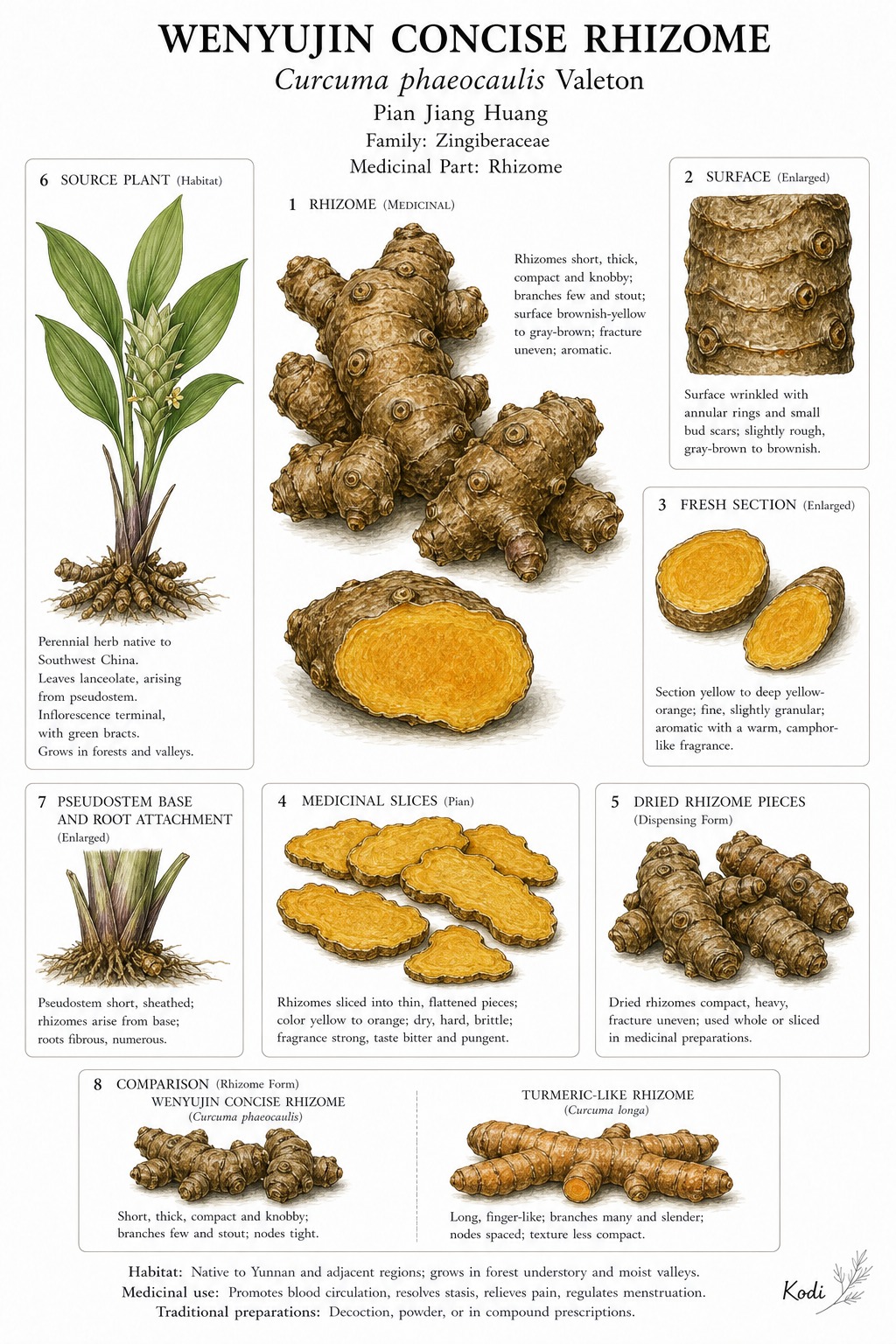
Known in TCM as Pian Jiang Huang (片姜黄), this acrid and bitter, warm herb enters the Liver and Spleen. Traditionally, it moves blood and promotes qi movement ... this compact Wenyujin rhizome lane is used when fixed pain, fullness, or menstrual obstruction reflects qi stagnation mixed with blood stasis, most often applied for blood stasis, dysmenorrhea, and traumatic injury. Modern research has identified Curdione among its active constituents.
Part used: Rhizome
Also Known As
Latin: Rhizoma Wenyujin Concisum | Pinyin: Pian Jiang Huang | Chinese: 片姜黄
TCM Properties
- Taste
- acrid, bitter
- Temperature
- warm
- Channels
- Liver, Spleen
Traditional Use
Primary Actions
- Moves blood and promotes qi movement ... this compact Wenyujin rhizome lane is used when fixed pain, fullness, or menstrual obstruction reflects qi stagnation mixed with blood stasis.
- Relieves pain and disperses accumulations ... traditional use extends to traumatic swelling, hypochondriac discomfort, and abdominal masses where a warming Curcuma rhizome is preferred over a cooling tuber lane.
- Represents a narrower Wenyujin trade form ... it stays closer to the blood-moving Curcuma rhizome family than to the cooler, more yin-focused `Yu Jin` tuber-root tradition.
Secondary Actions
- This page should not be flattened into the already-live `tuber-root-of-common-turmeric` record or the still-stub broader `zedoary-rhizome` lane ... all belong to Curcuma commerce, but the medicinal emphasis is not identical.
- The import and illustration workflow intentionally kept this lane compact-rhizome-forward rather than turmeric-bright or generalized zedoary-forward.
Classic Formulas
- Shao Fu Zhu Yu Tang and related blood-stasis formulas ... a common treatment context when Wenyujin-type curcuma is used for fixed lower-abdominal pain.
- Qi-and-blood pain prescriptions with Yan Hu Suo, Xiang Fu, or Chuan Xiong ... used when stagnation drives chest, flank, or menstrual pain.
- Trauma and mass-dispersion combinations with San Leng or E Zhu ... classical-style pairing logic when breaking stasis is more important than simple nourishment.
Classical References
- Curcuma rhizome traditions are classically grouped around moving blood, moving qi, reducing pain, and dispersing accumulations rather than around tonic or cooling-nourishing use.
- Within that family, this page tracks a compact Wenyujin rhizome presentation and not the better-known cooler `Yu Jin` tuber lane.
Modern Research
Active Compounds
- Curdione and curcumol ... major sesquiterpenoids discussed across Curcuma wenyujin rhizome research
- Curcumenol ... a well studied bioactive marker in the Wenyujin chemical family
- Beta-elemene and related terpenoids ... compounds of ongoing anticancer and anti-inflammatory interest
- Germacrone-type sesquiterpenes ... supportive contributors to the broader Curcuma rhizoma pharmacology literature
Studied Effects
- A 2020 review summarized the traditional uses, phytochemistry, and pharmacology of Curcuma wenyujin, highlighting ongoing interest in anti-inflammatory, hepatoprotective, and antitumor pathways while emphasizing the preclinical nature of much of the evidence (PMID 33309584).
- A 2024 review focused on sesquiterpenoids from Curcumae Rhizoma and described multiple blood-moving and inflammation-modulating constituents relevant to the Wenyujin rhizome family (PMID 38672405).
- A 2025 review specifically framed Curcumae Rhizoma as an anticancer traditional Chinese medicine, reinforcing the modern oncology interest around Wenyujin-related rhizome material while still centering mostly laboratory and translational evidence (PMID 40734908).
PubMed References
Safety & Interactions
Contraindications
- Pregnancy without professional supervision
- Active heavy bleeding or bleeding disorders
- Deficiency pain without qi stagnation or blood stasis
Cautions
- This is a moving Curcuma rhizome lane, not a gentle daily tonic, and it is used more cautiously in people with fragile constitutions or easy bleeding.
- Modern research often uses isolated terpenoids or extracts at concentrations that do not map directly to ordinary decoction use.
Drug Interactions
- Anticoagulant or antiplatelet drugs ... possible additive bleeding risk in sensitive patients
Conditions
- Blood Stasis Traditional ★★★★☆ JSON
- Dysmenorrhea Traditional ★★★☆☆ JSON
- Traumatic Injury Traditional ★★★☆☆ JSON
- Abdominal Pain Traditional ★★☆☆☆ JSON
Frequently Asked Questions
What is Wenyujin Concise Rhizome used for?
Wenyujin Concise Rhizome is traditionally used to Moves blood and promotes qi movement ... this compact Wenyujin rhizome lane is used when fixed pain, fullness, or menstrual obstruction reflects qi stagnation mixed with blood stasis., Relieves pain and disperses accumulations ... traditional use extends to traumatic swelling, hypochondriac discomfort, and abdominal masses where a warming Curcuma rhizome is preferred over a cooling tuber lane., Represents a narrower Wenyujin trade form ... it stays closer to the blood-moving Curcuma rhizome family than to the cooler, more yin-focused `Yu Jin` tuber-root tradition.. Research has investigated its effects on: A 2020 review summarized the traditional uses, phytochemistry, and pharmacology of Curcuma wenyujin, highlighting ongoing interest in anti-inflammatory, hepatoprotective, and antitumor pathways while emphasizing the preclinical nature of much of the evidence (PMID 33309584).; A 2024 review focused on sesquiterpenoids from Curcumae Rhizoma and described multiple blood-moving and inflammation-modulating constituents relevant to the Wenyujin rhizome family (PMID 38672405)..
What are other names for Wenyujin Concise Rhizome?
Wenyujin Concise Rhizome is also known as Compact Wenyujin Rhizome, Curcuma wenyujin Rhizome, Pian Jiang Huang. In TCM: 片姜黄 (Pian Jiang Huang); Rhizoma Wenyujin Concisum.
Is Wenyujin Concise Rhizome safe during pregnancy?
Wenyujin Concise Rhizome is not recommended during pregnancy.
What are the contraindications for Wenyujin Concise Rhizome?
Wenyujin Concise Rhizome should not be used in: Pregnancy without professional supervision; Active heavy bleeding or bleeding disorders; Deficiency pain without qi stagnation or blood stasis. Consult a qualified healthcare provider before use.
Does Wenyujin Concise Rhizome interact with any medications?
Wenyujin Concise Rhizome may interact with: Anticoagulant or antiplatelet drugs ... possible additive bleeding risk in sensitive patients. Always inform your healthcare provider of any herbal supplements you are taking.