Watermelon Rind
- Chinese
- 西瓜皮
- Pinyin
- Xi Gua Pi
- Latin
- Exocarpium Citrulli
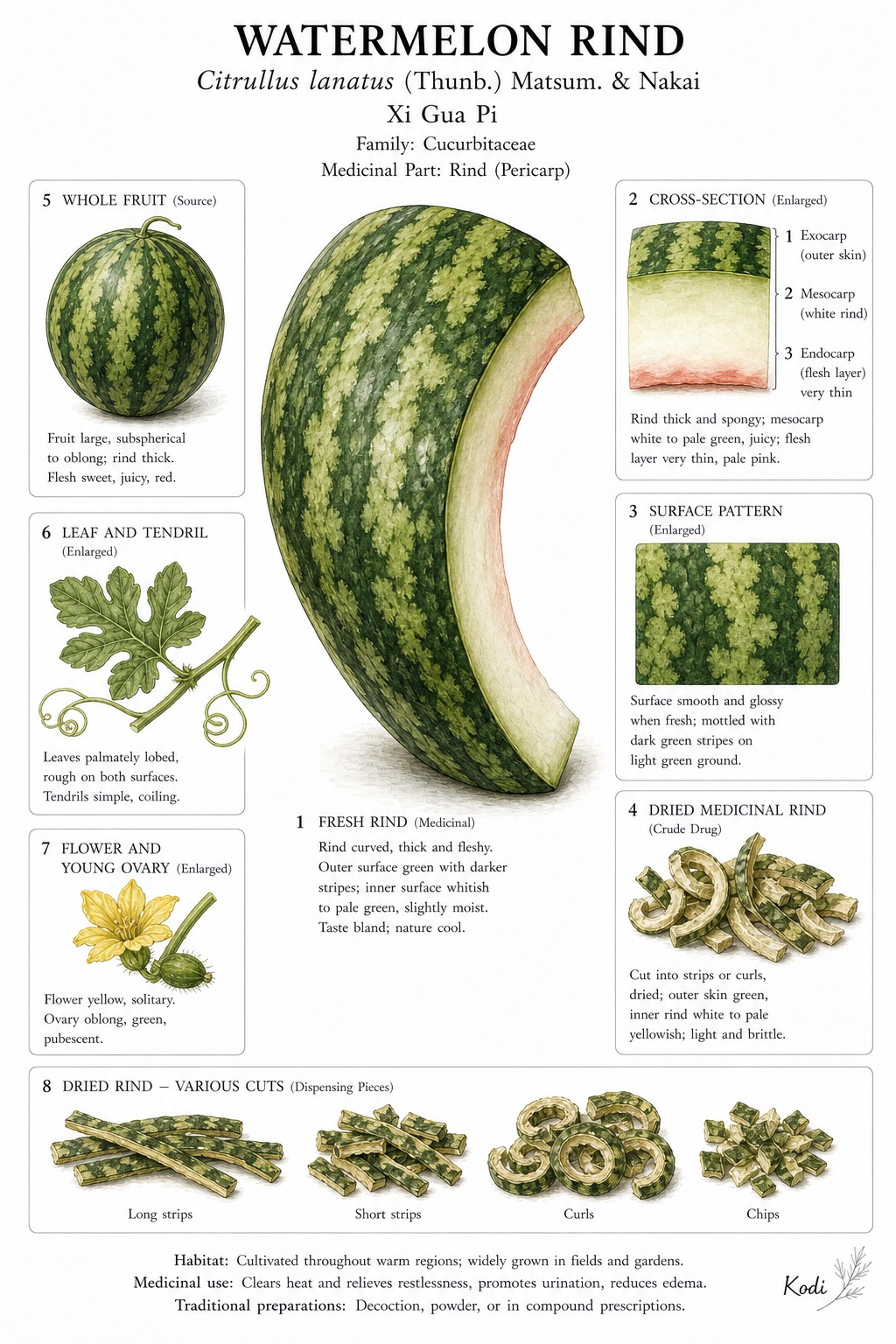
Known in TCM as Xi Gua Pi (西瓜皮), this sweet, cold herb enters the Heart, Stomach, and Bladder. Traditionally, it clears summer heat and relieves thirst ... Xi Gua Pi is a classic mild food-medicine for oppressive summer heat with irritability and fluid loss, most often applied for edema, fever, and urolithiasis. Modern research has identified Polyphenols among its active constituents.
Part used: Outer peel
Also Known As
Latin: Exocarpium Citrulli | Pinyin: Xi Gua Pi | Chinese: 西瓜皮
TCM Properties
- Taste
- sweet
- Temperature
- cold
- Channels
- Heart, Stomach, Bladder
Traditional Use
Primary Actions
- Clears summer heat and relieves thirst ... Xi Gua Pi is a classic mild food-medicine for oppressive summer heat with irritability and fluid loss.
- Promotes urination and reduces edema ... the rind is chosen when heat and fluid retention coexist, especially with scanty hot urination.
- Gently cools the Stomach and eases restlessness from heat ... the dried medicinal rind sits between food therapy and formal decoction use.
Secondary Actions
- This page stays rind-forward and should not drift into whole-watermelon fruit use or into `Xi Gua Shuang` style preparations made from the fruit.
- The formal medicinal material is often the trimmed white or green-white rind layer known as Xi Gua Cui Yi, which is slightly more focused than simply eating the fruit.
Classic Formulas
- Summer-heat pairings with He Ye or Xi Yang Shen ... classic use when thirst and heat overlap with fluid depletion.
- Mild edema and urinary-heat combinations with other cooling diuretics ... a gentle lower-burner support lane.
- Qing Luo Yin and related warm-disease food-medicine logic ... where the rind contributes cooling and fluid support without harshness.
Classical References
- Traditional Chinese medicine describes watermelon rind as sweet and cold, used to clear summer heat, relieve thirst, and promote urination.
- Its food-medicine character explains why it is often used more gently and in larger amounts than concentrated bitter medicinal herbs.
Modern Research
Active Compounds
- Polyphenols and flavonoids concentrated in the rind
- Citrulline-related and antioxidant nutrient fractions discussed in byproduct research
- Other extractable compounds studied for diuretic, antioxidant, and organ-protective effects
Studied Effects
- A 2026 review summarized nutritional composition, therapeutic potential, environmental impact, and commercial applications of watermelon rind, reflecting a growing modern effort to treat the rind as a bioactive byproduct rather than waste alone (PMID 40910198).
- A 2018 study reported anti-urolithiatic and diuretic activities of watermelon in vivo and in vitro, which is one of the clearer modern bridges to the rind's traditional urination-promoting use (PMID 29145146).
- A 2021 study found that watermelon rind ethanol extract showed hepato-renal protective effects against lead-impaired antioxidant defenses in male Wistar rats, supporting broader organ-protective interest in the rind extract (PMID 34841269).
PubMed References
- Watermelon Rind: Nutritional Composition, Therapeutic Potential, Environmental Impact, and Commercial Applications in Sustainable Industries. (2026)
- Evaluation of anti-urolithiatic and diuretic activities of watermelon (Citrullus lanatus) using in vivo and in vitro experiments. (2018)
- Watermelon rind ethanol extract exhibits hepato-renal protection against lead induced-impaired antioxidant defenses in male Wistar rats. (2021)
Safety & Interactions
Contraindications
- Marked Spleen-Stomach deficiency-cold with loose stool and no heat signs
Cautions
- Watermelon rind is gentle, but medicinal use is still more focused than ordinary fruit consumption and can aggravate cold weak digestion if overused.
- Prepared dried rind and fresh fruit are related but not identical in dose or application.
Conditions
- Edema Traditional ★★★☆☆ JSON
- Fever Traditional ★★☆☆☆ JSON
- Urolithiasis Research ★★☆☆☆ JSON
- Hypertension Traditional ★☆☆☆☆ JSON
Frequently Asked Questions
What is Watermelon Rind used for?
Watermelon Rind is traditionally used to Clears summer heat and relieves thirst ... Xi Gua Pi is a classic mild food-medicine for oppressive summer heat with irritability and fluid loss., Promotes urination and reduces edema ... the rind is chosen when heat and fluid retention coexist, especially with scanty hot urination., Gently cools the Stomach and eases restlessness from heat ... the dried medicinal rind sits between food therapy and formal decoction use.. Research has investigated its effects on: A 2026 review summarized nutritional composition, therapeutic potential, environmental impact, and commercial applications of watermelon rind, reflecting a growing modern effort to treat the rind as a bioactive byproduct rather than waste alone (PMID 40910198).; A 2018 study reported anti-urolithiatic and diuretic activities of watermelon in vivo and in vitro, which is one of the clearer modern bridges to the rind's traditional urination-promoting use (PMID 29145146)..
What are other names for Watermelon Rind?
Watermelon Rind is also known as Xi Gua Cui Yi, Watermelon peel, Citrullus lanatus rind. In TCM: 西瓜皮 (Xi Gua Pi); Exocarpium Citrulli.
Is Watermelon Rind safe during pregnancy?
The safety of Watermelon Rind during pregnancy has not been established. Consult a qualified healthcare provider before use.
What are the contraindications for Watermelon Rind?
Watermelon Rind should not be used in: Marked Spleen-Stomach deficiency-cold with loose stool and no heat signs. Consult a qualified healthcare provider before use.