Virgate Wormwood Herb
- Chinese
- 茵陈
- Pinyin
- Yin Chen
- Latin
- Herba Artemisiae Scopariae
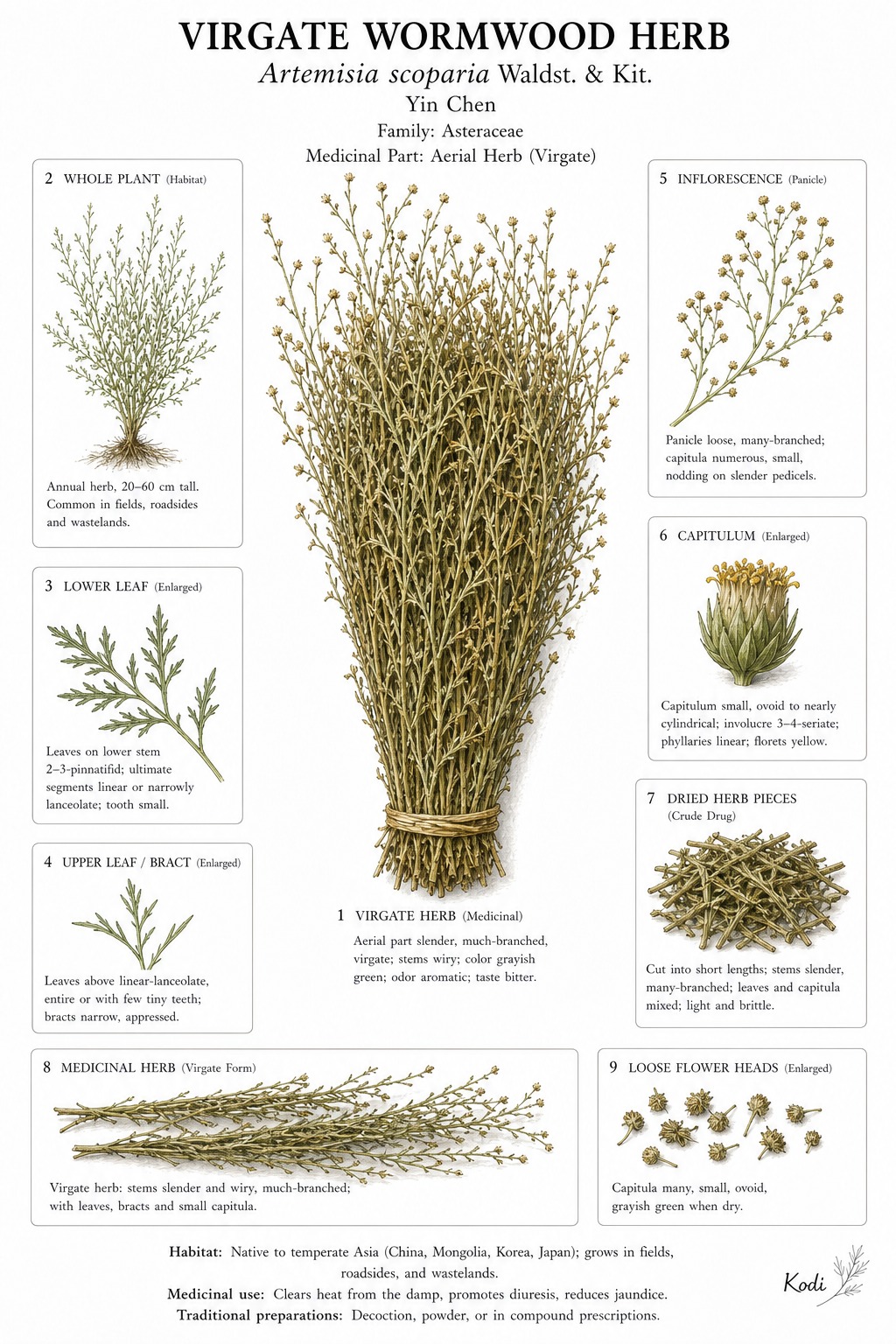
Known in TCM as Yin Chen (茵陈), this bitter and pungent, cool herb enters the Liver, Spleen, Gallbladder, and Stomach. Traditionally, it clears damp-heat and resolves jaundice ... virgate wormwood sits squarely in the classic Yin Chen lane for bright yellow damp-heat jaundice and dark scanty urine, most often applied for jaundice, hepatitis, and cholecystitis. Modern research has identified Scoparone among its active constituents.
Part used: Whole herb
Also Known As
Latin: Herba Artemisiae Scopariae | Pinyin: Yin Chen | Chinese: 茵陈
TCM Properties
- Taste
- bitter, pungent
- Temperature
- cool
- Channels
- Liver, Spleen, Gallbladder, Stomach
Traditional Use
Primary Actions
- Clears damp-heat and resolves jaundice ... virgate wormwood sits squarely in the classic Yin Chen lane for bright yellow damp-heat jaundice and dark scanty urine.
- Promotes urination and drains Liver-Gallbladder heat ... used when biliary heat, oppression, bitter taste, and urinary blockage travel together.
- Clears damp-heat from the skin and exterior tissues ... traditional use extends to itchy oozing lesions when heat and dampness lodge in the skin.
Secondary Actions
- This record foregrounds the `Artemisia scoparia` source-plant lane and should be read as a companion to the already-live Yin Chen and Yin Chen Hao synonym records, not as a brand-new therapeutic invention.
- Correct spring harvest and correct species identity matter because the broader Yin Chen drug group historically includes more than one Artemisia source.
Classic Formulas
- Yin Chen Hao Tang ... the defining jaundice formula where Yin Chen clears damp-heat through the Liver, Gallbladder, bowel, and urine together.
- Gan Lu Xiao Du Dan ... damp-warm and epidemic-damp formula in which Yin Chen vents damp-heat and reduces jaundice.
- Yin Chen-centered skin and damp-heat modifications ... practical use when the same damp-heat pattern reaches the exterior.
Classical References
- Classical Chinese medicine often uses the drug name Yin Chen across more than one Artemisia source, and this record keeps the source-plant focus on Artemisia scoparia without denying that broader drug-group history.
- The old seasonal warning that true Yin Chen is best in early spring remains relevant to this species-forward record as well.
Modern Research
Active Compounds
- Scoparone and related coumarins
- Caffeoylquinic acids including dicaffeoylquinic-acid derivatives
- Flavonoids and essential-oil fractions tied to anti-inflammatory and hepatoprotective research
Studied Effects
- A 2021 review summarized traditional uses, active constituents, and pharmacological effects of Artemisia scoparia and is the clearest modern overview for this source-plant lane (PMID 33636317).
- A 1994 study reported hepatoprotective effects of Artemisia scoparia against carbon tetrachloride injury, fitting the herb's longstanding hepatobiliary reputation (PMID 8041001).
- A 2020 mechanistic paper described anti-inflammatory activity of Artemisia scoparia across cultured adipocytes, macrophages, and pancreatic beta-cells, broadening the modern picture beyond jaundice alone (PMID 32741148).
PubMed References
- Artemisia scoparia: Traditional uses, active constituents and pharmacological effects. (2021)
- Hepatoprotective effects of artemisia scoparia against carbon tetrachloride: an environmental contaminant. (1994)
- Mechanisms of Artemisia scoparia's Anti-Inflammatory Activity in Cultured Adipocytes, Macrophages, and Pancreatic β-Cells. (2020)
Safety & Interactions
Contraindications
- Pronounced Spleen-Stomach deficiency-cold without damp-heat
- Long-term indiscriminate use in weak cold constitutions
Cautions
- This Artemisia scoparia page overlaps deliberately with the broader Yin Chen drug group, so clinical interpretation should respect that shared lineage rather than pretending the records represent unrelated herbs.
- Modern studies remain mostly preclinical or mechanistic and should not replace standard workup for jaundice or liver disease.
Conditions
Frequently Asked Questions
What is Virgate Wormwood Herb used for?
Virgate Wormwood Herb is traditionally used to Clears damp-heat and resolves jaundice ... virgate wormwood sits squarely in the classic Yin Chen lane for bright yellow damp-heat jaundice and dark scanty urine., Promotes urination and drains Liver-Gallbladder heat ... used when biliary heat, oppression, bitter taste, and urinary blockage travel together., Clears damp-heat from the skin and exterior tissues ... traditional use extends to itchy oozing lesions when heat and dampness lodge in the skin.. Research has investigated its effects on: A 2021 review summarized traditional uses, active constituents, and pharmacological effects of Artemisia scoparia and is the clearest modern overview for this source-plant lane (PMID 33636317).; A 1994 study reported hepatoprotective effects of Artemisia scoparia against carbon tetrachloride injury, fitting the herb's longstanding hepatobiliary reputation (PMID 8041001)..
What are other names for Virgate Wormwood Herb?
Virgate Wormwood Herb is also known as Artemisia scoparia herb, Scoparia wormwood, Yin Chen herb. In TCM: 茵陈 (Yin Chen); Herba Artemisiae Scopariae.
Is Virgate Wormwood Herb safe during pregnancy?
The safety of Virgate Wormwood Herb during pregnancy has not been established. Consult a qualified healthcare provider before use.
What are the contraindications for Virgate Wormwood Herb?
Virgate Wormwood Herb should not be used in: Pronounced Spleen-Stomach deficiency-cold without damp-heat; Long-term indiscriminate use in weak cold constitutions. Consult a qualified healthcare provider before use.