Villous Amomum Fruit (Xanthioides)
- Chinese
- 缩砂仁
- Pinyin
- Suo Sha Ren
- Latin
- Fructus Amomi
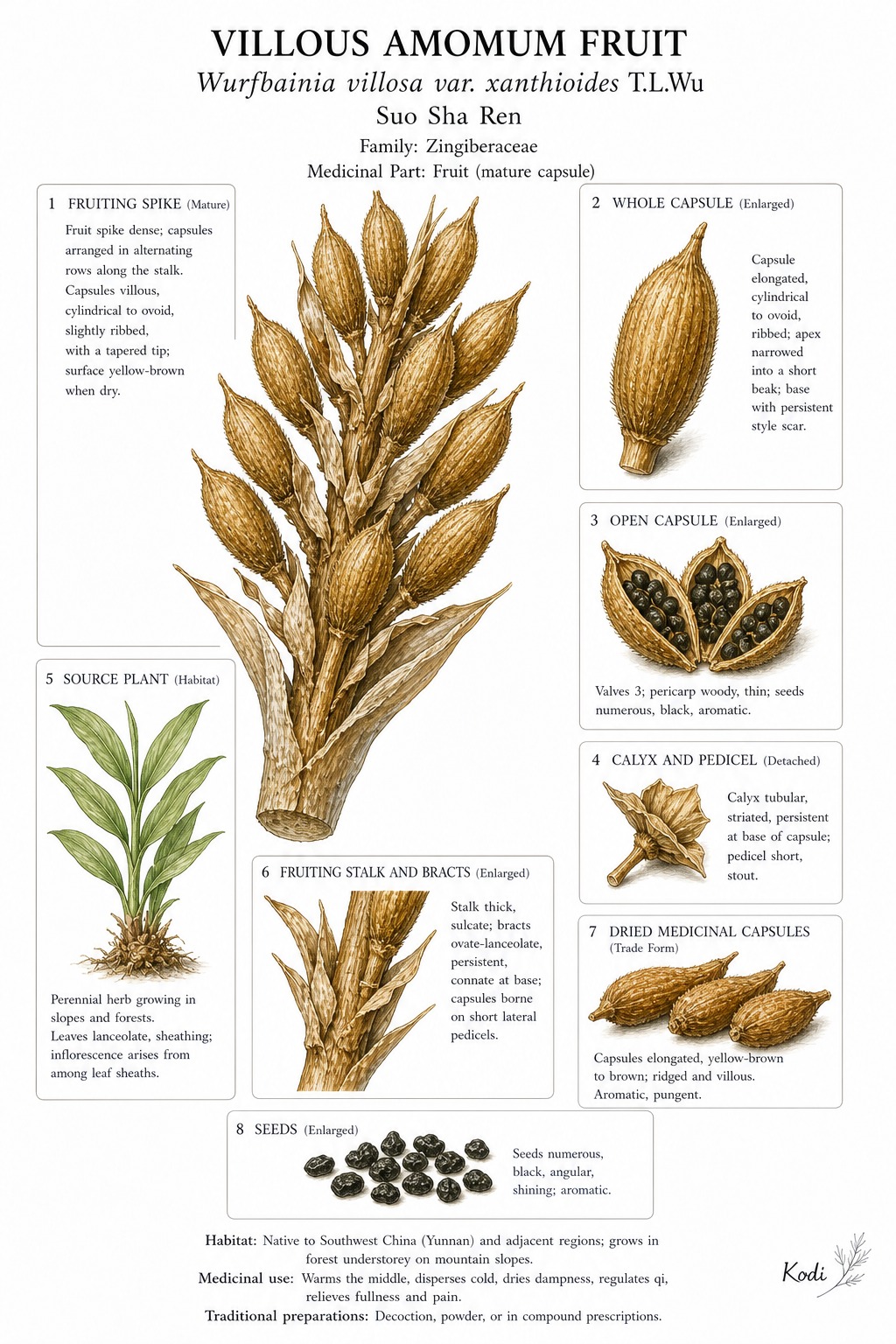
Known in TCM as Suo Sha Ren (缩砂仁), this pungent, warm herb enters the Spleen, Stomach, and Kidney. Traditionally, it transforms dampness and moves qi ... Suo Sha Ren is used for poor appetite, fullness, nausea, and middle-burner stagnation with cold-damp features, most often applied for poor appetite, abdominal distension, and diarrhea. Modern research has identified Volatile-oil among its active constituents.
Part used: Fruit
Also Known As
Latin: Fructus Amomi | Pinyin: Suo Sha Ren | Chinese: 缩砂仁
TCM Properties
- Taste
- pungent
- Temperature
- warm
- Channels
- Spleen, Stomach, Kidney
Traditional Use
Primary Actions
- Transforms dampness and moves qi ... Suo Sha Ren is used for poor appetite, fullness, nausea, and middle-burner stagnation with cold-damp features.
- Warms the middle and checks diarrhea ... its aromatic warming action is valued when weak digestive transformation leads to loose stool and abdominal discomfort.
- Calms the fetus in digestive-constraint patterns ... traditional use overlaps strongly with Sha Ren, especially when pregnancy nausea and weak digestion coexist.
Secondary Actions
- This record intentionally preserves the more elongated `var. xanthioides` trade lane instead of collapsing it into the rounder `villous-amomum-fruit` record.
- The therapeutic profile overlaps heavily with Sha Ren, but morphology, volatile-oil profile, and sourcing identity still matter in trade and authentication.
Classic Formulas
- Digestive damp-obstruction combinations with Chen Pi, Bai Zhu, or Ban Xia ... the classic middle-burner lane.
- Pregnancy-support pairings with Bai Zhu and Zi Su Geng ... used when nausea and weak descent dominate.
- Cold-damp diarrhea formulas with warming aromatic fruits ... a practical abdominal-stagnation context.
Classical References
- Traditional lists generally group Suo Sha Ren with the broader Sha Ren function set ... moving qi, transforming dampness, warming the middle, stopping diarrhea, and calming the fetus.
- The point of keeping this record separate is source identity and trade morphology rather than inventing a completely different classical action set.
Modern Research
Active Compounds
- Volatile-oil terpenes that differ measurably from the rounded Sha Ren trade lane
- Aromatic and sesquiterpenoid fractions characterized in comparative chemistry studies
- Broader Amomum villosum-group metabolites discussed across review literature
Studied Effects
- A 2024 review of Amomum villosum provides the broad modern phytochemical and pharmacologic background most relevant to both Sha Ren trade lanes, including this one (PMID 39069030).
- A 2019 comparative GC-MS and chemometric study directly compared volatile oils of Amomum villosum Lour. and Amomum villosum Lour. var. xanthioides, making it one of the key species-distinction references for this page (PMID 31035329).
- A 2021 study reported that an ethyl acetate fraction of Amomum villosum var. xanthioides attenuated ER-stress-driven nonalcoholic steatohepatitis in preclinical work, showing that the xanthioides lane has its own emerging pharmacology beyond morphology alone (PMID 34201527).
PubMed References
- Amomum villosum Lour.: An insight into ethnopharmacological, phytochemical, and pharmacological overview. (2024)
- Comparison of Volatile Oil between the Fruits of Amomum villosum Lour. and Amomum villosum Lour. var. xanthioides T. L. Wu et Senjen Based on GC-MS and Chemometric Techniques. (2019)
- Ethyl Acetate Fraction of Amomum villosum var. xanthioides Attenuates Hepatic Endoplasmic Reticulum Stress-Induced Non-Alcoholic Steatohepatitis via Improvement of Antioxidant Capacities. (2021)
Safety & Interactions
Contraindications
- Yin deficiency with dry heat
- Heat-type vomiting without cold-damp obstruction
Cautions
- This page is separated for source and trade accuracy, but the clinical profile still overlaps heavily with Sha Ren and should not be exaggerated into a wholly different herb.
- Essential-oil products are not interchangeable with whole-fruit decoction or powder use.
Conditions
- Poor Appetite Traditional ★★★★☆ JSON
- Abdominal Distension Traditional ★★★☆☆ JSON
- Diarrhea Traditional ★★★☆☆ JSON
- Nausea Pregnancy Traditional ★★★☆☆ JSON
Frequently Asked Questions
What is Villous Amomum Fruit (Xanthioides) used for?
Villous Amomum Fruit (Xanthioides) is traditionally used to Transforms dampness and moves qi ... Suo Sha Ren is used for poor appetite, fullness, nausea, and middle-burner stagnation with cold-damp features., Warms the middle and checks diarrhea ... its aromatic warming action is valued when weak digestive transformation leads to loose stool and abdominal discomfort., Calms the fetus in digestive-constraint patterns ... traditional use overlaps strongly with Sha Ren, especially when pregnancy nausea and weak digestion coexist.. Research has investigated its effects on: A 2024 review of Amomum villosum provides the broad modern phytochemical and pharmacologic background most relevant to both Sha Ren trade lanes, including this one (PMID 39069030).; A 2019 comparative GC-MS and chemometric study directly compared volatile oils of Amomum villosum Lour. and Amomum villosum Lour. var. xanthioides, making it one of the key species-distinction references for this page (PMID 31035329)..
What are other names for Villous Amomum Fruit (Xanthioides)?
Villous Amomum Fruit (Xanthioides) is also known as Suo Sha Ren, Wurfbainia villosa var. xanthioides fruit, Amomum villosum var. xanthioides fruit. In TCM: 缩砂仁 (Suo Sha Ren); Fructus Amomi.
Is Villous Amomum Fruit (Xanthioides) safe during pregnancy?
The safety of Villous Amomum Fruit (Xanthioides) during pregnancy has not been established. Consult a qualified healthcare provider before use.
What are the contraindications for Villous Amomum Fruit (Xanthioides)?
Villous Amomum Fruit (Xanthioides) should not be used in: Yin deficiency with dry heat; Heat-type vomiting without cold-damp obstruction. Consult a qualified healthcare provider before use.