Villous Amomum Fruit
- Chinese
- 砂仁
- Pinyin
- Sha Ren
- Latin
- Fructus Amomi
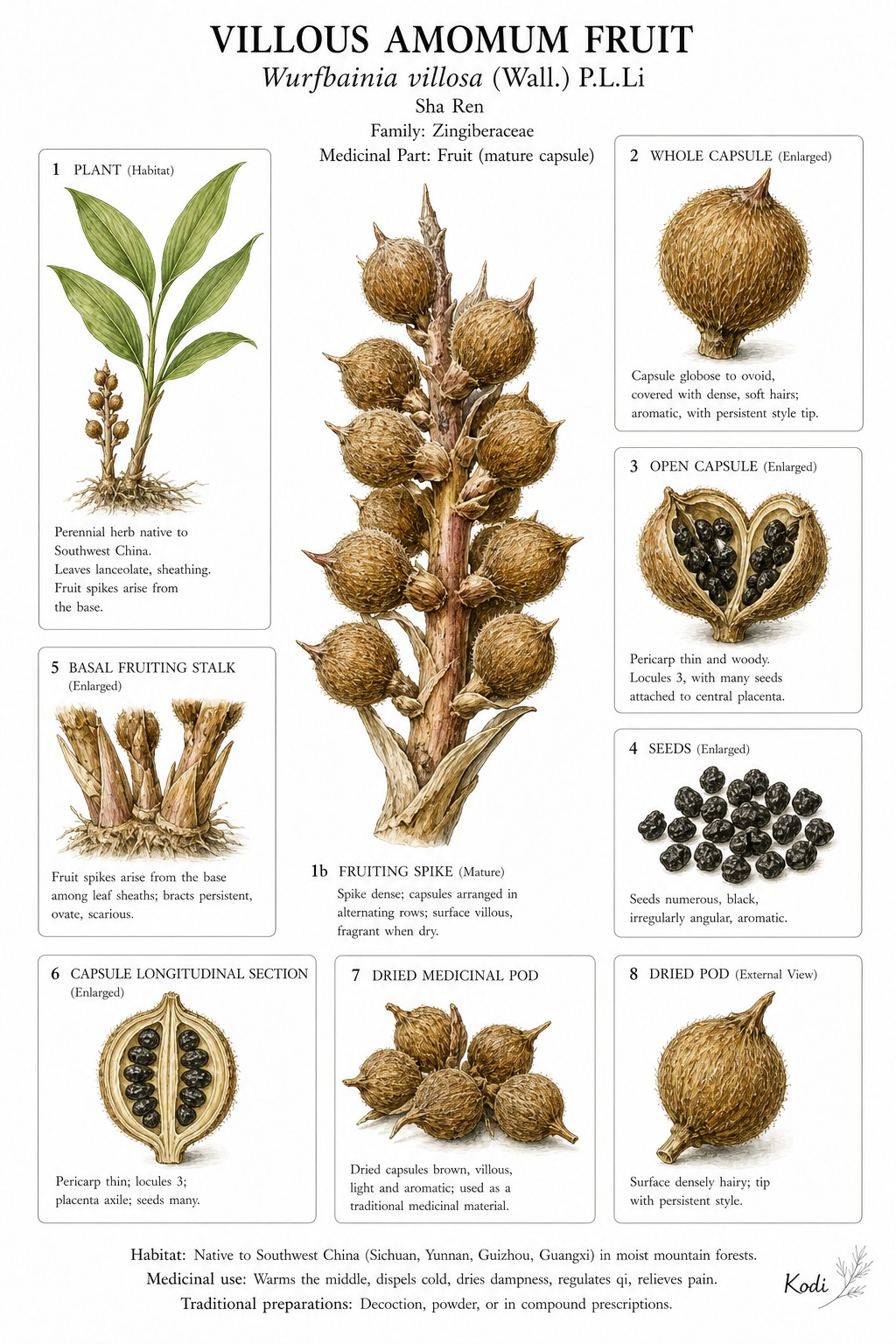
Known in TCM as Sha Ren (砂仁), this pungent, warm herb enters the Spleen, Stomach, and Kidney. Traditionally, it transforms dampness and moves qi in the middle burner ... Sha Ren is a classic aromatic fruit for poor appetite, abdominal fullness, nausea, and turbid damp obstruction, most often applied for poor appetite, nausea, and diarrhea. Modern research has identified Bornyl among its active constituents.
Part used: Fruit
Also Known As
Latin: Fructus Amomi | Pinyin: Sha Ren | Chinese: 砂仁
TCM Properties
- Taste
- pungent
- Temperature
- warm
- Channels
- Spleen, Stomach, Kidney
Traditional Use
Primary Actions
- Transforms dampness and moves qi in the middle burner ... Sha Ren is a classic aromatic fruit for poor appetite, abdominal fullness, nausea, and turbid damp obstruction.
- Warms the middle and checks diarrhea ... it is especially useful when loose stool and cramping arise from cold-damp or weak digestive transformation.
- Calms the fetus and relieves pregnancy nausea ... traditional use extends to restless fetus with poor digestion, nausea, or abdominal constraint.
Secondary Actions
- This page stays on the rounded `Wurfbainia villosa` capsule lane and should not be collapsed into the more elongated `villous-amomum-fruit-2` xanthioides record.
- Sha Ren is gentler and more pregnancy-compatible in classical use than hotter, rougher aromatic fruits such as Cao Guo.
Classic Formulas
- Xiang Sha Liu Jun Zi Tang ... a defining qi-moving and damp-transforming formula where Sha Ren protects and mobilizes the middle burner.
- Pregnancy-support pairings with Bai Zhu, Zi Su Geng, or Chen Pi ... a classic fetus-calming digestive lane.
- Diarrhea and cold-damp formulas with Bai Zhu, Gan Jiang, or other warming digestives ... when loose stool and poor appetite coexist.
Classical References
- Traditional herbology describes Sha Ren as pungent and warm, entering the Spleen, Stomach, and Kidney to transform dampness, promote qi movement, warm the middle, stop diarrhea, and calm the fetus.
- Because its aromatic fraction is valued, Sha Ren is often lightly crushed and added late in decoction rather than boiled aggressively from the start.
Modern Research
Active Compounds
- Bornyl acetate and other volatile-oil terpenes ... central to Sha Ren quality and pharmacology discussions
- Camphor, borneol-related aromatics, and other essential-oil constituents
- Flavonoid and small-molecule fractions discussed in broader Amomum villosum reviews
Studied Effects
- A 2024 overview summarized ethnopharmacology, phytochemistry, and pharmacology of Amomum villosum and is the best modern review anchor for the Sha Ren lane (PMID 39069030).
- A 2024 review on fruit essential oils from Amomum villosum and Amomum tsao-ko highlighted why the volatile fraction remains central to modern Sha Ren research (PMID 38463888).
- A 2020 placebo-controlled crossover study reported acute effects of Amomum villosum fruit extract on postprandial glycemia and insulin secretion in healthy subjects, showing that modern work is beginning to include human metabolic data (PMID 33100854).
PubMed References
- Amomum villosum Lour.: An insight into ethnopharmacological, phytochemical, and pharmacological overview. (2024)
- Health-promoting compounds in Amomum villosum Lour and Amomum tsao-ko: Fruit essential oil exhibiting great potential for human health. (2024)
- Acute effects of Amomum villosum Lour. fruit extract on postprandial glycemia and insulin secretion: A single-blind, placebo-controlled, crossover study in healthy subjects. (2020)
Safety & Interactions
Contraindications
- Yin deficiency with dry heat
- Heat-type vomiting without cold-damp obstruction
Cautions
- Whole fruits, crude powder, and concentrated essential-oil products are not interchangeable in strength or safety.
- Traditional fetus-calming use does not make all modern extracts automatically pregnancy-safe in all forms or doses.
Conditions
- Poor Appetite Traditional ★★★★☆ JSON
- Nausea Traditional ★★★★☆ JSON
- Diarrhea Traditional ★★★☆☆ JSON
- Nausea Pregnancy Traditional ★★★☆☆ JSON
Frequently Asked Questions
What is Villous Amomum Fruit used for?
Villous Amomum Fruit is traditionally used to Transforms dampness and moves qi in the middle burner ... Sha Ren is a classic aromatic fruit for poor appetite, abdominal fullness, nausea, and turbid damp obstruction., Warms the middle and checks diarrhea ... it is especially useful when loose stool and cramping arise from cold-damp or weak digestive transformation., Calms the fetus and relieves pregnancy nausea ... traditional use extends to restless fetus with poor digestion, nausea, or abdominal constraint.. Research has investigated its effects on: A 2024 overview summarized ethnopharmacology, phytochemistry, and pharmacology of Amomum villosum and is the best modern review anchor for the Sha Ren lane (PMID 39069030).; A 2024 review on fruit essential oils from Amomum villosum and Amomum tsao-ko highlighted why the volatile fraction remains central to modern Sha Ren research (PMID 38463888)..
What are other names for Villous Amomum Fruit?
Villous Amomum Fruit is also known as Sha Ren, Wurfbainia villosa fruit, Amomum villosum fruit. In TCM: 砂仁 (Sha Ren); Fructus Amomi.
Is Villous Amomum Fruit safe during pregnancy?
The safety of Villous Amomum Fruit during pregnancy has not been established. Consult a qualified healthcare provider before use.
What are the contraindications for Villous Amomum Fruit?
Villous Amomum Fruit should not be used in: Yin deficiency with dry heat; Heat-type vomiting without cold-damp obstruction. Consult a qualified healthcare provider before use.