Ussuri Fritillary Bulb
- Chinese
- 平贝母
- Pinyin
- Ping Bei Mu
- Latin
- Bulbus Fritillariae Ussuriensis
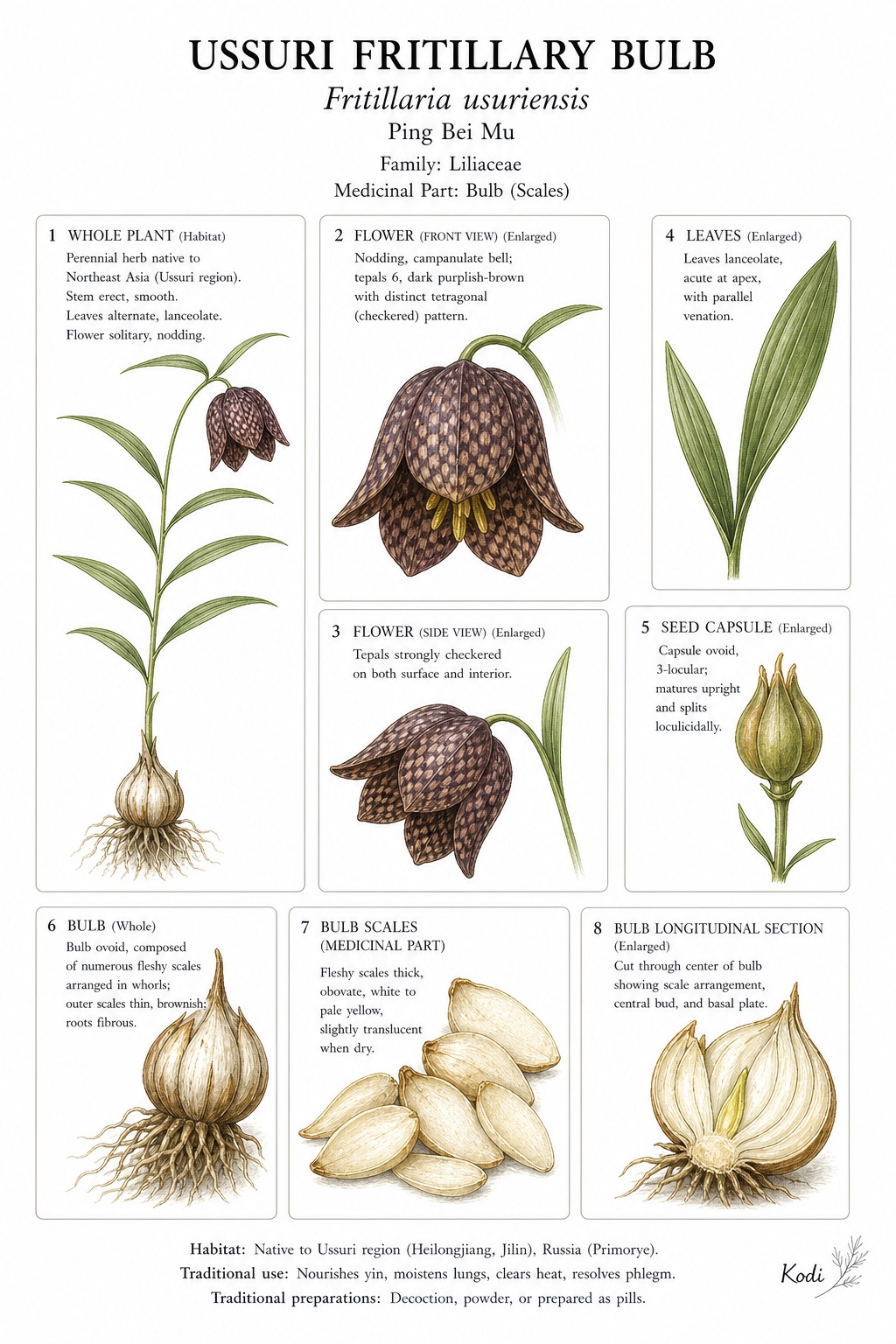
Known in TCM as Ping Bei Mu (平贝母), this bitter and sweet, slightly cold herb enters the Lung and Heart. Traditionally, it clears heat and nourishes the Lung ... Ping Bei Mu is used for dry cough, lingering heat, and throat or chest irritation with relatively little phlegm, most often applied for dry cough, productive cough, and hemoptysis. Modern research has identified Peimine among its active constituents.
Part used: Bulb
Also Known As
Latin: Bulbus Fritillariae Ussuriensis | Pinyin: Ping Bei Mu | Chinese: 平贝母
TCM Properties
- Taste
- bitter, sweet
- Temperature
- slightly cold
- Channels
- Lung, Heart
Traditional Use
Primary Actions
- Clears heat and nourishes the Lung ... Ping Bei Mu is used for dry cough, lingering heat, and throat or chest irritation with relatively little phlegm.
- Transforms phlegm and relieves cough ... it also covers cough with sticky sputum when some moistening is still needed rather than strong drying.
- Cools the Lung and checks blood-streaked sputum ... traditional use extends to consumptive or deficiency-heat cough patterns.
Secondary Actions
- This page stays on the distinct `Ping Bei Mu` lane of Fritillaria ussuriensis and should not be flattened into generic `Bei Mu` or confused with the already-live `Yi Bei Mu` record.
- Compared with harsher fritillary lanes, Ping Bei Mu sits in a gentler middle space ... cooling and phlegm-resolving, but still somewhat moistening.
Classic Formulas
- Dry-cough combinations with Sha Shen, Mai Men Dong, or Bai He ... a classic Ping Bei Mu direction.
- Heat-phlegm cough pairings with Pi Pa Ye or Gua Lou ... used when phlegm remains but the Lung also needs cooling.
- Blood-streaked sputum support with cooling moistening herbs ... a gentler fritillary-use context.
Classical References
- Traditional summaries describe Ping Bei Mu as bitter, sweet, and slightly cold, entering the Lung and Heart to clear heat, nourish the Lung, transform phlegm, and stop cough.
- Like other fritillary bulbs, it inherits the classic aconite incompatibility teaching and requires careful species identification in trade.
Modern Research
Active Compounds
- Peimine and peiminine ... major steroidal alkaloids associated with Ping Bei Mu pharmacology
- Sipeimine and related isosteroidal alkaloids
- Other total-alkaloid fractions relevant to pulmonary and inflammatory research
Studied Effects
- A 2026 comprehensive review of peimine summarized its botanical distribution, biosynthesis, pharmacological effects, and pharmacokinetics, providing a strong modern anchor for Ping Bei Mu chemistry and activity (PMID 41692275).
- A 2017 study found that peimine inhibited proinflammatory cytokine production through NF-κB and MAPK regulation in mast-cell models, supporting the anti-inflammatory side of fritillary use (PMID 28808406).
- A 2015 study reported antitumor properties of extracts and steroidal alkaloids from cultivated Bulbus Fritillariae ussuriensis, showing that species-specific modern work does exist beyond generic Fritillaria reviews (PMID 25880867).
PubMed References
- Peimine: A comprehensive review of its botanical distribution, biosynthesis, pharmacological effects and pharmacokinetics. (2026)
- Peimine Inhibits the Production of Proinflammatory Cytokines Through Regulation of the Phosphorylation of NF-κB and MAPKs in HMC-1 Cells. (2017)
- Evaluation of antitumor property of extracts and steroidal alkaloids from the cultivated Bulbus Fritillariae ussuriensis and preliminary investigation of its mechanism of action. (2015)
Safety & Interactions
Contraindications
- Cold-phlegm cough without heat or dryness
- Use of adulterated or misidentified fritillary bulbs
Cautions
- Correct species identification matters because fritillary bulbs are frequently mixed in trade.
- Preclinical alkaloid research should not be overstated into disease-specific clinical efficacy.
Drug Interactions
- Aconite-family medicinals such as Chuan Wu, Cao Wu, and Fu Zi ... classical incompatibility teaching advises against combining fritillary bulbs with aconites
Conditions
- Dry Cough Traditional ★★★★☆ JSON
- Productive Cough Traditional ★★★☆☆ JSON
- Hemoptysis Traditional ★★☆☆☆ JSON
- Phlegm Accumulation Traditional ★★★☆☆ JSON
Frequently Asked Questions
What is Ussuri Fritillary Bulb used for?
Ussuri Fritillary Bulb is traditionally used to Clears heat and nourishes the Lung ... Ping Bei Mu is used for dry cough, lingering heat, and throat or chest irritation with relatively little phlegm., Transforms phlegm and relieves cough ... it also covers cough with sticky sputum when some moistening is still needed rather than strong drying., Cools the Lung and checks blood-streaked sputum ... traditional use extends to consumptive or deficiency-heat cough patterns.. Research has investigated its effects on: A 2026 comprehensive review of peimine summarized its botanical distribution, biosynthesis, pharmacological effects, and pharmacokinetics, providing a strong modern anchor for Ping Bei Mu chemistry and activity (PMID 41692275).; A 2017 study found that peimine inhibited proinflammatory cytokine production through NF-κB and MAPK regulation in mast-cell models, supporting the anti-inflammatory side of fritillary use (PMID 28808406)..
What are other names for Ussuri Fritillary Bulb?
Ussuri Fritillary Bulb is also known as Ping Bei Mu, Fritillaria ussuriensis bulb, Ping Beimu. In TCM: 平贝母 (Ping Bei Mu); Bulbus Fritillariae Ussuriensis.
Is Ussuri Fritillary Bulb safe during pregnancy?
The safety of Ussuri Fritillary Bulb during pregnancy has not been established. Consult a qualified healthcare provider before use.
What are the contraindications for Ussuri Fritillary Bulb?
Ussuri Fritillary Bulb should not be used in: Cold-phlegm cough without heat or dryness; Use of adulterated or misidentified fritillary bulbs. Consult a qualified healthcare provider before use.
Does Ussuri Fritillary Bulb interact with any medications?
Ussuri Fritillary Bulb may interact with: Aconite-family medicinals such as Chuan Wu, Cao Wu, and Fu Zi ... classical incompatibility teaching advises against combining fritillary bulbs with aconites. Always inform your healthcare provider of any herbal supplements you are taking.