Uniflower Swisscentaury Root
- Chinese
- 漏芦
- Pinyin
- Lou Lu
- Latin
- Radix Rhapontici
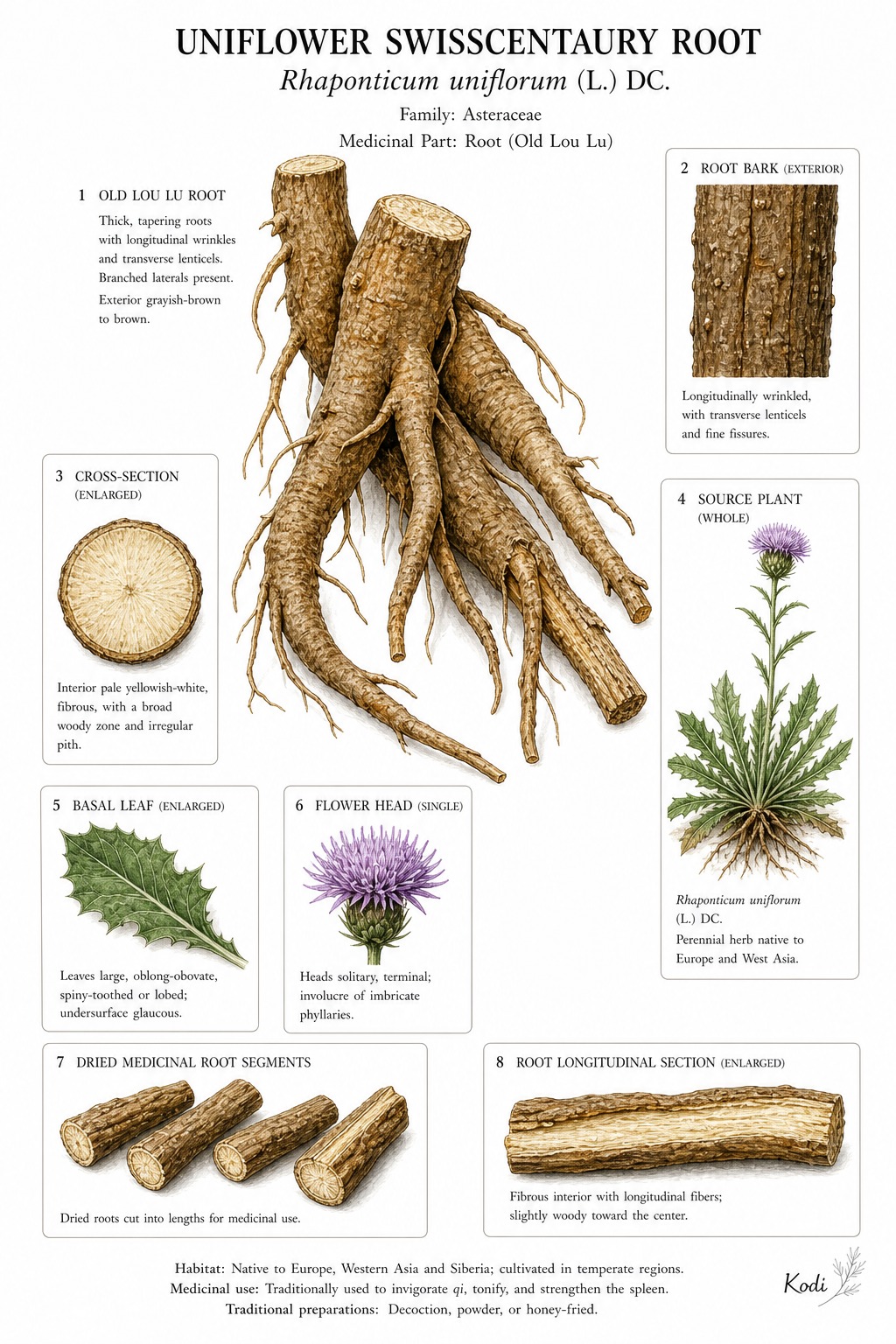
Known in TCM as Lou Lu (漏芦), this bitter, cold herb enters the Stomach. Traditionally, it clears heat and resolves toxin ... older Lou Lu records use the root for breast abscess, scrofulous swelling, and toxic sores with hardness or pain, most often applied for mastitis, insufficient lactation, and breast abscess. Modern research has identified Phytoecdysteroids among its active constituents.
Part used: Root
Also Known As
Latin: Radix Rhapontici | Pinyin: Lou Lu | Chinese: 漏芦
TCM Properties
- Taste
- bitter
- Temperature
- cold
- Channels
- Stomach
Traditional Use
Primary Actions
- Clears heat and resolves toxin ... older Lou Lu records use the root for breast abscess, scrofulous swelling, and toxic sores with hardness or pain.
- Promotes lactation and unblocks the breasts ... it is chosen when painful distention, swelling, or blocked flow prevents normal milk movement.
- Relaxes the sinews and opens the channels ... traditional use also includes wind-damp pain, muscular tightness, and contracture.
Secondary Actions
- This page intentionally preserves the older `Radix Rhapontici` Lou Lu lane and should not be collapsed into the already-live Echinops-based `globethistle-root` record.
- The overlap in name is historically real, but plant identity and sourcing matter because the modern pharmacopoeial Yu Zhou Lou Lu lane is not the same root.
Classic Formulas
- Lou Lu with Wang Bu Liu Xing and Tong Cao ... a classic blocked-lactation and painful breast-distention strategy.
- Lou Lu with Jin Yin Hua and Lian Qiao ... heat-toxin and swelling logic for breast abscess or scrofulous nodules.
- Lou Lu with Fang Feng or Qin Jiao ... channel-opening use for painful obstruction and stiffness.
Classical References
- Traditional summaries describe older Lou Lu as bitter and cold, entering the Stomach to clear heat, reduce swelling, promote lactation, and relax the channels.
- Import and trade confusion around Lou Lu is longstanding, which is why this Rhaponticum record should remain explicitly distinct from the Echinops source now used in modern pharmacopoeial practice.
Modern Research
Active Compounds
- Phytoecdysteroids and related terpenoid constituents highlighted in Rhaponticum reviews
- Flavonoids, sesquiterpenes, and phenolic fractions reported from Rhaponticum uniflorum
- Multi-component anti-inflammatory extracts studied under the Rhapontici Radix label
Studied Effects
- A 2022 comprehensive review summarized ethnopharmacological uses, metabolite diversity, and bioactivity of Rhaponticum uniflorum and is the clearest modern overview for the older Lou Lu lane (PMID 36421734).
- A 2024 study reported anti-inflammatory effects of Rhapontici Radix extract on mastitis in vivo and in vitro, which maps unusually well to the herb's traditional breast-swelling use (PMID 38942158).
- A 2022 study found that Rhaponticum uniflorum inflorescence extract ameliorated LPS-mediated acute lung injury through Nrf2/HO-1 signaling, supporting broader anti-inflammatory interest even outside the classic lactation lane (PMID 35738472).
PubMed References
- The Ethnopharmacological Uses, Metabolite Diversity, and Bioactivity of Rhaponticum uniflorum (Leuzea uniflora): A Comprehensive Review. (2022)
- In vivo and in vitro anti-inflammation of Rhapontici Radix extract on mastitis via TMEM59 and GPR161. (2024)
- Ethanol extracts of Rhaponticum uniflorum (L.) DC inflorescence ameliorate LPS-mediated acute lung injury by alleviating inflammatory responses via the Nrf2/HO-1 signaling pathway. (2022)
Safety & Interactions
Contraindications
- Pregnancy
- Qi deficiency or weak digestion without heat, toxin, or blocked lactation
- Flat non-inflamed ulcers without clear toxic swelling
Cautions
- Correct sourcing matters because older Rhaponticum Lou Lu and modern Echinops Lou Lu are not interchangeable simply because the pinyin is shared.
- Most modern evidence remains preclinical and should not replace evaluation of mastitis, breast abscess, or lactation failure.
Conditions
- Mastitis Traditional ★★★★☆ JSON
- Insufficient Lactation Traditional ★★★★☆ JSON
- Breast Abscess Traditional ★★★☆☆ JSON
- Joint Pain Traditional ★★☆☆☆ JSON
Frequently Asked Questions
What is Uniflower Swisscentaury Root used for?
Uniflower Swisscentaury Root is traditionally used to Clears heat and resolves toxin ... older Lou Lu records use the root for breast abscess, scrofulous swelling, and toxic sores with hardness or pain., Promotes lactation and unblocks the breasts ... it is chosen when painful distention, swelling, or blocked flow prevents normal milk movement., Relaxes the sinews and opens the channels ... traditional use also includes wind-damp pain, muscular tightness, and contracture.. Research has investigated its effects on: A 2022 comprehensive review summarized ethnopharmacological uses, metabolite diversity, and bioactivity of Rhaponticum uniflorum and is the clearest modern overview for the older Lou Lu lane (PMID 36421734).; A 2024 study reported anti-inflammatory effects of Rhapontici Radix extract on mastitis in vivo and in vitro, which maps unusually well to the herb's traditional breast-swelling use (PMID 38942158)..
What are other names for Uniflower Swisscentaury Root?
Uniflower Swisscentaury Root is also known as Lou Lu Root, Rhaponticum uniflorum root, Rhapontici. In TCM: 漏芦 (Lou Lu); Radix Rhapontici.
Is Uniflower Swisscentaury Root safe during pregnancy?
Uniflower Swisscentaury Root is not recommended during pregnancy.
What are the contraindications for Uniflower Swisscentaury Root?
Uniflower Swisscentaury Root should not be used in: Pregnancy; Qi deficiency or weak digestion without heat, toxin, or blocked lactation; Flat non-inflamed ulcers without clear toxic swelling. Consult a qualified healthcare provider before use.