Williams Elder Twig
- Chinese
- 接骨木
- Pinyin
- Jie Gu Mu
- Latin
- Ramulus Sambuci Williamsii
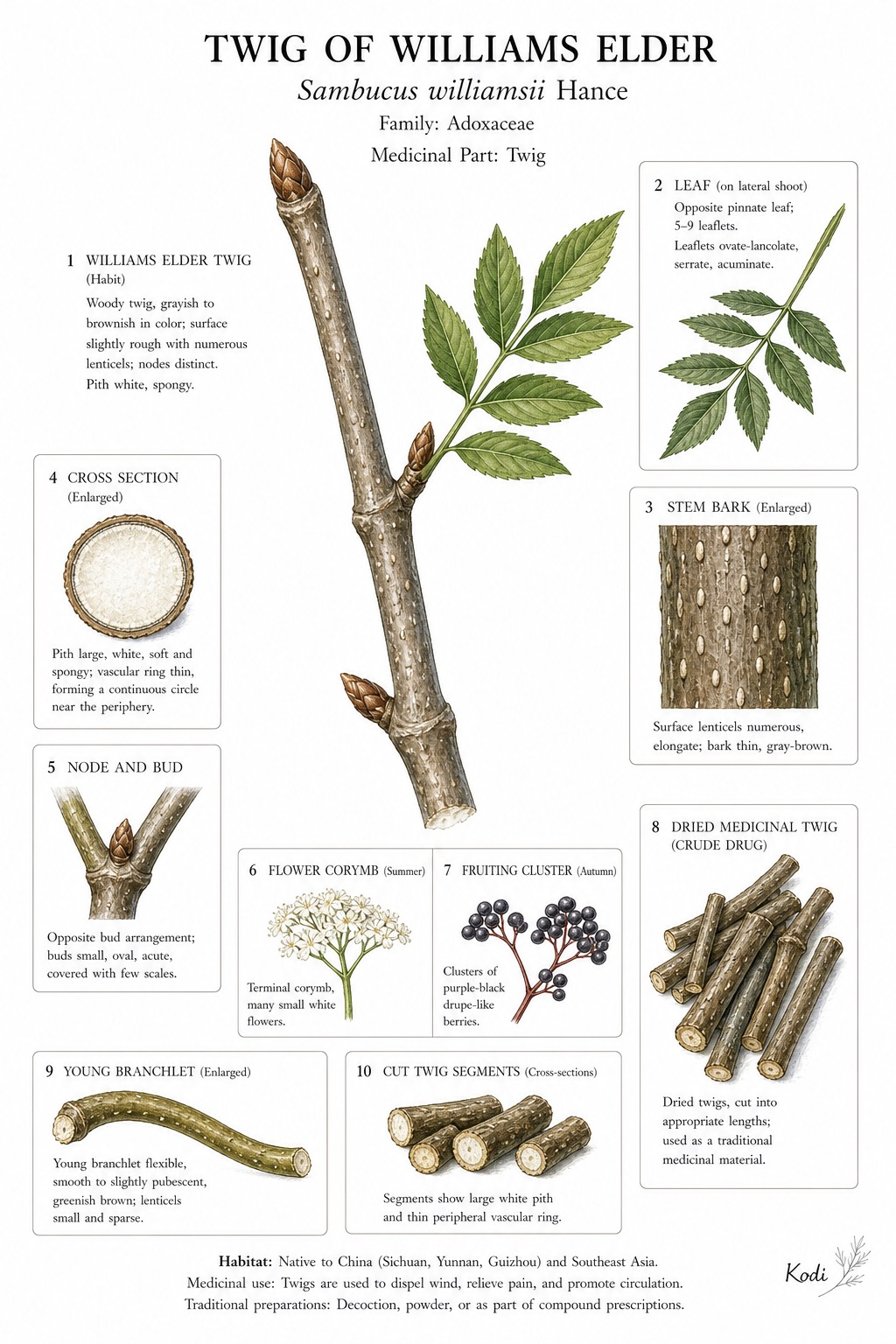
Known in TCM as Jie Gu Mu (接骨木), this sweet and bitter, neutral herb enters the Liver. Traditionally, it dispels wind-damp and opens the channels ... Jie Gu Mu is used for rheumatic soreness, painful obstruction, and stiffness affecting the limbs and lower back, most often applied for traumatic injury, joint pain, and low back pain. Modern research has identified Lignans among its active constituents.
Part used: Twig
Also Known As
Latin: Ramulus Sambuci Williamsii | Pinyin: Jie Gu Mu | Chinese: 接骨木
TCM Properties
- Taste
- sweet, bitter
- Temperature
- neutral
- Channels
- Liver
Traditional Use
Primary Actions
- Dispels wind-damp and opens the channels ... Jie Gu Mu is used for rheumatic soreness, painful obstruction, and stiffness affecting the limbs and lower back.
- Activates blood and relieves pain ... traditional use includes bruising, traumatic injury, and lingering pain after falls or overuse.
- Strengthens sinews and supports fracture-healing traditions ... the twig lane is closely associated with orthopedic folk use around bone and connective-tissue recovery.
Secondary Actions
- This page stays on the Chinese twig identity of Sambucus williamsii and should not be flattened into the broader Western elderberry fruit-and-syrup story.
- Trade confusion with other Sambucus parts matters because Chinese bone and trauma use centers on twig, bark, or closely related woody material rather than berry-only products.
Classic Formulas
- Fracture-healing and injury combinations with Xu Duan, Gu Sui Bu, or blood-moving herbs ... a classic orthopedic lane.
- Wind-damp pain pairings with Qin Jiao, Du Huo, or Hai Tong Pi ... practical channel-unblocking use.
- External washes or poultice-style applications for bruising and swelling ... part of its longstanding folk handling.
Classical References
- Traditional summaries describe Jie Gu Mu as sweet, bitter, and neutral, entering the Liver to dispel wind, open the channels, activate blood, and relieve pain.
- The name itself points toward bone-setting use, which helps explain the herb's persistent orthopedic identity in Chinese medicine.
Modern Research
Active Compounds
- Lignans ... the most discussed modern constituent group in Sambucus williamsii bone research
- Phenolic glycosides and related woody-part metabolites
- Other triterpenoid and polysaccharide fractions described in broader review literature
Studied Effects
- A 2024 comprehensive review summarized traditional uses, processing, phytochemistry, pharmacology, toxicology, and pharmacokinetics of Sambucus williamsii and is the best modern overview for Jie Gu Mu (PMID 38401662).
- A 2016 study reported that root bark of Sambucus williamsii promoted rat femoral fracture healing through the BMP-2/Runx2 pathway, matching the herb's longstanding orthopedic reputation (PMID 27178636).
- A 2016 phytochemistry paper isolated bioactive lignan constituents from the twigs of Sambucus williamsii, keeping the evidence relevant to this twig-centered record rather than only the root bark lane (PMID 26988298).
PubMed References
- Sambucus williamsii Hance: A comprehensive review of traditional uses, processing specifications, botany, phytochemistry, pharmacology, toxicology, and pharmacokinetics. (2024)
- Root bark of Sambucus Williamsii Hance promotes rat femoral fracture healing by the BMP-2/Runx2 signaling pathway. (2016)
- Bioactive lignan constituents from the twigs of Sambucus williamsii. (2016)
Safety & Interactions
Contraindications
- Pregnancy
- Patterns without trauma, stasis, or wind-damp obstruction
- Unsupervised use in patients with significant bleeding tendency
Cautions
- Part identity matters ... twig, bark, root bark, and berry preparations are not interchangeable.
- Most modern evidence remains preclinical and should not replace appropriate fracture, sprain, or rheumatology evaluation.
Conditions
- Traumatic Injury Traditional ★★★★☆ JSON
- Joint Pain Traditional ★★★☆☆ JSON
- Low Back Pain Traditional ★★★☆☆ JSON
- Rheumatism Traditional ★★★☆☆ JSON
Frequently Asked Questions
What is Williams Elder Twig used for?
Williams Elder Twig is traditionally used to Dispels wind-damp and opens the channels ... Jie Gu Mu is used for rheumatic soreness, painful obstruction, and stiffness affecting the limbs and lower back., Activates blood and relieves pain ... traditional use includes bruising, traumatic injury, and lingering pain after falls or overuse., Strengthens sinews and supports fracture-healing traditions ... the twig lane is closely associated with orthopedic folk use around bone and connective-tissue recovery.. Research has investigated its effects on: A 2024 comprehensive review summarized traditional uses, processing, phytochemistry, pharmacology, toxicology, and pharmacokinetics of Sambucus williamsii and is the best modern overview for Jie Gu Mu (PMID 38401662).; A 2016 study reported that root bark of Sambucus williamsii promoted rat femoral fracture healing through the BMP-2/Runx2 pathway, matching the herb's longstanding orthopedic reputation (PMID 27178636)..
What are other names for Williams Elder Twig?
Williams Elder Twig is also known as Jie Gu Mu, Sambucus williamsii twig, Williams elder. In TCM: 接骨木 (Jie Gu Mu); Ramulus Sambuci Williamsii.
Is Williams Elder Twig safe during pregnancy?
Williams Elder Twig is not recommended during pregnancy.
What are the contraindications for Williams Elder Twig?
Williams Elder Twig should not be used in: Pregnancy; Patterns without trauma, stasis, or wind-damp obstruction; Unsupervised use in patients with significant bleeding tendency. Consult a qualified healthcare provider before use.