Turpentine Oil
- Chinese
- 松节油
- Pinyin
- Song Jie You
- Latin
- Oleum Terebinthinae
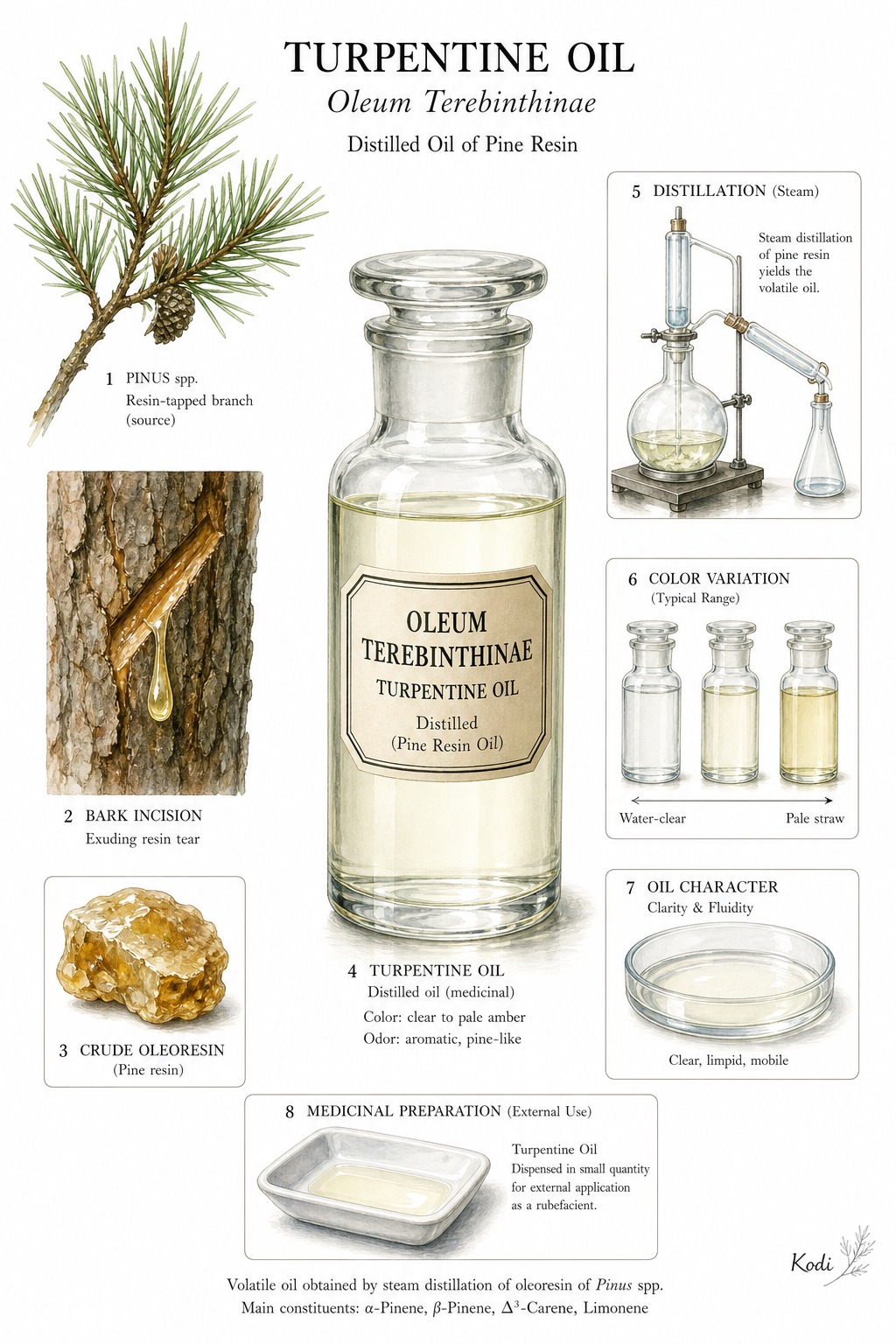
Known in TCM as Song Jie You (松节油), this pungent, warm herb enters the Liver and Lung. Traditionally, it promotes circulation and relieves pain in external-use traditions ... Song Jie You is preserved mainly as a warming topical oil for myalgia, arthralgia, sprain, and localized cold pain, most often applied for joint pain, rheumatism, and traumatic injury. Modern research has identified Alpha-pinene among its active constituents.
Part used: Oil
Also Known As
Latin: Oleum Terebinthinae | Pinyin: Song Jie You | Chinese: 松节油
TCM Properties
- Taste
- pungent
- Temperature
- warm
- Channels
- Liver, Lung
Traditional Use
Primary Actions
- Promotes circulation and relieves pain in external-use traditions ... Song Jie You is preserved mainly as a warming topical oil for myalgia, arthralgia, sprain, and localized cold pain.
- Stimulates local tissue and helps disperse swelling or congestion ... it appears in medicated-rub and liniment-style handling rather than in ordinary decoction practice.
- Historical respiratory or internal use exists in older medicine traditions, but the modern meaning of this page is overwhelmingly route-specific and safety-limited.
Secondary Actions
- This record must stay distilled-oil-forward and should not be flattened into raw pine resin, rosin, or hardware-store solvent use.
- Modern discussion of turpentine oil needs toxicity and route at the center ... any medicinal value sits beside a very real poison-control history.
Classic Formulas
- External analgesic and rubefacient oil traditions ... the main practical lane for Song Jie You in topical pain care.
- Historical chest-rub and aromatic respiratory preparations ... documentary context only, not a recommendation for casual internal use.
- Liniments for localized cold pain, sprain, and stiffness ... a more accurate traditional-modern bridge than treating the oil like a general ingestible herb.
Classical References
- Traditional single-herb listings preserve Song Jie You as a skin-stimulating warming oil used mainly for pain and external application.
- Its preparation state matters completely ... this is a distilled terpene-rich oil, not just any pine-derived material.
Modern Research
Active Compounds
- Alpha-pinene and beta-pinene ... principal monoterpenes in turpentine oil
- Other terpene fractions such as limonene and related volatile compounds ... central to both activity and irritant potential
- Oxidation products of turpentine terpenes ... relevant to respiratory and irritancy studies
Studied Effects
- A 2023 randomized placebo-controlled clinical trial evaluated turpentine ointment in bacterial skin infections, showing that topical turpentine-derived preparations still attract clinical interest in carefully formulated external use (PMID 36417842).
- A 1987 study examined oxidation products of oleum terebinthinae on guinea-pig airway smooth muscle, illustrating the older respiratory pharmacology literature surrounding the oil (PMID 3440034).
- A 1982 review on poisoning by spirits of turpentine or turpentine oil remains a reminder that toxicity is inseparable from the medicinal history of this substance (PMID 7114622).
PubMed References
- Turpentine Ointment in Bacterial Skin Infections: A Randomized, Placebo-Controlled, Double-Blind Clinical Trial. (2023)
- Activity of the oxidation products of oleum terebinthinae "Landes" on guinea pig airway smooth muscle in vivo and in vitro. (1987)
- [Poisoning by spirits of turpentine or turpentine oil. Review of its treatment apropos of a personal case]. (1982)
Safety & Interactions
Contraindications
- Pregnancy
- Any unsupervised internal use
- Application to large open wounds, highly sensitive skin, or major mucosal surfaces
- Chronic kidney disease or known terpene sensitivity
Cautions
- Turpentine oil is irritant, flammable, and potentially toxic ... medicinal discussion must not be confused with casual home or hardware-store use.
- Commercial paint or solvent products are not medicinal substitutes for authenticated Song Jie You preparations.
- Topical use can still provoke dermatitis or worsen inflamed tissue if used too strongly.
Conditions
- Joint Pain Traditional ★★☆☆☆ JSON
- Rheumatism Traditional ★★☆☆☆ JSON
- Traumatic Injury Traditional ★★☆☆☆ JSON
- Cough Traditional ★☆☆☆☆ JSON
Frequently Asked Questions
What is Turpentine Oil used for?
Turpentine Oil is traditionally used to Promotes circulation and relieves pain in external-use traditions ... Song Jie You is preserved mainly as a warming topical oil for myalgia, arthralgia, sprain, and localized cold pain., Stimulates local tissue and helps disperse swelling or congestion ... it appears in medicated-rub and liniment-style handling rather than in ordinary decoction practice., Historical respiratory or internal use exists in older medicine traditions, but the modern meaning of this page is overwhelmingly route-specific and safety-limited.. Research has investigated its effects on: A 2023 randomized placebo-controlled clinical trial evaluated turpentine ointment in bacterial skin infections, showing that topical turpentine-derived preparations still attract clinical interest in carefully formulated external use (PMID 36417842).; A 1987 study examined oxidation products of oleum terebinthinae on guinea-pig airway smooth muscle, illustrating the older respiratory pharmacology literature surrounding the oil (PMID 3440034)..
What are other names for Turpentine Oil?
Turpentine Oil is also known as Song Jie You, Oleum terebinthinae, Pine turpentine oil. In TCM: 松节油 (Song Jie You); Oleum Terebinthinae.
Is Turpentine Oil safe during pregnancy?
Turpentine Oil is not recommended during pregnancy.
What are the contraindications for Turpentine Oil?
Turpentine Oil should not be used in: Pregnancy; Any unsupervised internal use; Application to large open wounds, highly sensitive skin, or major mucosal surfaces; Chronic kidney disease or known terpene sensitivity. Consult a qualified healthcare provider before use.