Tuber Root of Common Turmeric
- Chinese
- 郁金
- Pinyin
- Yu Jin
- Latin
- Radix Curcumae
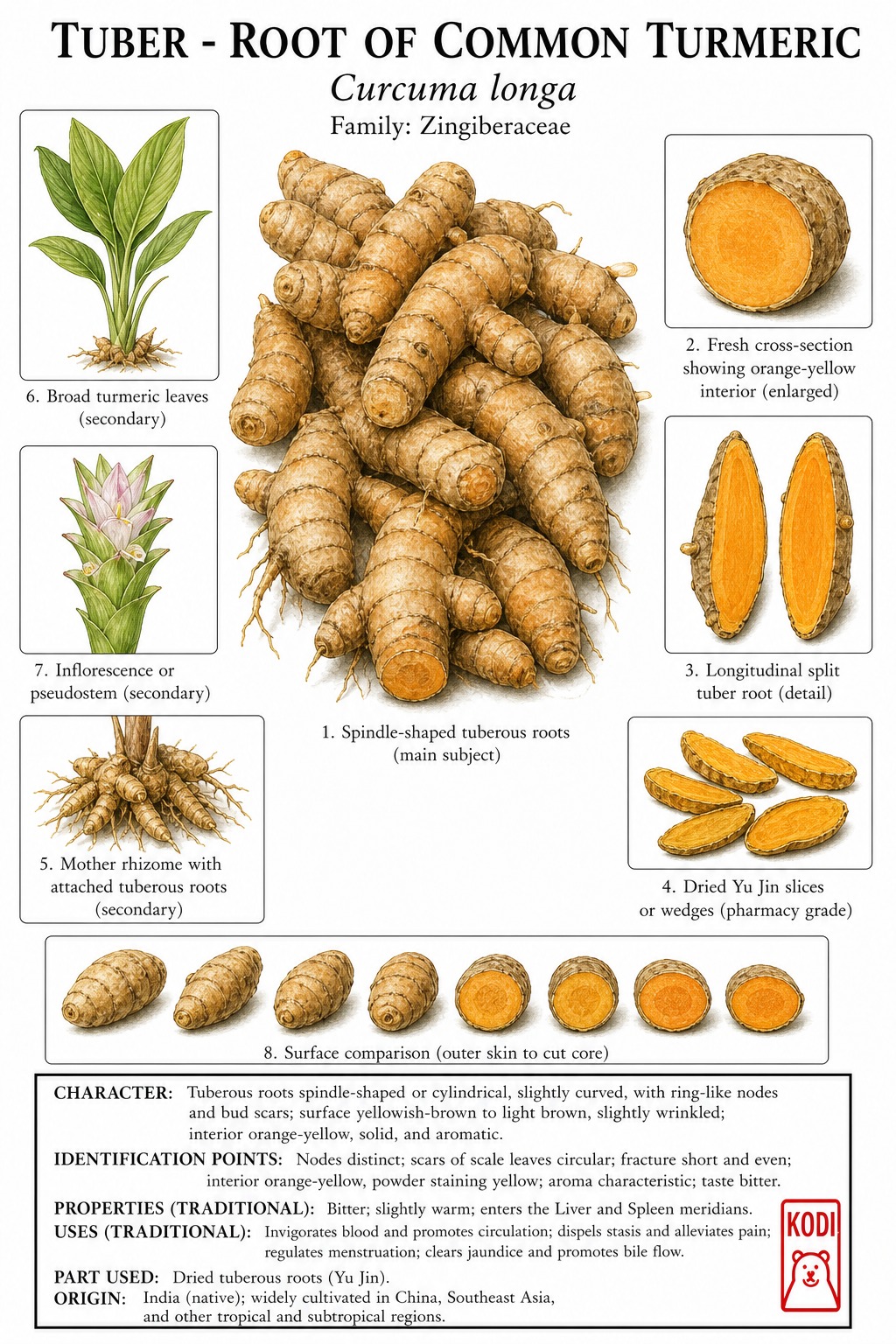
Known in TCM as Yu Jin (郁金), this acrid and bitter, cold herb enters the Heart, Liver, and Lung. Traditionally, it invigorates blood and moves qi ... Yu Jin is used for constrained pain in the chest, flanks, or menstruation when stasis and qi stagnation travel together, most often applied for jaundice, dysmenorrhea, and hypochondriac pain. Modern research has identified Curcuminoids among its active constituents.
Part used: Root
Also Known As
Latin: Radix Curcumae | Pinyin: Yu Jin | Chinese: 郁金
TCM Properties
- Taste
- acrid, bitter
- Temperature
- cold
- Channels
- Heart, Liver, Lung
Traditional Use
Primary Actions
- Invigorates blood and moves qi ... Yu Jin is used for constrained pain in the chest, flanks, or menstruation when stasis and qi stagnation travel together.
- Clears the Heart and opens the orifices ... classic use extends to agitation, clouded spirit, or phlegm-heat disturbing the Heart and gallbladder sphere.
- Cools blood and benefits jaundice ... the tuber root is also used when heat affects the blood or when damp-heat impairs bile flow and causes yellowing.
Secondary Actions
- This page must stay on the Yu Jin tuber-root lane and remain distinct from `rhizome-of-common-turmeric` / Jiang Huang and `rhizome-of-kwangsi-turmeric` / E Zhu ... same family, different medicinal direction.
- Modern Curcumae Radix literature spans more than one Curcuma source species, so the clinical identity is the medicinal tuber-root lane rather than culinary turmeric in general.
Classic Formulas
- Bai Jin Wan ... classical orifice-opening and phlegm-constraint strategy where Yu Jin helps clear constraint from the Heart-mind sphere.
- Blood-stasis and qi-stagnation pain combinations with Xiang Fu, Chuan Xiong, or Yan Hu Suo ... a practical traditional lane for chest-rib and menstrual pain.
- Jaundice pairings with Yin Chen and Zhi Zi ... classic logic when the clinical priority is clearing damp-heat and freeing constrained bile flow.
Classical References
- Traditional herbology gives Yu Jin the unusual combination of moving qi, moving blood, cooling blood, opening the orifices, and relieving jaundice.
- Its split from Jiang Huang and E Zhu is fundamental ... turmeric-family medicinals are related, but they are not therapeutically interchangeable.
Modern Research
Active Compounds
- Curcuminoids such as curcumin and related diarylheptanoids ... the best-known broad Curcuma constituents
- Volatile-oil sesquiterpenes ... major contributors to aromatic and pharmacologic profiling of Curcumae Radix
- Other species-sensitive Curcuma metabolites ... relevant because modern Yu Jin literature spans several botanical source plants
Studied Effects
- A 2022 review of Curcumae Radix summarized botany, traditional uses, phytochemistry, pharmacology, and toxicology and remains a core modern reference for Yu Jin (PMID 34633034).
- A 2024 review expanded that overview to include quality control, reinforcing that Curcumae Radix is now treated as a well-defined medicinal lane rather than as an informal turmeric byproduct (PMID 38462532).
- A 2021 review of Curcuma wenyujin highlighted how multiple Curcuma source species contribute to the Curcumae Radix evidence base, which matters when interpreting Yu Jin studies linked to but not limited to Curcuma longa (PMID 33309584).
PubMed References
- Curcumae Radix: a review of its botany, traditional uses, phytochemistry, pharmacology and toxicology. (2022)
- Curcumae Radix: A Review of Traditional Use, Phytochemistry, Pharmacology, Toxicology and Quality Control. (2024)
- Review of the traditional uses, phytochemistry, and pharmacology of Curcuma wenyujin Y. H. Chen et C. Ling. (2021)
Safety & Interactions
Contraindications
- Pregnancy without professional supervision
- Heavy active bleeding without a clear blood-stasis rationale
- Gallstone or bile-duct disease when concentrated extracts are being used
Cautions
- Yu Jin moves both qi and blood and should not be reduced to the idea of harmless kitchen turmeric.
- Concentrated Curcuma extracts are not equivalent to standard crude-herb dosing and may behave differently from decoction-style use.
Drug Interactions
- Anticoagulant or antiplatelet drugs ... possible additive bleeding risk
Conditions
- Jaundice Traditional ★★★☆☆ JSON
- Dysmenorrhea Traditional ★★★☆☆ JSON
- Hypochondriac Pain Traditional ★★★☆☆ JSON
- Depression Traditional ★★☆☆☆ JSON
Frequently Asked Questions
What is Tuber Root of Common Turmeric used for?
Tuber Root of Common Turmeric is traditionally used to Invigorates blood and moves qi ... Yu Jin is used for constrained pain in the chest, flanks, or menstruation when stasis and qi stagnation travel together., Clears the Heart and opens the orifices ... classic use extends to agitation, clouded spirit, or phlegm-heat disturbing the Heart and gallbladder sphere., Cools blood and benefits jaundice ... the tuber root is also used when heat affects the blood or when damp-heat impairs bile flow and causes yellowing.. Research has investigated its effects on: A 2022 review of Curcumae Radix summarized botany, traditional uses, phytochemistry, pharmacology, and toxicology and remains a core modern reference for Yu Jin (PMID 34633034).; A 2024 review expanded that overview to include quality control, reinforcing that Curcumae Radix is now treated as a well-defined medicinal lane rather than as an informal turmeric byproduct (PMID 38462532)..
What are other names for Tuber Root of Common Turmeric?
Tuber Root of Common Turmeric is also known as Yu Jin, Curcumae Radix, Turmeric tuber root. In TCM: 郁金 (Yu Jin); Radix Curcumae.
Is Tuber Root of Common Turmeric safe during pregnancy?
Tuber Root of Common Turmeric is not recommended during pregnancy.
What are the contraindications for Tuber Root of Common Turmeric?
Tuber Root of Common Turmeric should not be used in: Pregnancy without professional supervision; Heavy active bleeding without a clear blood-stasis rationale; Gallstone or bile-duct disease when concentrated extracts are being used. Consult a qualified healthcare provider before use.
Does Tuber Root of Common Turmeric interact with any medications?
Tuber Root of Common Turmeric may interact with: Anticoagulant or antiplatelet drugs ... possible additive bleeding risk. Always inform your healthcare provider of any herbal supplements you are taking.