Common Bletilla Tuber
- Chinese
- 白及
- Pinyin
- Bai Ji
- Latin
- Rhizoma Bletillae
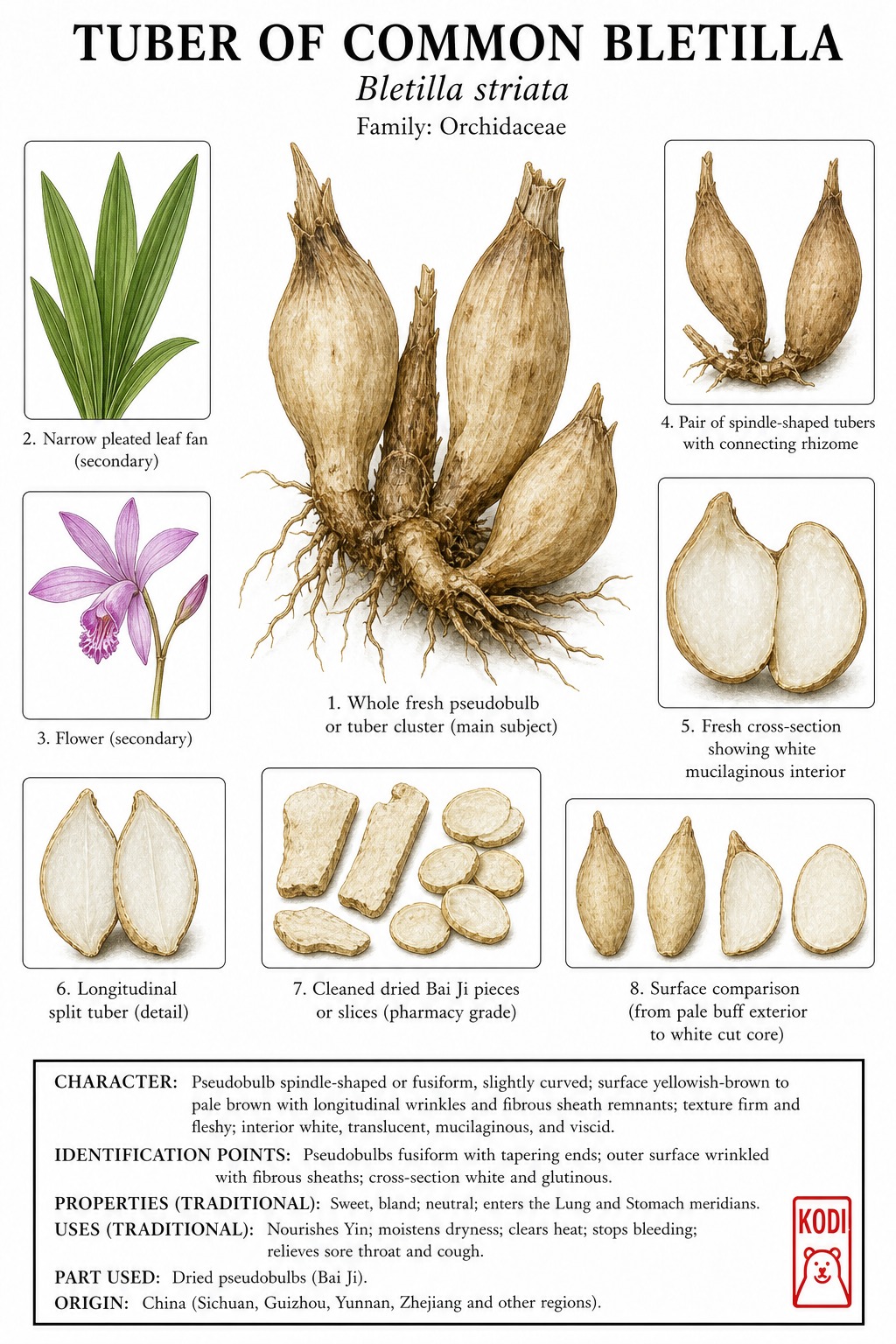
Known in TCM as Bai Ji (白及), this bitter and sweet and astringent, slightly cold herb enters the Lung, Liver, and Stomach. Traditionally, it stops bleeding ... Bai Ji is a classic astringent-hemostatic tuber for coughing blood, vomiting blood, traumatic bleeding, and ulcer-type bleeding, most often applied for hemoptysis, burns, and gastric ulcer. Modern research has identified Bletilla among its active constituents.
Part used: Rhizome
Also Known As
Latin: Rhizoma Bletillae | Pinyin: Bai Ji | Chinese: 白及
TCM Properties
- Taste
- bitter, sweet, astringent
- Temperature
- slightly cold
- Channels
- Lung, Liver, Stomach
Traditional Use
Primary Actions
- Stops bleeding ... Bai Ji is a classic astringent-hemostatic tuber for coughing blood, vomiting blood, traumatic bleeding, and ulcer-type bleeding.
- Reduces swelling and promotes tissue repair ... it is widely used topically for burns, sores, fissures, and damaged tissue that needs protection and healing.
- Generates flesh and helps close ulcers ... traditional use extends to chronic non-healing lesions and stomach or lung ulceration where repair is a major goal.
Secondary Actions
- This page should stay underground-part-forward on the medicinal Bai Ji tuber and not drift into ornamental orchid content.
- Bai Ji is one of the clearer examples of a herb valued both internally for bleeding and externally for wound repair, which explains its persistent pharmacy importance.
Classic Formulas
- Hemostatic powder traditions with E Jiao, Ce Bai Ye, or blood-cooling herbs ... used when the treatment goal is to stop bleeding while protecting tissue.
- Topical Bai Ji powder or paste ... classic handling for burns, sores, and traumatic skin injury.
- Ulcer and tissue-repair pairings ... a practical lane when the astringent, protective, and flesh-generating aspects are all needed together.
Classical References
- Traditional herbology records Bai Ji as bitter, sweet, astringent, and slightly cold, with the core actions of stopping bleeding, reducing swelling, and promoting flesh regeneration.
- Its dual internal-external role is one of the herb's most stable classical features.
Modern Research
Active Compounds
- Bletilla striata polysaccharides ... the best-known bioactive fractions in wound-healing and hemostatic research
- Bibenzyl and phenanthrene-type compounds ... supporting constituents in phytochemical studies
- Phenolic and other small-molecule fractions ... discussed in broader pharmacology reviews
Studied Effects
- A 2025 review summarized ethnopharmacology, phytochemistry, pharmacological effects, and quality control of Bletilla striata and provides the clearest modern overview for Bai Ji (PMID 40645542).
- A 2026 study described an ultraelastic Bletilla striata polysaccharide hydrogel bandage for rapid sealing, hemostasis, and infection-resistant healing, closely matching the herb's classic wound-repair and bleeding-control lane (PMID 42229333).
- A second 2026 study developed a biomimetic asymmetric Bletilla striata polysaccharide hydrogel for infected wound treatment, showing how modern biomaterials research continues to build directly on Bai Ji's tissue-repair reputation (PMID 42214522).
PubMed References
- A comprehensive review of ethnopharmacology, phytochemistry, pharmacological effects, and quality control of Bletilla striata. (2025)
- Ultraelastic adaptive Bletilla striata polysaccharide hydrogel bandage for rapid sealing, hemostasis and infection-resistant healing. (2026)
- Biomimetic asymmetric Bletilla striata polysaccharide hydrogel with wet adhesion and antibacterial activity for active-passive treatment of infected wound. (2026)
Safety & Interactions
Contraindications
- Early-stage excess swelling without a tissue-repair or bleeding rationale
Cautions
- The strongest modern wound and hemostasis literature is still largely preclinical or biomaterials-focused rather than a direct substitute for emergency care.
- Astringent tissue-protective herbs can be poorly matched to lesions that still require active drainage or strong pathogen-clearing treatment.
Conditions
- Hemoptysis Traditional ★★★☆☆ JSON
- Burns Traditional ★★★☆☆ JSON
- Gastric Ulcer Traditional ★★☆☆☆ JSON
- Traumatic Injury Traditional ★★☆☆☆ JSON
Frequently Asked Questions
What is Common Bletilla Tuber used for?
Common Bletilla Tuber is traditionally used to Stops bleeding ... Bai Ji is a classic astringent-hemostatic tuber for coughing blood, vomiting blood, traumatic bleeding, and ulcer-type bleeding., Reduces swelling and promotes tissue repair ... it is widely used topically for burns, sores, fissures, and damaged tissue that needs protection and healing., Generates flesh and helps close ulcers ... traditional use extends to chronic non-healing lesions and stomach or lung ulceration where repair is a major goal.. Research has investigated its effects on: A 2025 review summarized ethnopharmacology, phytochemistry, pharmacological effects, and quality control of Bletilla striata and provides the clearest modern overview for Bai Ji (PMID 40645542).; A 2026 study described an ultraelastic Bletilla striata polysaccharide hydrogel bandage for rapid sealing, hemostasis, and infection-resistant healing, closely matching the herb's classic wound-repair and bleeding-control lane (PMID 42229333)..
What are other names for Common Bletilla Tuber?
Common Bletilla Tuber is also known as Bai Ji, Bletilla rhizome, Bletilla striata tuber. In TCM: 白及 (Bai Ji); Rhizoma Bletillae.
Is Common Bletilla Tuber safe during pregnancy?
The safety of Common Bletilla Tuber during pregnancy has not been established. Consult a qualified healthcare provider before use.
What are the contraindications for Common Bletilla Tuber?
Common Bletilla Tuber should not be used in: Early-stage excess swelling without a tissue-repair or bleeding rationale. Consult a qualified healthcare provider before use.