Tsaoko
- Chinese
- 草果
- Pinyin
- Cao Guo
- Latin
- Fructus Tsaoko
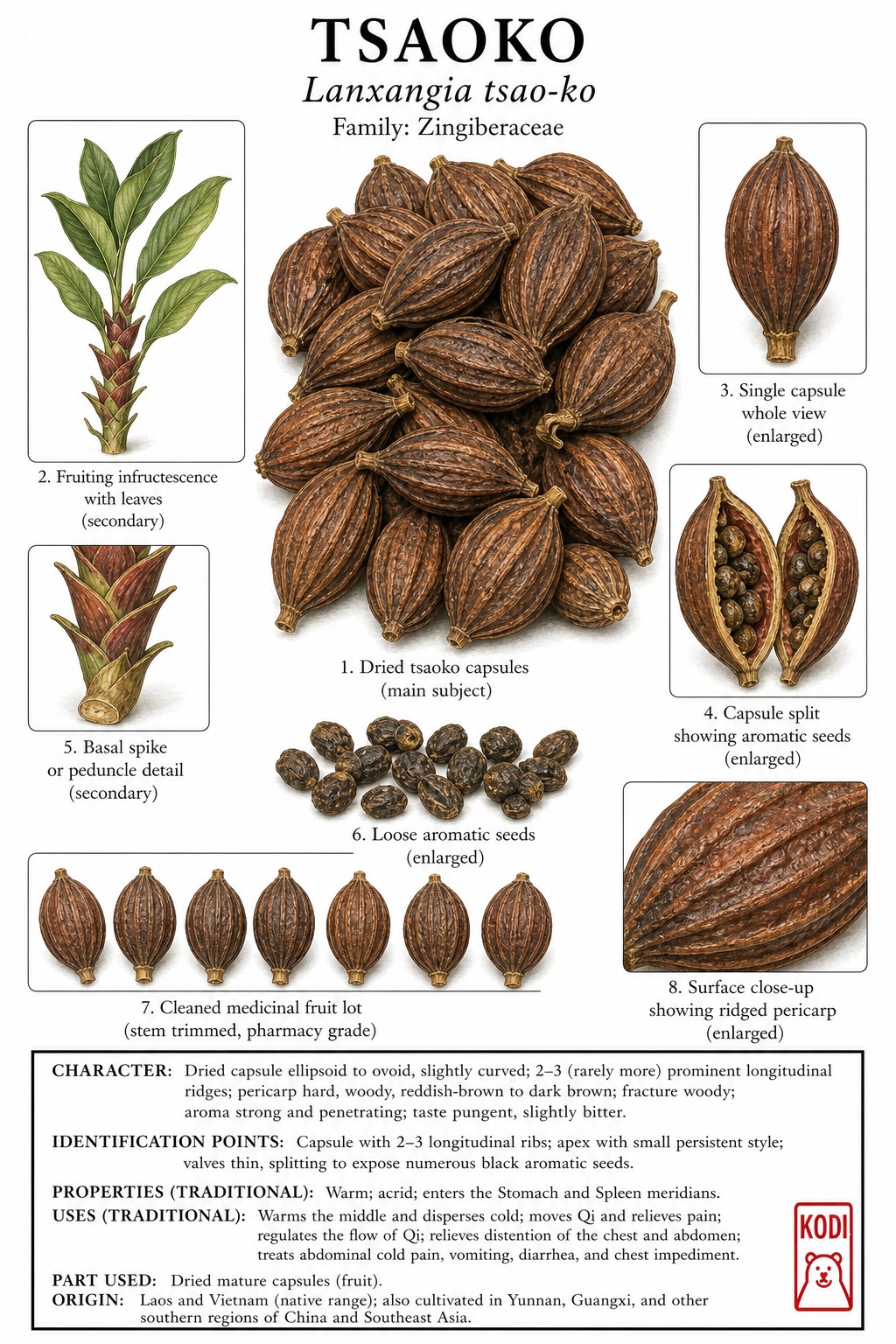
Known in TCM as Cao Guo (草果), this pungent, warm herb enters the Spleen and Stomach. Traditionally, it dries dampness and disperses cold in the middle burner ... Cao Guo is used for abdominal fullness, cold-damp stagnation, poor appetite, foul turbidity, and a heavy obstructed digestive center, most often applied for poor appetite, nausea, and abdominal distension. Modern research has identified 1,8-cineole among its active constituents.
Part used: Fruit
Also Known As
Latin: Fructus Tsaoko | Pinyin: Cao Guo | Chinese: 草果
TCM Properties
- Taste
- pungent
- Temperature
- warm
- Channels
- Spleen, Stomach
Traditional Use
Primary Actions
- Dries dampness and disperses cold in the middle burner ... Cao Guo is used for abdominal fullness, cold-damp stagnation, poor appetite, foul turbidity, and a heavy obstructed digestive center.
- Warms the Stomach and stops nausea or vomiting ... its strongly aromatic warming nature makes it useful when retching and heaviness arise from cold-damp obstruction rather than from heat.
- Cuts malaria and transforms miasmatic turbidity ... traditional use extends to alternating fever-chills and epidemic damp-filth patterns where aromatic penetration is prioritized.
Secondary Actions
- This page should stay on the large dried capsule of Cao Guo and remain distinct from Bai Dou Kou, Hong Dou Kou, and other cardamom-family trade lanes.
- Its function is stronger, hotter, and more damp-turbidity-focused than the gentler digestive aromatics often grouped nearby in commerce.
Classic Formulas
- Da Yuan Yin ... the signature epidemic damp-turbidity and malaria-context formula in which Cao Guo penetrates membrane-source obstruction.
- Cao Guo Yin and related malaria traditions ... classic use when foul dampness, obstruction, and alternating fever are central.
- Cold-damp vomiting combinations with Hou Po, Ban Xia, or Gan Jiang ... practical middle-burner strategy when heaviness, nausea, and distension travel together.
Classical References
- Traditional herbology places Cao Guo among the strong aromatic dampness-transforming herbs that dry cold turbidity and address miasmatic obstruction.
- Its malaria association is part of the older damp-filth tradition rather than a modern isolated antiplasmodial claim.
Modern Research
Active Compounds
- 1,8-cineole and other volatile-oil terpenes ... the dominant aromatic fraction discussed in Cao Guo research
- Terpenoid and ester-rich essential-oil constituents ... relevant to antibacterial and antioxidant interest
- Other spice-like aromatic small molecules that help define the fruit's warming and penetrative profile
Studied Effects
- A 2022 comprehensive review of Amomum tsao-ko covered traditional uses, botany, phytochemistry, and pharmacology and remains the best single modern overview for Cao Guo (PMID 35035319).
- A 2024 review of health-promoting compounds in Amomum villosum and Amomum tsao-ko focused on fruit essential oils and highlighted why the aromatic oil fraction is central to modern Cao Guo research (PMID 38463888).
- A 2025 study comparing essential oils from four plant fruits included Lanxangia tsao-ko and reported antibacterial, antioxidant, and cytotoxicity screening data for its essential oil, supporting continued interest in the fruit's volatile fraction (PMID 41135723).
PubMed References
- Amomum tsao-ko Crevost & Lemarié: a comprehensive review on traditional uses, botany, phytochemistry, and pharmacology. (2022)
- Health-promoting compounds in Amomum villosum Lour and Amomum tsao-ko: Fruit essential oil exhibiting great potential for human health. (2024)
- Analysis of chemical composition, antibacterial activity, antioxidant properties, and cytotoxicity of essential oils from four plant fruits. (2025)
Safety & Interactions
Contraindications
- Yin deficiency with dry heat
- Heat-type vomiting or stomach fire without cold-damp obstruction
Cautions
- Cao Guo is a hot aromatic fruit and can aggravate dryness or heat if used outside a cold-damp or turbidity pattern.
- Concentrated essential-oil exposure is not interchangeable with ordinary crude-fruit decoction use.
Conditions
- Poor Appetite Traditional ★★★☆☆ JSON
- Nausea Traditional ★★★☆☆ JSON
- Abdominal Distension Traditional ★★★☆☆ JSON
- Malaria Traditional ★★★☆☆ JSON
Frequently Asked Questions
What is Tsaoko used for?
Tsaoko is traditionally used to Dries dampness and disperses cold in the middle burner ... Cao Guo is used for abdominal fullness, cold-damp stagnation, poor appetite, foul turbidity, and a heavy obstructed digestive center., Warms the Stomach and stops nausea or vomiting ... its strongly aromatic warming nature makes it useful when retching and heaviness arise from cold-damp obstruction rather than from heat., Cuts malaria and transforms miasmatic turbidity ... traditional use extends to alternating fever-chills and epidemic damp-filth patterns where aromatic penetration is prioritized.. Research has investigated its effects on: A 2022 comprehensive review of Amomum tsao-ko covered traditional uses, botany, phytochemistry, and pharmacology and remains the best single modern overview for Cao Guo (PMID 35035319).; A 2024 review of health-promoting compounds in Amomum villosum and Amomum tsao-ko focused on fruit essential oils and highlighted why the aromatic oil fraction is central to modern Cao Guo research (PMID 38463888)..
What are other names for Tsaoko?
Tsaoko is also known as Cao Guo, Tsaoko fruit, Amomum tsao-ko fruit. In TCM: 草果 (Cao Guo); Fructus Tsaoko.
Is Tsaoko safe during pregnancy?
The safety of Tsaoko during pregnancy has not been established. Consult a qualified healthcare provider before use.
What are the contraindications for Tsaoko?
Tsaoko should not be used in: Yin deficiency with dry heat; Heat-type vomiting or stomach fire without cold-damp obstruction. Consult a qualified healthcare provider before use.