Trogopterus Dung
- Chinese
- 五灵脂
- Pinyin
- Wu Ling Zhi
- Latin
- Faeces Trogopterori
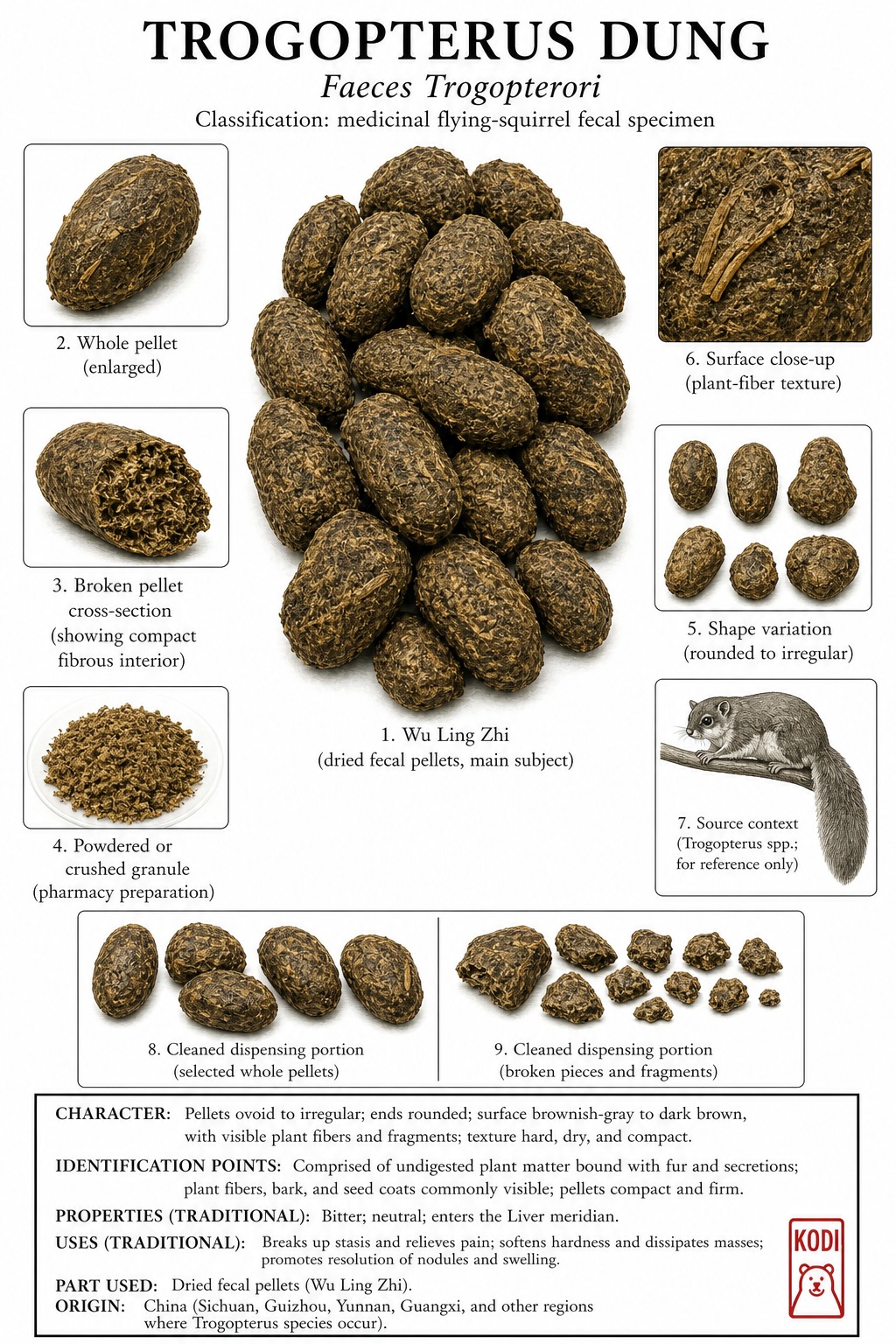
Known in TCM as Wu Ling Zhi (五灵脂), this bitter and sweet, warm herb enters the Liver. Traditionally, it invigorates blood and dispels stasis ... Wu Ling Zhi is a classic choice for fixed stasis pain, especially when menstrual or abdominal pain is sharp and localized, most often applied for dysmenorrhea, abdominal pain, and traumatic injury. Modern research has identified Poorly among its active constituents.
Part used: Faeces
Also Known As
Latin: Faeces Trogopterori | Pinyin: Wu Ling Zhi | Chinese: 五灵脂
TCM Properties
- Taste
- bitter, sweet
- Temperature
- warm
- Channels
- Liver
Traditional Use
Primary Actions
- Invigorates blood and dispels stasis ... Wu Ling Zhi is a classic choice for fixed stasis pain, especially when menstrual or abdominal pain is sharp and localized.
- Relieves pain ... traditional use extends to dysmenorrhea, postpartum abdominal pain, chest or epigastric discomfort, and traumatic injury where static blood is central.
- Transforms stasis without being a gentle tonic ... it belongs to the rougher pain-relieving blood-movement lane rather than to nourishing blood strategies.
Secondary Actions
- This page should stay specimen-forward on the dried pellet excreta of the medicinal source animal and remain clinical rather than sensational.
- Modern indexed literature on isolated Wu Ling Zhi is sparse, so this record relies more heavily than most on classical identity and on formula-level research context.
Classic Formulas
- Shi Xiao San ... the famous pairing of Wu Ling Zhi with Pu Huang for dysmenorrhea and stasis pain.
- Blood-stasis pain combinations with Yan Hu Suo or Dang Gui ... practical traditional strategy when movement and pain relief are needed together.
- Traumatic-injury powders and postpartum abdominal-pain use ... a longstanding extension of the herb's stasis-relieving profile.
Classical References
- Traditional herbology presents Wu Ling Zhi as a warm blood-stasis-relieving medicament used especially for fixed painful patterns.
- Older incompatibility teaching famously pairs Wu Ling Zhi against Ren Shen, a reminder that the herb's historical handling rules are part of its identity.
Modern Research
Active Compounds
- Poorly characterized resinous and lipid-like extractive fractions ... the chemistry literature is much thinner here than for ordinary plant medicinals
- Sterol and organic-acid related constituents ... discussed in older profiling work
- Formula-level composite bioactive mixtures ... more often studied through Shi Xiao San than through isolated Wu Ling Zhi
Studied Effects
- A 1998 review summarized the older research base on Faeces Trogopterori, which remains one of the few direct indexed overviews of the isolated medicinal material itself (PMID 11599395).
- A 2020 study found that Shi Xiao San, the classical Wu Ling Zhi plus Pu Huang formula, ameliorated adenomyosis development in a mouse model, offering modern support at the formula level for its traditional stasis-pain lane (PMID 32765781).
- A 2022 study on Shixiao San reported effects on inflammatory factors and pain in rats with endometriosis, again suggesting that most modern evidence around Wu Ling Zhi is currently mediated through its best-known classical pairing rather than through solo-herb trials (PMID 35182668).
PubMed References
Safety & Interactions
Contraindications
- Pregnancy without professional supervision
- Bleeding without blood-stasis rationale
Cautions
- Wu Ling Zhi is a blood-moving animal-derived excreta medicine and is not a casual household remedy.
- Because sourcing, hygiene, and authentication matter more than with many plant herbs, quality control deserves extra attention here.
Conditions
- Dysmenorrhea Traditional ★★★★☆ JSON
- Abdominal Pain Traditional ★★★☆☆ JSON
- Traumatic Injury Traditional ★★☆☆☆ JSON
- Blood Stasis Traditional ★★★☆☆ JSON
Frequently Asked Questions
What is Trogopterus Dung used for?
Trogopterus Dung is traditionally used to Invigorates blood and dispels stasis ... Wu Ling Zhi is a classic choice for fixed stasis pain, especially when menstrual or abdominal pain is sharp and localized., Relieves pain ... traditional use extends to dysmenorrhea, postpartum abdominal pain, chest or epigastric discomfort, and traumatic injury where static blood is central., Transforms stasis without being a gentle tonic ... it belongs to the rougher pain-relieving blood-movement lane rather than to nourishing blood strategies.. Research has investigated its effects on: A 1998 review summarized the older research base on Faeces Trogopterori, which remains one of the few direct indexed overviews of the isolated medicinal material itself (PMID 11599395).; A 2020 study found that Shi Xiao San, the classical Wu Ling Zhi plus Pu Huang formula, ameliorated adenomyosis development in a mouse model, offering modern support at the formula level for its traditional stasis-pain lane (PMID 32765781)..
What are other names for Trogopterus Dung?
Trogopterus Dung is also known as Wu Ling Zhi, Faeces Trogopterori, Flying squirrel feces. In TCM: 五灵脂 (Wu Ling Zhi); Faeces Trogopterori.
Is Trogopterus Dung safe during pregnancy?
Trogopterus Dung is not recommended during pregnancy.
What are the contraindications for Trogopterus Dung?
Trogopterus Dung should not be used in: Pregnancy without professional supervision; Bleeding without blood-stasis rationale. Consult a qualified healthcare provider before use.