Tokyo Violet Herb
- Chinese
- 紫花地丁
- Pinyin
- Zi Hua Di Ding
- Latin
- Herba Violae
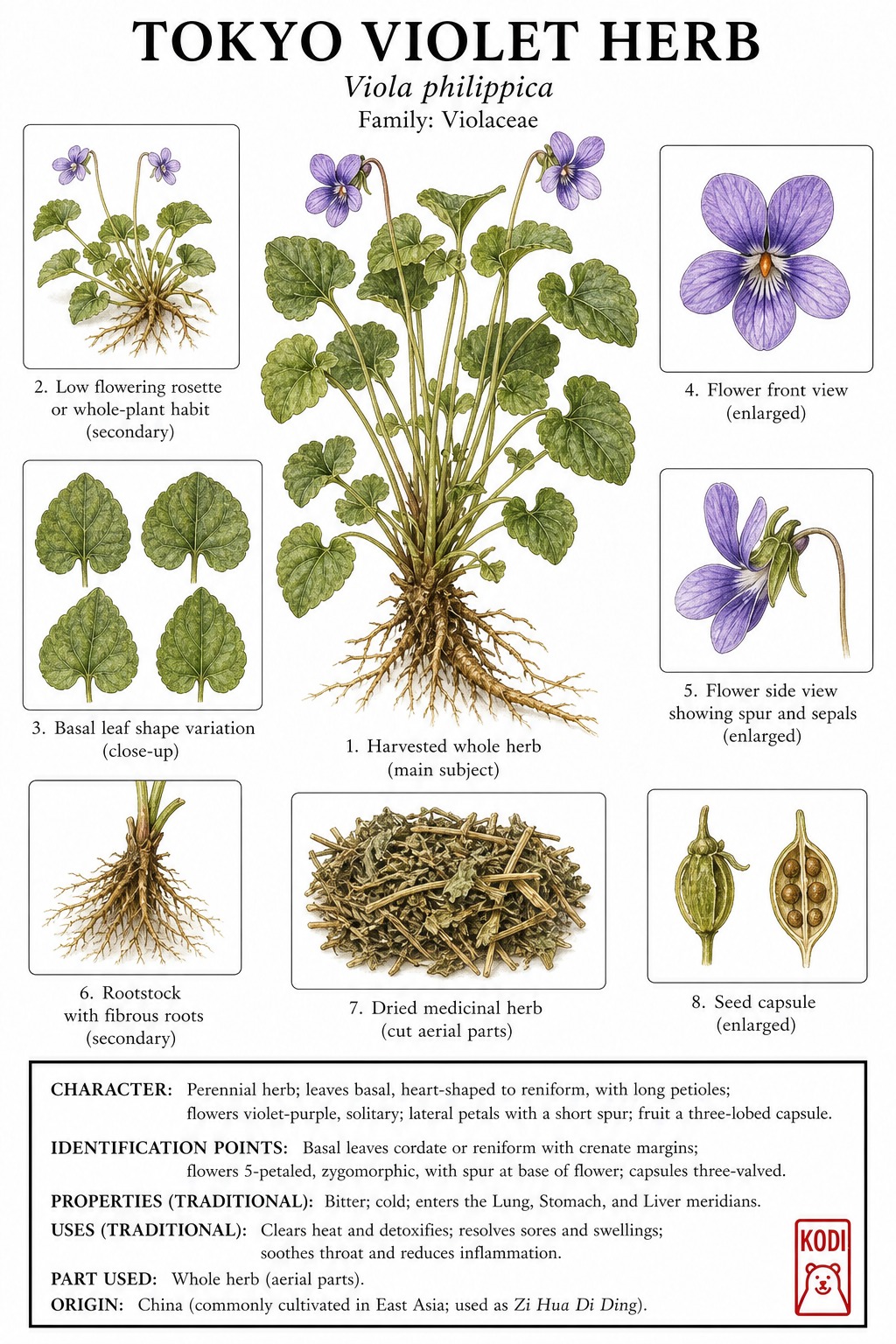
Known in TCM as Zi Hua Di Ding (紫花地丁), this bitter and pungent, cold herb enters the Heart and Liver. Traditionally, it clears heat and resolves fire toxin ... Zi Hua Di Ding is a core violet-herb lane for carbuncles, boils, cellulitic swelling, and other hot toxic lesions, most often applied for carbuncle, sore throat, and breast abscess. Modern research has identified Flavonoids among its active constituents.
Part used: Whole herb
Also Known As
Latin: Herba Violae | Pinyin: Zi Hua Di Ding | Chinese: 紫花地丁
TCM Properties
- Taste
- bitter, pungent
- Temperature
- cold
- Channels
- Heart, Liver
Traditional Use
Primary Actions
- Clears heat and resolves fire toxin ... Zi Hua Di Ding is a core violet-herb lane for carbuncles, boils, cellulitic swelling, and other hot toxic lesions.
- Reduces swelling and dissipates nodules ... traditional use extends to breast abscess, inflamed lymphatic swellings, and painful localized toxic accumulations.
- Cools blood and relieves inflamed throat or bite-related toxicity ... the herb is also used for sore throat and venomous bite presentations where heat, redness, and swelling are prominent.
Secondary Actions
- This page should stay distinct from the broader already-live `all-grass-of-tokyo-violet` / `Di Ding` lane ... Zi Hua Di Ding is the official violet-forward whole-herb presentation rather than a catchall substitute group.
- The local prompt and source literature both point to the harvested whole herb of Viola species, not just a decorative flower or garden ornamental reference.
Classic Formulas
- Wu Wei Xiao Du Yin ... classic fire-toxin formula where Zi Hua Di Ding helps address boils, carbuncles, and swollen painful lesions.
- Fresh-herb poultice traditions ... a longstanding external-use route for toxic swellings and bite-related inflammation.
- Heat-toxin combinations with Pu Gong Ying, Ye Ju Hua, or Tian Kui Zi ... common pairing logic when the clinical priority is to cool, detoxify, and reduce swelling.
Classical References
- Traditional herbology places Zi Hua Di Ding among the leading heat-toxin herbs for sores, swellings, breast abscess, and venomous bites.
- Official species-focused modern review literature strengthens the distinction between the violet herb lane and broader substitute-rich Di Ding naming.
Modern Research
Active Compounds
- Flavonoids and their glycosides ... major quantitative markers in Violae Herba quality-control work
- Coumarins ... repeatedly discussed in anti-inflammatory and antimicrobial research
- Cyclic peptides and alkaloids ... unusual constituent groups highlighted in newer Violae Herba reviews
Studied Effects
- A 2025 review of Violae Herba summarized traditional uses, phytochemistry, pharmacology, quality control, and clinical applications, confirming that the official Zi Hua Di Ding lane now has a much stronger modern review base than older substitute-rich Di Ding discussions (PMID 40188895).
- A second 2025 review focused on Viola yedoensis and its therapeutic efficacy, reinforcing the anti-inflammatory, antimicrobial, and antitumor interest surrounding the violet-herb group (PMID 40363729).
- A 2019 study found inhibitory antiviral activity from Viola philippica aqueous extracts against grouper iridovirus, illustrating the broader antimicrobial and antiviral direction of modern violet-herb research even when the exact disease models are not human clinical use (PMID 30893481).
PubMed References
- Violae Herba: A comprehensive review of the traditional uses, phytochemistry, pharmacology, quality control and clinical applications. (2025)
- A Comprehensive Review of the Phytochemistry and Therapeutic Efficacy of Viola yedoensis Makino. (2025)
- The inhibitory activities and antiviral mechanism of Viola philippica aqueous extracts against grouper iridovirus infection in vitro and in vivo. (2019)
Safety & Interactions
Contraindications
- Cold-type sores or weak digestion with marked deficiency cold
Cautions
- Its cold bitter direction can aggravate weak digestion if used repeatedly in patients without clear heat-toxin signs.
- As with many heat-clearing herbs, topical and internal use are chosen differently depending on whether the lesion is localized, suppurative, or systemic.
Conditions
- Carbuncle Traditional ★★★★☆ JSON
- Sore Throat Traditional ★★★☆☆ JSON
- Breast Abscess Traditional ★★★☆☆ JSON
- Snakebite Traditional ★★☆☆☆ JSON
Frequently Asked Questions
What is Tokyo Violet Herb used for?
Tokyo Violet Herb is traditionally used to Clears heat and resolves fire toxin ... Zi Hua Di Ding is a core violet-herb lane for carbuncles, boils, cellulitic swelling, and other hot toxic lesions., Reduces swelling and dissipates nodules ... traditional use extends to breast abscess, inflamed lymphatic swellings, and painful localized toxic accumulations., Cools blood and relieves inflamed throat or bite-related toxicity ... the herb is also used for sore throat and venomous bite presentations where heat, redness, and swelling are prominent.. Research has investigated its effects on: A 2025 review of Violae Herba summarized traditional uses, phytochemistry, pharmacology, quality control, and clinical applications, confirming that the official Zi Hua Di Ding lane now has a much stronger modern review base than older substitute-rich Di Ding discussions (PMID 40188895).; A second 2025 review focused on Viola yedoensis and its therapeutic efficacy, reinforcing the anti-inflammatory, antimicrobial, and antitumor interest surrounding the violet-herb group (PMID 40363729)..
What are other names for Tokyo Violet Herb?
Tokyo Violet Herb is also known as Zi Hua Di Ding, Violae Herba, Viola philippica herb. In TCM: 紫花地丁 (Zi Hua Di Ding); Herba Violae.
Is Tokyo Violet Herb safe during pregnancy?
The safety of Tokyo Violet Herb during pregnancy has not been established. Consult a qualified healthcare provider before use.
What are the contraindications for Tokyo Violet Herb?
Tokyo Violet Herb should not be used in: Cold-type sores or weak digestion with marked deficiency cold. Consult a qualified healthcare provider before use.