Tokay Gecko
- Chinese
- 蛤蚜
- Pinyin
- Ge Jie
- Latin
- Gecko
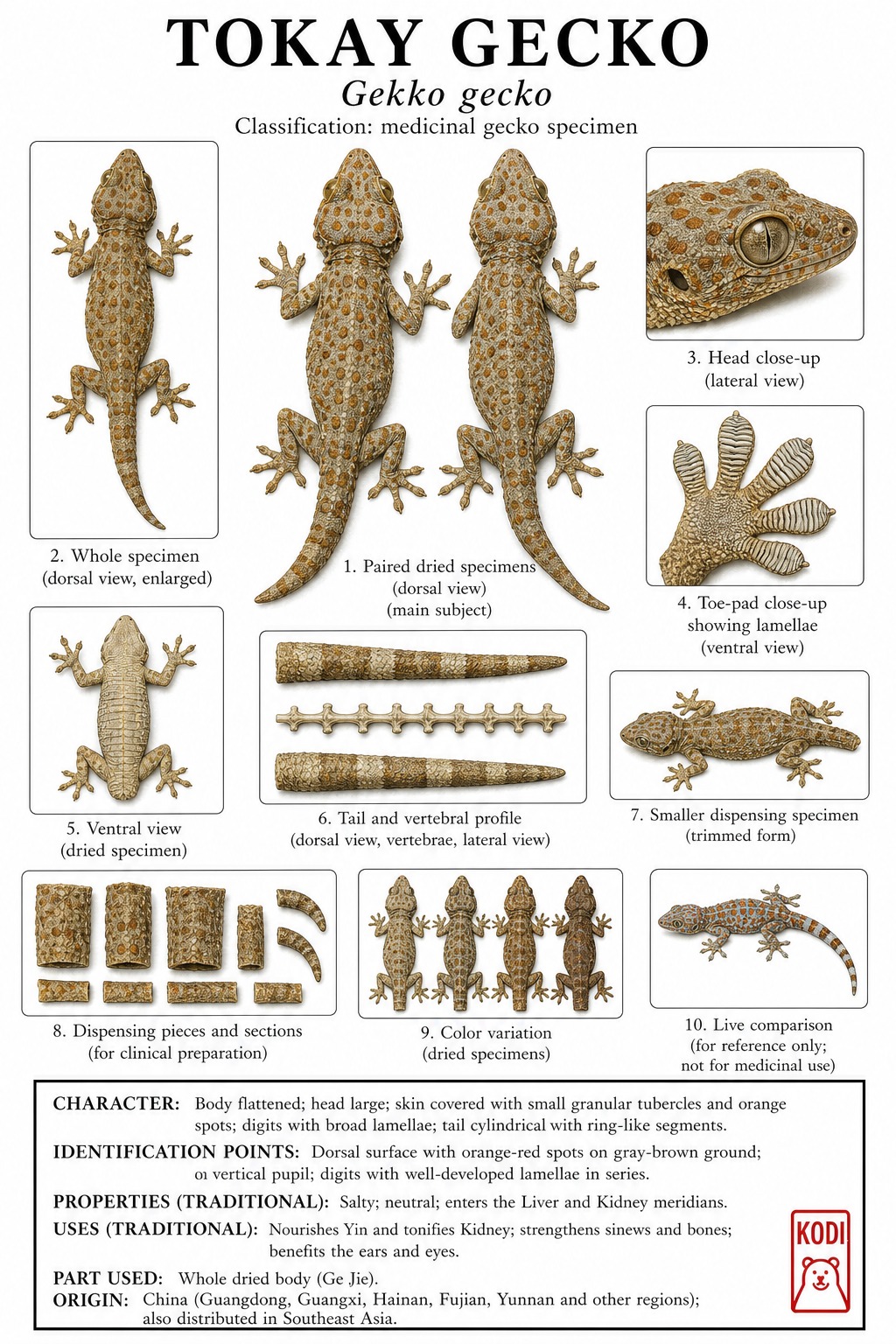
Known in TCM as Ge Jie (蛤蚜), this salty, neutral herb enters the Lung and Kidney. Traditionally, it tonifies the Lung and Kidney and grasps qi ... Ge Jie is classically used for chronic wheezing, shortness of breath, and deficiency-type asthma where inhalation is weak and the Kidneys fail to receive qi, most often applied for asthma, wheezing, and cough. Modern research has identified Protein among its active constituents.
Also Known As
Latin: Gecko | Pinyin: Ge Jie | Chinese: 蛤蚜
TCM Properties
- Taste
- salty
- Temperature
- neutral
- Channels
- Lung, Kidney
Traditional Use
Primary Actions
- Tonifies the Lung and Kidney and grasps qi ... Ge Jie is classically used for chronic wheezing, shortness of breath, and deficiency-type asthma where inhalation is weak and the Kidneys fail to receive qi.
- Supports chronic cough and consumptive weakness ... traditional use extends to lingering cough, fatigue, and wasting states where respiratory weakness travels with deeper deficiency.
- Assists essence and Yang deficiency patterns ... older indication lists include impotence, weakness of the low back, and exhaustion when deficiency is longstanding rather than acute.
Secondary Actions
- This page should remain specimen-forward on the dried animal medicine Ge Jie rather than being flattened into a generic protein supplement story.
- Animal-source identity, sourcing ethics, and authentication matter here because gecko trade records can blur species, quality, and conservation concerns.
Classic Formulas
- Ge Jie Ding Chuan Wan ... the best-known wheezing lane where Ge Jie supports the Lung and Kidney together.
- Ren Shen Ge Jie San and related deficiency-cough traditions ... gecko is paired with qi and essence tonics when breathing weakness is chronic and depleted.
- Consumptive-cough and impotence pairings ... classical use links respiration, essence, and lower-burner weakness rather than treating Ge Jie as a single-purpose asthma animal.
Classical References
- Traditional herbology describes Ge Jie as entering the Lung and Kidney to grasp qi, stop wheezing, and supplement deficiency.
- Its classical role is specifically chronic and deficiency-oriented ... not acute excess-phlegm asthma or hot cough with strong pathogen presence.
Modern Research
Active Compounds
- Protein and peptide fractions ... the major extract classes discussed in modern gecko pharmacology
- Amino-acid-rich nutritive fractions ... part of the traditional-deficiency bridge often explored in animal-source tonic research
- Other macromolecular extract components associated with angiogenesis and airway-inflammation studies
Studied Effects
- A 2015 study reported anti-angiogenic activity from gecko aqueous extracts and their macromolecular components, showing that modern gecko research often centers on protein-rich fractions rather than on small-molecule herbal chemistry (PMID 25773854).
- A 2022 murine study found that Gekko gecko extract attenuated airway inflammation and mucus hypersecretion in ovalbumin-induced asthma, offering a modern experimental correlate for the classic wheezing lane (PMID 34461187).
- A 2026 study found that gecko protein F2 inhibited tumor angiogenesis through VEGF, MAPK, and ERK pathway effects, illustrating why contemporary literature often overlaps with oncology and vascular biology (PMID 41652140).
PubMed References
- Anti-angiogenic activity of gecko aqueous extracts and its macromolecular components in CAM and HUVE-12 cells. (2015)
- Gekko gecko extract attenuates airway inflammation and mucus hypersecretion in a murine model of ovalbumin-induced asthma. (2022)
- Gecko protein F2 inhibits tumor angiogenesis by suppressing the VEGF/MAPK/ERK signaling pathway. (2026)
Safety & Interactions
Contraindications
- Acute wheezing from strong exterior pathogen or excess phlegm-heat without deficiency
- Use of unverified wildlife-source material
Cautions
- Ge Jie is an animal-source medicament used for chronic deficiency patterns, not a casual over-the-counter respiratory tonic.
- Authentication and legal sourcing matter because animal-medicine supply chains can be inconsistent, adulterated, or ethically problematic.
Conditions
Frequently Asked Questions
What is Tokay Gecko used for?
Tokay Gecko is traditionally used to Tonifies the Lung and Kidney and grasps qi ... Ge Jie is classically used for chronic wheezing, shortness of breath, and deficiency-type asthma where inhalation is weak and the Kidneys fail to receive qi., Supports chronic cough and consumptive weakness ... traditional use extends to lingering cough, fatigue, and wasting states where respiratory weakness travels with deeper deficiency., Assists essence and Yang deficiency patterns ... older indication lists include impotence, weakness of the low back, and exhaustion when deficiency is longstanding rather than acute.. Research has investigated its effects on: A 2015 study reported anti-angiogenic activity from gecko aqueous extracts and their macromolecular components, showing that modern gecko research often centers on protein-rich fractions rather than on small-molecule herbal chemistry (PMID 25773854).; A 2022 murine study found that Gekko gecko extract attenuated airway inflammation and mucus hypersecretion in ovalbumin-induced asthma, offering a modern experimental correlate for the classic wheezing lane (PMID 34461187)..
What are other names for Tokay Gecko?
Tokay Gecko is also known as Ge Jie, Dried tokay gecko, Gekko gecko. In TCM: 蛤蚜 (Ge Jie); Gecko.
Is Tokay Gecko safe during pregnancy?
The safety of Tokay Gecko during pregnancy has not been established. Consult a qualified healthcare provider before use.
What are the contraindications for Tokay Gecko?
Tokay Gecko should not be used in: Acute wheezing from strong exterior pathogen or excess phlegm-heat without deficiency; Use of unverified wildlife-source material. Consult a qualified healthcare provider before use.