Toad Venom
- Chinese
- 蟾酥
- Pinyin
- Chan Su
- Latin
- Venenum Bufonis
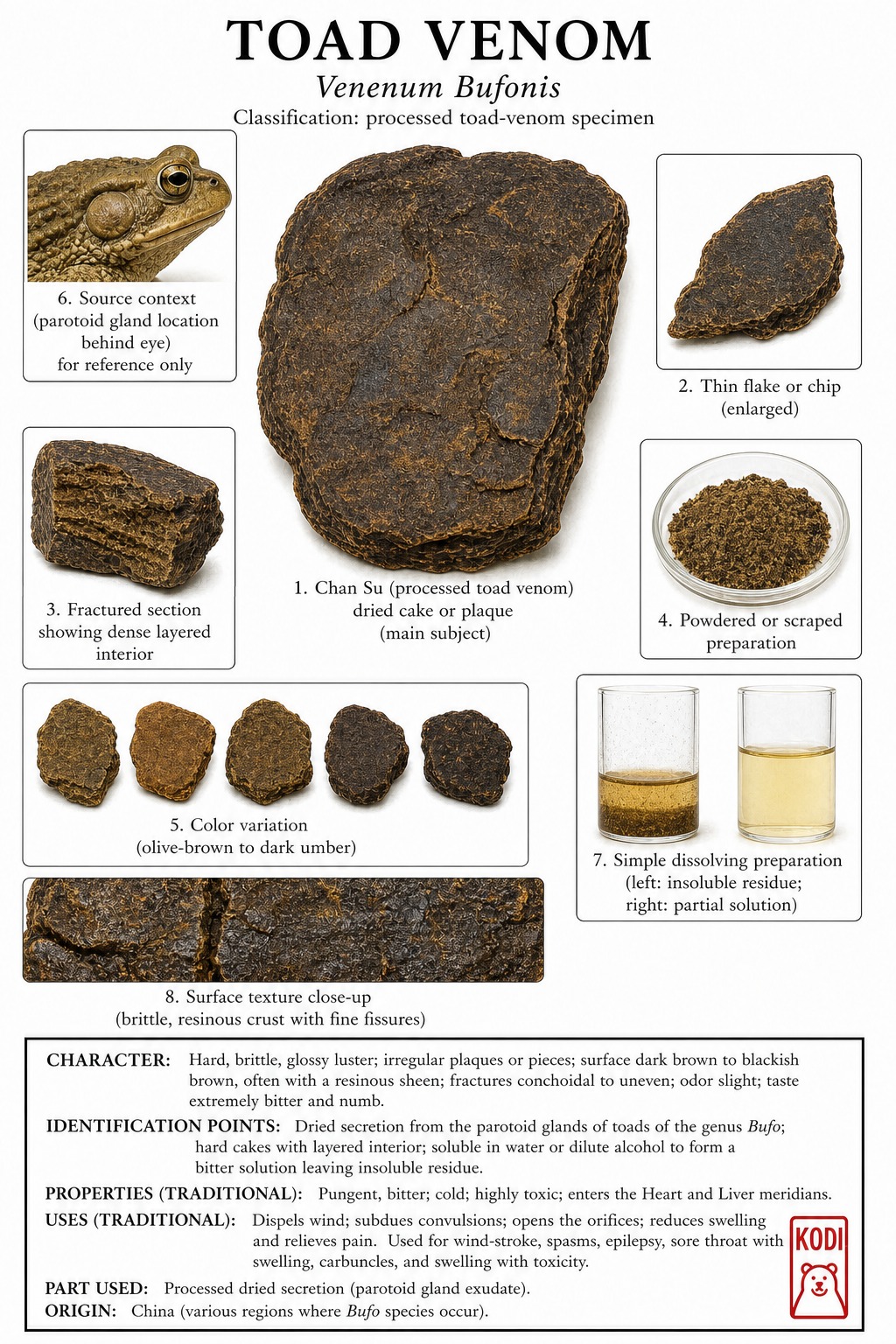
Known in TCM as Chan Su (蟾酥), this pungent and sweet, warm herb enters the Heart. Traditionally, it opens the orifices and revives consciousness ... Chan Su was historically used for sudden collapse, fainting, and closed presentations where turbid toxin or shock-like obstruction was said to block awareness, most often applied for sore throat, pharyngitis, and toothache. Modern research has identified Bufadienolides among its active constituents.
Part used: Venom
Also Known As
Latin: Venenum Bufonis | Pinyin: Chan Su | Chinese: 蟾酥
TCM Properties
- Taste
- pungent, sweet
- Temperature
- warm
- Channels
- Heart
Traditional Use
Primary Actions
- Opens the orifices and revives consciousness ... Chan Su was historically used for sudden collapse, fainting, and closed presentations where turbid toxin or shock-like obstruction was said to block awareness.
- Resolves toxicity and reduces swelling ... traditional use includes severe sore throat, oral or skin ulceration, carbuncles, and other intensely inflamed toxic swellings.
- Relieves severe pain ... because the material is intensely active and toxic, this role appears in very small internal doses or carefully controlled topical use rather than in routine decoction practice.
Secondary Actions
- This is a highly toxic animal-source secretion and should remain a safety-first clinical record, not a novelty or sensational animal-medicine page.
- Modern discussion usually centers on standardized extracts such as cinobufacini or on toxicology, not on improvised use of crude Chan Su.
Classic Formulas
- Liu Shen Wan ... a classic toxic-swelling and throat-pain patent tradition in which Chan Su appears in tiny amounts.
- Aromatic resuscitative pill traditions ... historical use for collapse and closed presentations belongs to this lane rather than to ordinary tonic prescribing.
- Topical toxic-swelling powders and ulcer applications ... a practical external route when the aim was to attack toxin and relieve pain without relying on large internal dosing.
Classical References
- Traditional herbology describes Chan Su as a toxic, strongly acting substance that opens the orifices, attacks toxin, reduces swelling, and relieves pain.
- The combination of resuscitative use and toxic-swelling use explains why Chan Su has always been regarded as potent and hazardous rather than as a routine materia medica staple.
Modern Research
Active Compounds
- Bufadienolides such as bufalin, cinobufagin, and resibufogenin ... the best-known cardioactive and antitumor-associated constituents
- Indole alkaloids and related small molecules ... supporting components in Bufonis Venenum chemistry
- Protein and peptide fractions present in standardized preparations such as cinobufacini
Studied Effects
- A 2019 overview of Venenum bufonis summarized its traditional use, chemistry, pharmacology, pharmacokinetics, and toxicology, making clear that Chan Su remains one of the most potent and risk-laden animal-source medicinals in the literature (PMID 30905791).
- A 2024 multi-omics study identified bufadienolide quality markers while directly comparing antitumor activity with cardiovascular toxicity in zebrafish, reinforcing the herb's unusually narrow margin between pharmacologic interest and safety concern (PMID 39121534).
- A 2026 narrative review of cinobufacini in endometrial cancer illustrates how modern interest often shifts from crude Chan Su toward standardized downstream preparations in integrative oncology contexts (PMID 42180964).
PubMed References
- Venenum bufonis: An overview of its traditional use, natural product chemistry, pharmacology, pharmacokinetics and toxicology. (2019)
- Multi-omics reveals bufadienolide Q-markers of Bufonis Venenum based on antitumor activity and cardiovascular toxicity in zebrafish. (2024)
- A narrative review of cinobufacini for endometrial cancer: mechanisms and therapeutic implications. (2026)
Safety & Interactions
Contraindications
- Pregnancy
- Arrhythmia, structural heart disease, or significant cardiovascular instability
- Any unsupervised internal use
Cautions
- Chan Su contains cardioactive bufadienolides and can cause serious poisoning ... this is not a self-prescribing herb.
- Crude animal material, patent-medicine doses, and standardized extracts are not interchangeable.
- Cardiovascular toxicity and narrow therapeutic margin are central modern realities, not theoretical concerns.
Drug Interactions
- Digoxin and other cardiac glycosides ... additive toxicity risk
- Antiarrhythmic drugs ... possible additive electrophysiologic effects
- QT-affecting drugs ... theoretical additive rhythm risk in susceptible patients
Conditions
- Sore Throat Traditional ★★★☆☆ JSON
- Pharyngitis Traditional ★★★☆☆ JSON
- Toothache Traditional ★★☆☆☆ JSON
- Carbuncle Traditional ★★☆☆☆ JSON
Frequently Asked Questions
What is Toad Venom used for?
Toad Venom is traditionally used to Opens the orifices and revives consciousness ... Chan Su was historically used for sudden collapse, fainting, and closed presentations where turbid toxin or shock-like obstruction was said to block awareness., Resolves toxicity and reduces swelling ... traditional use includes severe sore throat, oral or skin ulceration, carbuncles, and other intensely inflamed toxic swellings., Relieves severe pain ... because the material is intensely active and toxic, this role appears in very small internal doses or carefully controlled topical use rather than in routine decoction practice.. Research has investigated its effects on: A 2019 overview of Venenum bufonis summarized its traditional use, chemistry, pharmacology, pharmacokinetics, and toxicology, making clear that Chan Su remains one of the most potent and risk-laden animal-source medicinals in the literature (PMID 30905791).; A 2024 multi-omics study identified bufadienolide quality markers while directly comparing antitumor activity with cardiovascular toxicity in zebrafish, reinforcing the herb's unusually narrow margin between pharmacologic interest and safety concern (PMID 39121534)..
What are other names for Toad Venom?
Toad Venom is also known as Chan Su, Bufonis venom, Toad secretion. In TCM: 蟾酥 (Chan Su); Venenum Bufonis.
Is Toad Venom safe during pregnancy?
Toad Venom is not recommended during pregnancy.
What are the contraindications for Toad Venom?
Toad Venom should not be used in: Pregnancy; Arrhythmia, structural heart disease, or significant cardiovascular instability; Any unsupervised internal use. Consult a qualified healthcare provider before use.
Does Toad Venom interact with any medications?
Toad Venom may interact with: Digoxin and other cardiac glycosides ... additive toxicity risk; Antiarrhythmic drugs ... possible additive electrophysiologic effects; QT-affecting drugs ... theoretical additive rhythm risk in susceptible patients. Always inform your healthcare provider of any herbal supplements you are taking.