Tea-Seed Oil
- Chinese
- 茶油
- Pinyin
- Cha You
- Latin
- Oleum Camelliae
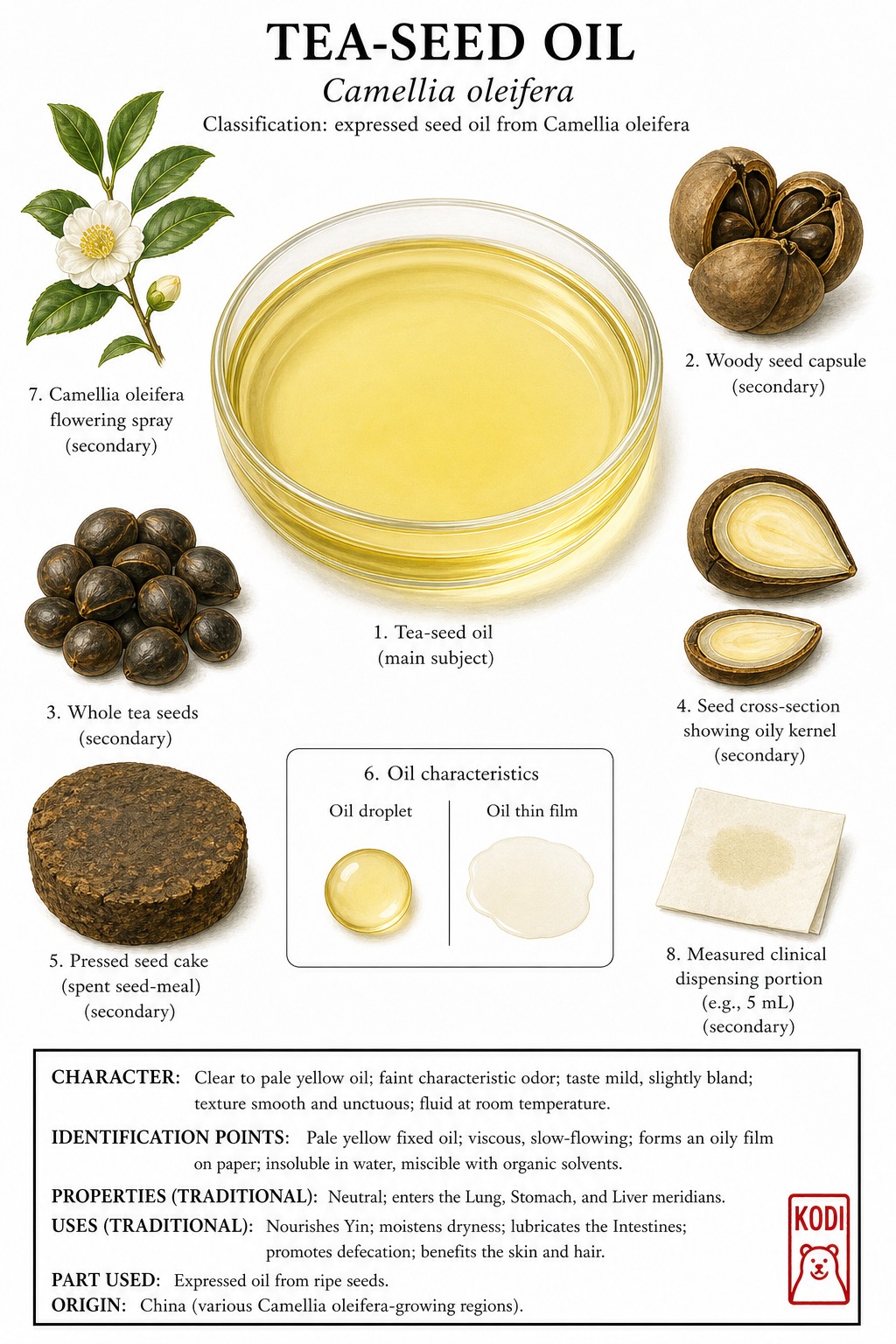
Known in TCM as Cha You (茶油), this sweet and bitter, cool herb enters the Large Intestine. Traditionally, it removes toxicity and soothes damaged tissue ... Cha You is used externally for scalds, burns, and irritated skin where a cooling protective oil is preferred, most often applied for constipation, burns, and scabies. Modern research has identified Oleic among its active constituents.
Part used: Oil
Also Known As
Latin: Oleum Camelliae | Pinyin: Cha You | Chinese: 茶油
TCM Properties
- Taste
- sweet, bitter
- Temperature
- cool
- Channels
- Large Intestine
Traditional Use
Primary Actions
- Removes toxicity and soothes damaged tissue ... Cha You is used externally for scalds, burns, and irritated skin where a cooling protective oil is preferred.
- Moistens the intestines ... traditional internal use includes dry constipation and obstructed stool when lubrication is needed more than harsh purging.
- Kills parasites and relieves worm-related discomfort ... older records include scabies and abdominal pain from roundworm or ascarid obstruction.
Secondary Actions
- This is an oil-forward monograph and should stay distinct from tea leaves, green tea, and tea tree products that belong to very different medicinal lanes.
- Cha You bridges food and medicine, but the classical identity still centers on lubrication, skin protection, and parasite-oriented use.
Classic Formulas
- Simple internal Cha You with cold water ... a traditional route for dry constipation.
- External application for scalds, burns, and itchy parasitic lesions ... the most practical and recognizable use lane for the oil.
- Worm-related abdominal-pain use ... a narrower older tradition that keeps the oil separate from purely culinary oils.
Classical References
- Traditional herbology describes Oleum Camelliae as sweet, bitter, and cool, entering the Large Intestine to remove toxicity, moisten the intestines, and kill parasites.
- The classical indication list includes constipation, scalds, burns, scabies, abdominal pain from roundworm, and eruptive disease.
Modern Research
Active Compounds
- Oleic acid-rich lipid fraction
- Linoleic acid and other supportive fatty acids
- Tocopherols, squalene, and minor phenolic antioxidant fractions
Studied Effects
- A 2026 review summarized health benefits and emerging applications of Camellia oleifera oil, providing the best current umbrella source for tea-seed-oil research (PMID 40540300).
- A 2025 experimental study found camellia oil improved skin-barrier function in a DNCB-induced atopic-dermatitis model, which fits the oil's long topical soothing tradition (PMID 39836107).
- Another 2025 study reported anti-inflammatory effects of Camellia seed oil in zebrafish and RAW264.7-cell assays, supporting continued mechanistic interest in the oil's surface and inflammation-related applications (PMID 40686458).
PubMed References
- Camellia oleifera oil: unveiling health benefits and exploring novel applications. (2026)
- Restorative effects of camellia oil on the skin-barrier function in a model of DNCB-induced atopic dermatitis. (2025)
- Anti-inflammatory effects of Camellia seed oil on zebrafish and RAW264.7 cells studied using an in vitro bioassay. (2025)
Safety & Interactions
Contraindications
- Loose stools where extra lubrication worsens the pattern
- Known camellia-seed allergy
Cautions
- Tea-seed oil is not the same thing as tea tree oil.
- Topical soothing use does not make it an appropriate sole treatment for deep burns, infected wounds, or parasitic disease without evaluation.
Conditions
- Constipation Traditional ★★★☆☆ JSON
- Burns Traditional ★★☆☆☆ JSON
- Scabies Traditional ★★☆☆☆ JSON
- Abdominal Pain Traditional ★☆☆☆☆ JSON
Frequently Asked Questions
What is Tea-Seed Oil used for?
Tea-Seed Oil is traditionally used to Removes toxicity and soothes damaged tissue ... Cha You is used externally for scalds, burns, and irritated skin where a cooling protective oil is preferred., Moistens the intestines ... traditional internal use includes dry constipation and obstructed stool when lubrication is needed more than harsh purging., Kills parasites and relieves worm-related discomfort ... older records include scabies and abdominal pain from roundworm or ascarid obstruction.. Research has investigated its effects on: A 2026 review summarized health benefits and emerging applications of Camellia oleifera oil, providing the best current umbrella source for tea-seed-oil research (PMID 40540300).; A 2025 experimental study found camellia oil improved skin-barrier function in a DNCB-induced atopic-dermatitis model, which fits the oil's long topical soothing tradition (PMID 39836107)..
What are other names for Tea-Seed Oil?
Tea-Seed Oil is also known as Tea oil, Camellia seed oil, Camellia. In TCM: 茶油 (Cha You); Oleum Camelliae.
Is Tea-Seed Oil safe during pregnancy?
The safety of Tea-Seed Oil during pregnancy has not been established. Consult a qualified healthcare provider before use.
What are the contraindications for Tea-Seed Oil?
Tea-Seed Oil should not be used in: Loose stools where extra lubrication worsens the pattern; Known camellia-seed allergy. Consult a qualified healthcare provider before use.