Tangerine Peel
- Chinese
- 橘皮
- Pinyin
- Ju Pi
- Latin
- Pericarpium Citri Tangerinae
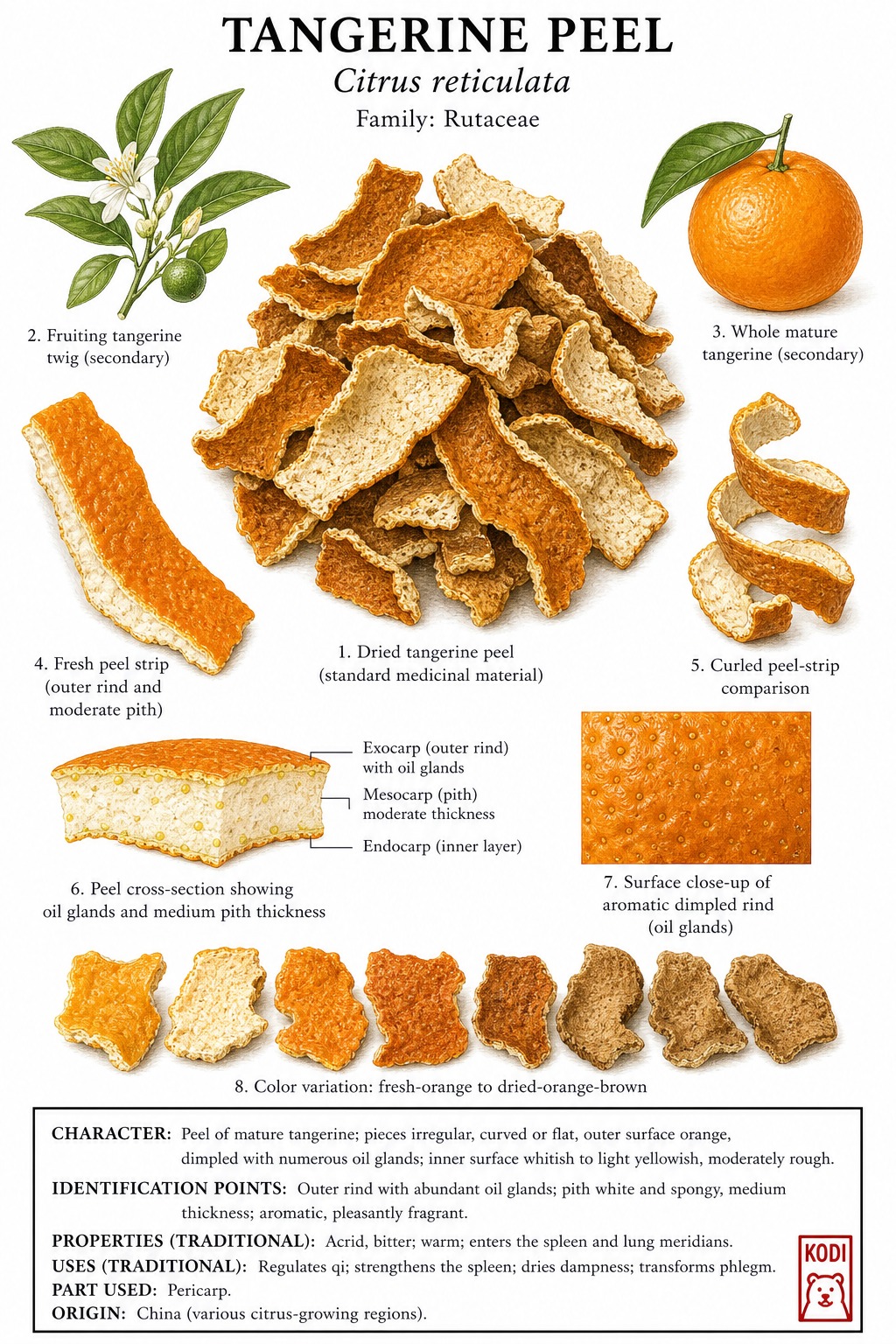
Known in TCM as Ju Pi (橘皮), this pungent and bitter, warm herb enters the Spleen and Lung. Traditionally, it promotes the flow of qi and relieves fullness ... Ju Pi is used for Spleen-Stomach qi stagnation with abdominal distension, poor appetite, and epigastric discomfort, most often applied for abdominal distension, nausea, and poor appetite. Modern research has identified Hesperidin among its active constituents.
Part used: Peel
Also Known As
Latin: Pericarpium Citri Tangerinae | Pinyin: Ju Pi | Chinese: 橘皮
TCM Properties
- Taste
- pungent, bitter
- Temperature
- warm
- Channels
- Spleen, Lung
Traditional Use
Primary Actions
- Promotes the flow of qi and relieves fullness ... Ju Pi is used for Spleen-Stomach qi stagnation with abdominal distension, poor appetite, and epigastric discomfort.
- Arrests vomiting and harmonizes the Stomach ... it is a classic citrus-peel support when qi rebellion and dampness combine to cause nausea or vomiting.
- Dries dampness and resolves phlegm ... the peel helps when cough, chest congestion, and copious sputum reflect cold-phlegm or damp-phlegm.
Secondary Actions
- This page stays on the straightforward tangerine-peel lane and should not be flattened into the more aged Chen Pi identity or the green-peel family.
- Ju Pi overlaps heavily with Chen Pi, but the older preserved-peel identity carries a stronger aging tradition and more developed modern monograph literature.
Classic Formulas
- Ping Wei San ... Ju Pi style qi movement and dampness transformation for fullness, poor appetite, and middle-burner obstruction.
- Ju Pi Tang with Sheng Jiang ... traditional stomach-harmonizing pairing for nausea and vomiting.
- Er Chen Tang family logic ... peel use for damp-phlegm cough with chest fullness and digestive sluggishness.
Classical References
- Traditional herbology describes Ju Pi as pungent, bitter, and warm, entering the Spleen and Lung to move qi, stop vomiting, dry dampness, and transform phlegm.
- Its action is mild enough for broad compatibility, which is why citrus peel appears so often in digestive and phlegm formulas.
Modern Research
Active Compounds
- Hesperidin
- Nobiletin and tangeretin
- Limonene-rich volatile oil fractions
- Broader citrus-peel flavonoid complexes
Studied Effects
- A 2023 review summarized health benefits, microbial transformations, and authenticity work around Citri reticulatae pericarpium bioactive compounds, which remains the closest modern evidence base for the broader Ju Pi and Chen Pi family (PMID 37326362).
- In diabetic rats, citrus peel from the Chen Pi medicinal lane protected against endothelial dysfunction and vascular inflammation, reinforcing ongoing cardiometabolic and anti-inflammatory interest in the peel family (PMID 36558380).
- Recent flavonoid identification and antioxidant-comparison work across citrus peel and green peel deepened the modern chemistry map for tangerine-peel medicines and their processed variants (PMID 38678045).
PubMed References
- Review of recent advances on health benefits, microbial transformations, and authenticity identification of Citri reticulatae Pericarpium bioactive compounds (2023)
- Citri Reticulatae Pericarpium (Chenpi) Protects against Endothelial Dysfunction and Vascular Inflammation in Diabetic Rats (2022)
- Comprehensive identifying flavonoids in Citri Reticulatae Pericarpium and Citri Reticulatae Pericarpium Viride and their antioxidant activity comparison (2024)
Safety & Interactions
Contraindications
- Yin deficiency dry cough without phlegm
- Patterns without qi stagnation, dampness, or phlegm
Cautions
- Citrus peel medicines are warming and drying and may aggravate dryness or reflux in some patients if overused.
- The best modern literature is usually broader citrus-peel family research rather than Ju Pi-only clinical trials.
Conditions
- Abdominal Distension Traditional ★★★★☆ JSON
- Nausea Traditional ★★★★☆ JSON
- Poor Appetite Traditional ★★★☆☆ JSON
- Cough Traditional ★★☆☆☆ JSON
Frequently Asked Questions
What is Tangerine Peel used for?
Tangerine Peel is traditionally used to Promotes the flow of qi and relieves fullness ... Ju Pi is used for Spleen-Stomach qi stagnation with abdominal distension, poor appetite, and epigastric discomfort., Arrests vomiting and harmonizes the Stomach ... it is a classic citrus-peel support when qi rebellion and dampness combine to cause nausea or vomiting., Dries dampness and resolves phlegm ... the peel helps when cough, chest congestion, and copious sputum reflect cold-phlegm or damp-phlegm.. Research has investigated its effects on: A 2023 review summarized health benefits, microbial transformations, and authenticity work around Citri reticulatae pericarpium bioactive compounds, which remains the closest modern evidence base for the broader Ju Pi and Chen Pi family (PMID 37326362).; In diabetic rats, citrus peel from the Chen Pi medicinal lane protected against endothelial dysfunction and vascular inflammation, reinforcing ongoing cardiometabolic and anti-inflammatory interest in the peel family (PMID 36558380)..
What are other names for Tangerine Peel?
Tangerine Peel is also known as Mandarin peel, Ju Pi, Citri. In TCM: 橘皮 (Ju Pi); Pericarpium Citri Tangerinae.
Is Tangerine Peel safe during pregnancy?
The safety of Tangerine Peel during pregnancy has not been established. Consult a qualified healthcare provider before use.
What are the contraindications for Tangerine Peel?
Tangerine Peel should not be used in: Yin deficiency dry cough without phlegm; Patterns without qi stagnation, dampness, or phlegm. Consult a qualified healthcare provider before use.