Talc
- Chinese
- 滑石
- Pinyin
- Hua Shi
- Latin
- Talcum
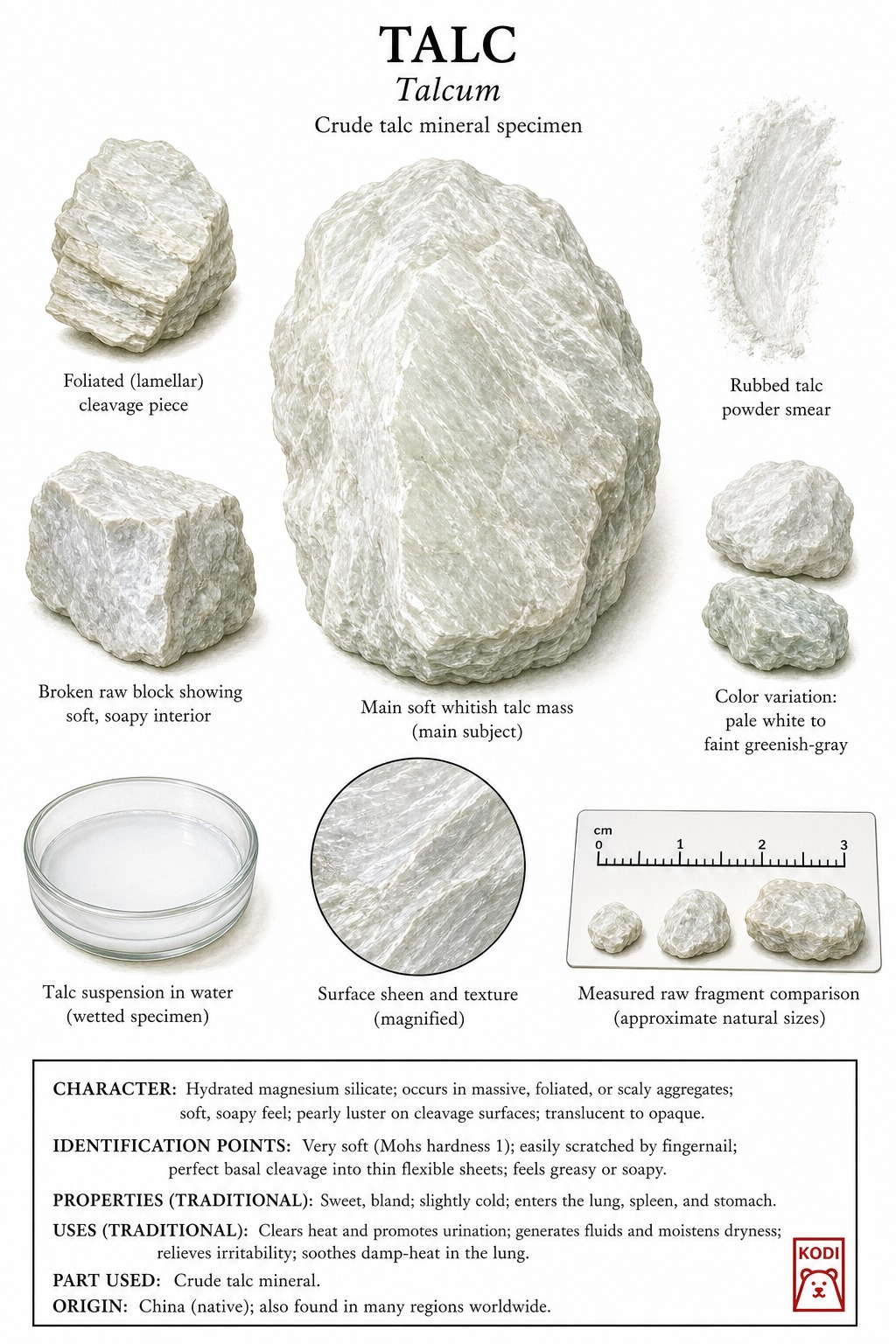
Known in TCM as Hua Shi (滑石), this sweet and bland, cold herb enters the Bladder, Lung, and Stomach. Traditionally, it induces urination and treats damp-heat strangury ... Hua Shi is a core mineral for painful, scanty, dark urination and damp-heat obstructing the Bladder, most often applied for urinary tract infection, urolithiasis, and eczema. Modern research has identified Hydrated among its active constituents.
Part used: Talc
Also Known As
Latin: Talcum | Pinyin: Hua Shi | Chinese: 滑石
TCM Properties
- Taste
- sweet, bland
- Temperature
- cold
- Channels
- Bladder, Lung, Stomach
Traditional Use
Primary Actions
- Induces urination and treats damp-heat strangury ... Hua Shi is a core mineral for painful, scanty, dark urination and damp-heat obstructing the Bladder.
- Clears summer-heat and drains dampness ... it appears in warm-weather formulas when thirst, irritability, dark urine, and body heaviness all point to summer-damp.
- Promotes healing and relieves itching externally ... the crude mineral or its refined powder is used for damp sores, eczema, miliaria, and superficially weeping lesions.
Secondary Actions
- This page stays on the raw mineral Hua Shi lane, separate from the finer presentation-oriented Hua Shi Fen powder page.
- The therapeutic identity is drainage, absorbency, and external cooling rather than nutrient supplementation.
Classic Formulas
- Ba Zheng San ... the classic damp-heat strangury formula in which Hua Shi is one of the key bladder-draining minerals.
- Liu Yi San ... simple summer-heat and dampness formula built around Hua Shi and Gan Cao.
- San Ren Tang ... damp-warm formula where Hua Shi helps separate dampness and vent constrained summer-heat.
Classical References
- Traditional herbology describes Hua Shi as sweet, bland, and cold, entering the Bladder, Lung, and Stomach to promote urination, clear summer-heat, and relieve damp skin irritation.
- Because it is a mineral, proper refinement and wrapped decoction are classical handling details rather than optional style points.
Modern Research
Active Compounds
- Hydrated magnesium silicate as the principal mineral matrix
- Magnesium oxide and related trace mineral fractions used in quality control
- Lamellar silicate structure responsible for absorbent and protective behavior
Studied Effects
- Indexed modern literature on talc as a Chinese medicinal mineral is much thinner than the classical literature and focuses heavily on identification and quality control rather than clinical trials.
- A 2017 study used near-infrared spectroscopy with machine learning to determine magnesium oxide content in medicinal talcum, showing how modern work often centers on authentication of the raw mineral (PMID 28758413).
- Modern practical relevance also depends on route safety, contamination control, and appropriate external versus internal use rather than on broad disease-claim pharmacology.
PubMed References
Safety & Interactions
Contraindications
- Yin injury or urinary difficulty from deficiency rather than damp-heat
- Use of unrefined or contaminated industrial talc
Cautions
- Fine talc should not be inhaled, especially in infants or anyone with compromised lungs.
- Mineral-source quality matters because talc safety depends on refinement and contamination control.
- Internal use should follow proper medicinal processing rather than cosmetic or industrial sourcing.
Conditions
- Urinary Tract Infection Traditional ★★★☆☆ JSON
- Urolithiasis Traditional ★★★☆☆ JSON
- Eczema Traditional ★★☆☆☆ JSON
- Edema Traditional ★★☆☆☆ JSON
Frequently Asked Questions
What is Talc used for?
Talc is traditionally used to Induces urination and treats damp-heat strangury ... Hua Shi is a core mineral for painful, scanty, dark urination and damp-heat obstructing the Bladder., Clears summer-heat and drains dampness ... it appears in warm-weather formulas when thirst, irritability, dark urine, and body heaviness all point to summer-damp., Promotes healing and relieves itching externally ... the crude mineral or its refined powder is used for damp sores, eczema, miliaria, and superficially weeping lesions.. Research has investigated its effects on: Indexed modern literature on talc as a Chinese medicinal mineral is much thinner than the classical literature and focuses heavily on identification and quality control rather than clinical trials.; A 2017 study used near-infrared spectroscopy with machine learning to determine magnesium oxide content in medicinal talcum, showing how modern work often centers on authentication of the raw mineral (PMID 28758413)..
What are other names for Talc?
Talc is also known as Medicinal talc. In TCM: 滑石 (Hua Shi); Talcum.
Is Talc safe during pregnancy?
The safety of Talc during pregnancy has not been established. Consult a qualified healthcare provider before use.
What are the contraindications for Talc?
Talc should not be used in: Yin injury or urinary difficulty from deficiency rather than damp-heat; Use of unrefined or contaminated industrial talc. Consult a qualified healthcare provider before use.