Golden Bell Fruit
- Chinese
- 金铃子
- Pinyin
- Jin Ling Zi
- Latin
- Fructus Meliae Toosendan
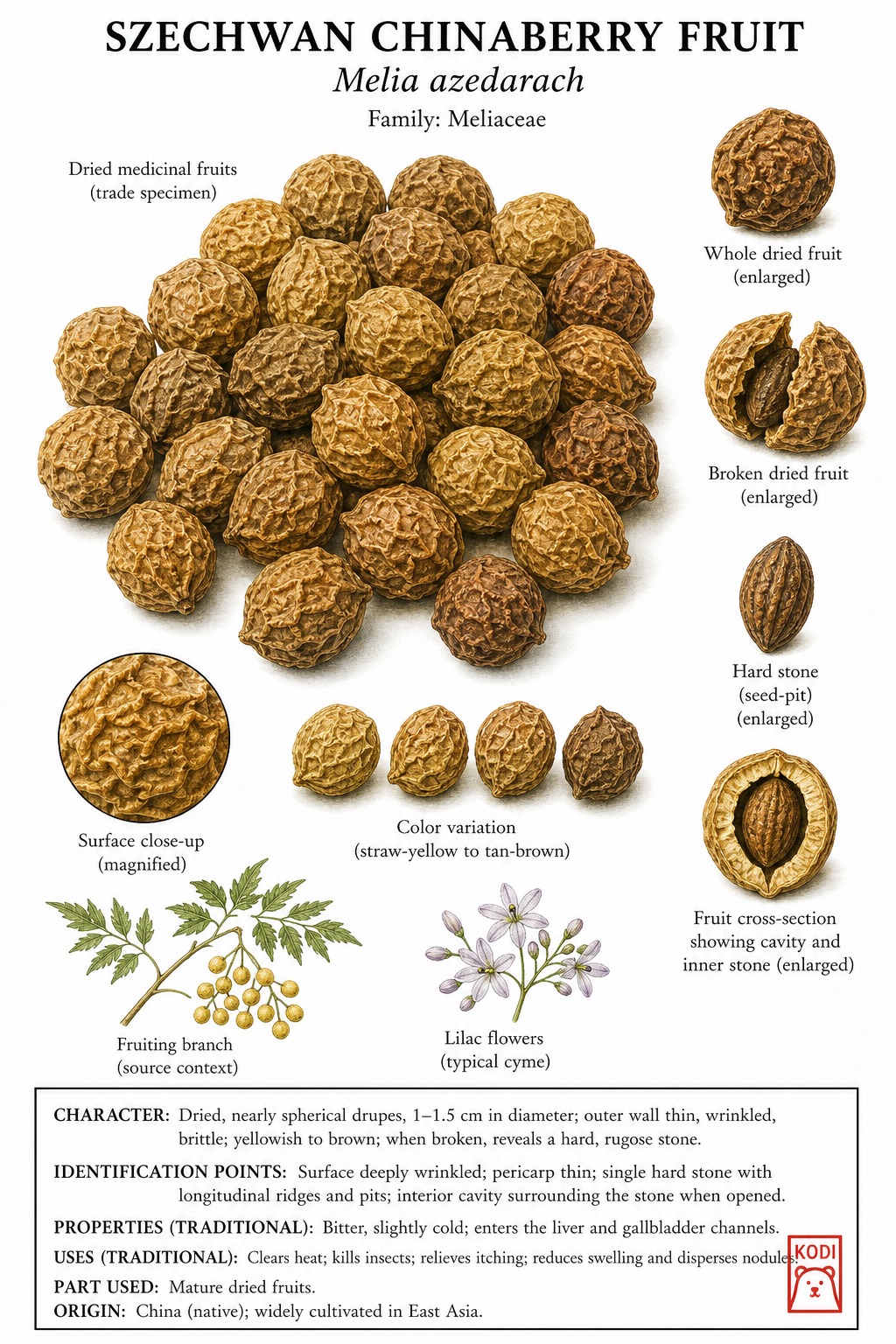
Known in TCM as Jin Ling Zi (金铃子), this bitter, cold herb enters the Liver, Stomach, Small Intestine, and Bladder. Traditionally, it moves qi and stops pain ... Jin Ling Zi is the trade-name lane of the same bitter-cold medicinal fruit used for hypochondriac, epigastric, and lower-abdominal pain with constrained heat, most often applied for abdominal pain, liver qi stagnation, and intestinal parasites. Modern research has identified Toosendanin among its active constituents.
Part used: Fruit
Also Known As
Latin: Fructus Meliae Toosendan | Pinyin: Jin Ling Zi | Chinese: 金铃子
TCM Properties
- Taste
- bitter
- Temperature
- cold
- Channels
- Liver, Stomach, Small Intestine, Bladder
Traditional Use
Primary Actions
- Moves qi and stops pain ... Jin Ling Zi is the trade-name lane of the same bitter-cold medicinal fruit used for hypochondriac, epigastric, and lower-abdominal pain with constrained heat.
- Dissipates constrained Liver heat ... it is especially associated with irritability, rib-side pain, and stomach-region pain where Liver overcontrol and heat both matter.
- Expels worms and relieves colicky discomfort ... the historical antiparasitic role remains secondary but real.
Secondary Actions
- This entry stays dried-trade-fruit-forward and should not be collapsed into the more source-plant-forward Chuan Lian Zi page.
- The formula identity of Jin Ling Zi is especially strong because the herb name lives on in Jin Ling Zi San, one of the most recognizable Liver-pain pairings in Chinese medicine.
Classic Formulas
- Jin Ling Zi San ... the signature Jin Ling Zi plus Yan Hu Suo pairing for Liver-qi pain and heat-constrained abdominal pain.
- Ju He Wan style testicular-pain and hernia formulas ... the fruit often appears when nodulation, Liver stagnation, and lower-burner pain overlap.
- Worm-expelling combinations ... used historically when abdominal pain and parasite burden occur together.
Classical References
- Later herbology often presents Jin Ling Zi as the name most clinicians remember from pain formulas even though the pharmacopoeial Latin remains Fructus Meliae Toosendan.
- The clinical identity remains pain relief through qi movement and cold-bitter drainage, with mild toxicity always part of the discussion.
Modern Research
Active Compounds
- Toosendanin
- Limonoid-rich bitter fractions
- Triterpenes and other Melia fruit secondary metabolites
Studied Effects
- A 2023 review synthesized the modern chemistry, pharmacology, and toxicology of Fructus Meliae Toosendan and is directly relevant to the Jin Ling Zi trade-name lane as well (PMID 36395606).
- Experimental work reported anti-influenza A effects from Melia Fructus extract through interference with viral entry and polymerase activity (PMID 28400751).
- Toosendanin also showed anti-inflammatory benefit in a murine colitis model, underscoring how the fruit's modern pharmacology extends beyond classical pain indications (PMID 31520988).
PubMed References
- An overview of Fructus Meliae Toosendan: Botany, traditional uses, phytochemistry, pharmacology and toxicology. (2023)
- Ethanolic Extract of Melia Fructus Has Anti-influenza A Virus Activity by Affecting Viral Entry and Viral RNA Polymerase. (2017)
- Toosendanin alleviates dextran sulfate sodium-induced colitis by inhibiting M1 macrophage polarization and regulating NLRP3 inflammasome and Nrf2/HO-1 signaling. (2019)
Safety & Interactions
Contraindications
- Pregnancy
- Marked Spleen-Stomach deficiency cold
- Use outside supervised dosing because the herb is mildly toxic
Cautions
- Jin Ling Zi is a real medicinal fruit with toxicologic limits, not a harmless bitter digestive.
- Overuse can provoke nausea, vomiting, or other toxicity signals rather than simply stronger pain relief.
- Persistent chest, abdominal, or groin pain needs proper diagnosis rather than repeated unsupervised use.
Conditions
- Abdominal Pain Traditional ★★★★☆ JSON
- Liver Qi Stagnation Traditional ★★★☆☆ JSON
- Intestinal Parasites Traditional ★★☆☆☆ JSON
- Dysmenorrhea Traditional ★★☆☆☆ JSON
Frequently Asked Questions
What is Golden Bell Fruit used for?
Golden Bell Fruit is traditionally used to Moves qi and stops pain ... Jin Ling Zi is the trade-name lane of the same bitter-cold medicinal fruit used for hypochondriac, epigastric, and lower-abdominal pain with constrained heat., Dissipates constrained Liver heat ... it is especially associated with irritability, rib-side pain, and stomach-region pain where Liver overcontrol and heat both matter., Expels worms and relieves colicky discomfort ... the historical antiparasitic role remains secondary but real.. Research has investigated its effects on: A 2023 review synthesized the modern chemistry, pharmacology, and toxicology of Fructus Meliae Toosendan and is directly relevant to the Jin Ling Zi trade-name lane as well (PMID 36395606).; Experimental work reported anti-influenza A effects from Melia Fructus extract through interference with viral entry and polymerase activity (PMID 28400751)..
What are other names for Golden Bell Fruit?
Golden Bell Fruit is also known as Szechwan Chinaberry Fruit, Jinlingzi, Melia. In TCM: 金铃子 (Jin Ling Zi); Fructus Meliae Toosendan.
Is Golden Bell Fruit safe during pregnancy?
Golden Bell Fruit is not recommended during pregnancy.
What are the contraindications for Golden Bell Fruit?
Golden Bell Fruit should not be used in: Pregnancy; Marked Spleen-Stomach deficiency cold; Use outside supervised dosing because the herb is mildly toxic. Consult a qualified healthcare provider before use.