Szechwan Chinaberry Fruit
- Chinese
- 川楂子
- Pinyin
- Chuan Lian Zi
- Latin
- Fructus Meliae Toosendan
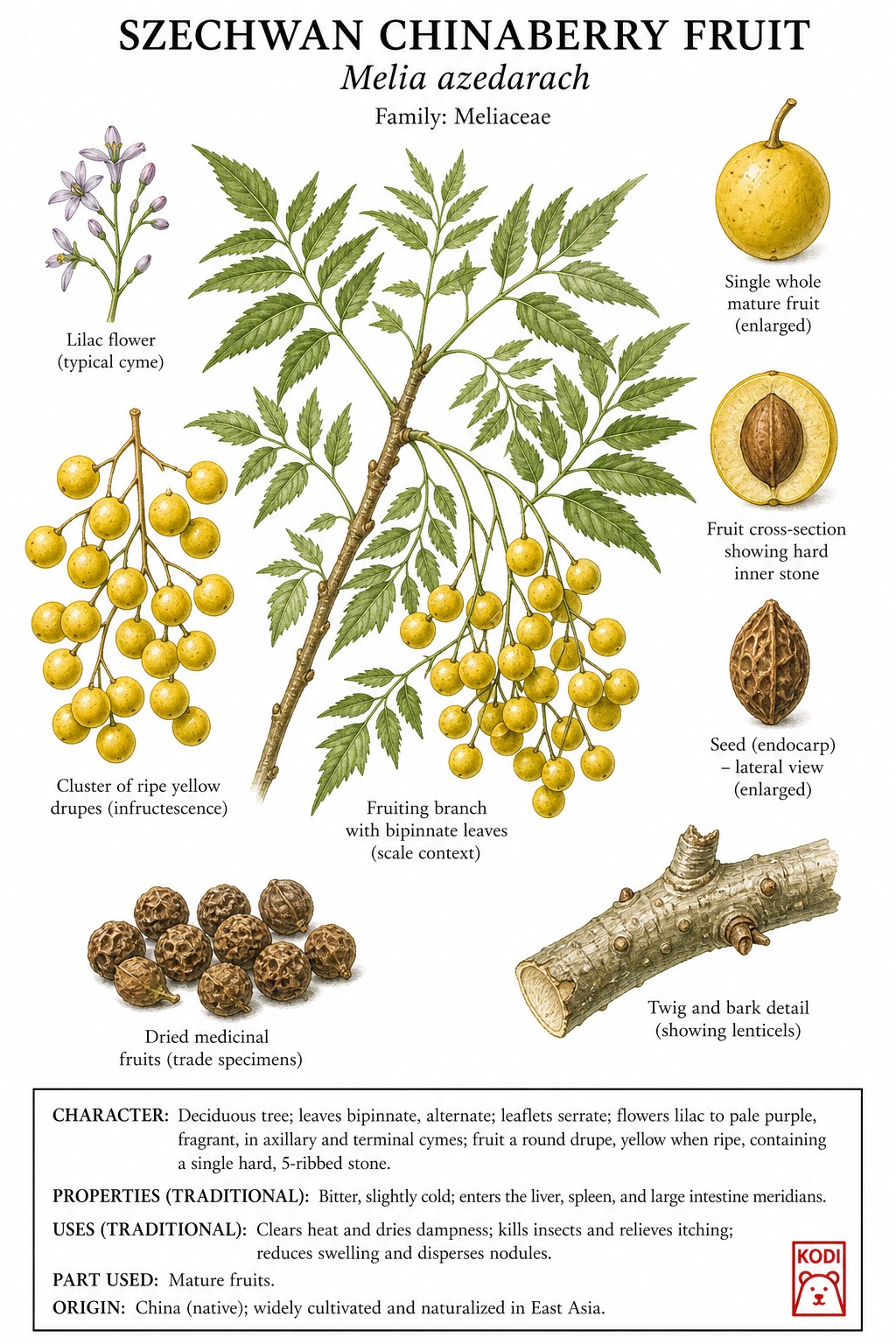
Known in TCM as Chuan Lian Zi (川楂子), this bitter, cold herb enters the Liver, Stomach, Small Intestine, and Bladder. Traditionally, it moves Liver qi and alleviates pain ... Chuan Lian Zi is a classic bitter-cold pain herb for hypochondriac, epigastric, abdominal, and hernia-type pain with qi stagnation and heat, most often applied for abdominal pain, liver qi stagnation, and intestinal parasites. Modern research has identified Toosendanin among its active constituents.
Part used: Fruit
Also Known As
Latin: Fructus Meliae Toosendan | Pinyin: Chuan Lian Zi | Chinese: 川楂子
TCM Properties
- Taste
- bitter
- Temperature
- cold
- Channels
- Liver, Stomach, Small Intestine, Bladder
Traditional Use
Primary Actions
- Moves Liver qi and alleviates pain ... Chuan Lian Zi is a classic bitter-cold pain herb for hypochondriac, epigastric, abdominal, and hernia-type pain with qi stagnation and heat.
- Clears constrained heat from the Liver channel ... its cold nature makes it especially useful when stagnation has turned hot and pain is sharp, irritable, or burning.
- Expels roundworms and relieves associated discomfort ... older use includes intestinal worms, colic, and external antiparasitic application.
Secondary Actions
- This page stays source-plant-forward on the accepted medicinal fruit lane rather than on a generic Melia fruit description.
- It should remain distinct from the companion Jin Ling Zi entry, which carries the same herb family through a more trade-name-forward presentation.
Classic Formulas
- Jin Ling Zi San ... classic pairing with Yan Hu Suo for Liver-qi pain, hypochondriac pain, and heat-constrained abdominal pain.
- Worm-expelling combinations with Bing Lang or Ku Lian Pi ... a traditional route when intestinal parasites are part of the presentation.
- Branch-fried or vinegar-fried preparations ... common processing logic to moderate harshness and emphasize pain relief.
Classical References
- Traditional herbology describes Chuan Lian Zi as bitter, cold, and mildly toxic, entering the Liver and digestive channels to move qi and stop pain.
- Its defining profile is painful constrained heat with a worm-expelling side role, not broad everyday digestive tonic use.
Modern Research
Active Compounds
- Toosendanin
- Limonoids from Melia fruit
- Triterpenoid and bitter secondary-metabolite fractions linked to pharmacologic and toxicologic activity
Studied Effects
- A 2023 review summarized botany, traditional uses, phytochemistry, pharmacology, and toxicology for Fructus Meliae Toosendan, making it the best current overview for this medicinal fruit family (PMID 36395606).
- An ethanolic extract of Melia Fructus showed anti-influenza A activity in 2017 by affecting viral entry and viral RNA polymerase, illustrating ongoing antiviral interest in the fruit (PMID 28400751).
- Toosendanin reduced colitis severity in a dextran-sulfate-sodium model by regulating inflammatory polarization and inflammasome-related signaling, extending modern interest beyond pain relief (PMID 31520988).
PubMed References
- An overview of Fructus Meliae Toosendan: Botany, traditional uses, phytochemistry, pharmacology and toxicology. (2023)
- Ethanolic Extract of Melia Fructus Has Anti-influenza A Virus Activity by Affecting Viral Entry and Viral RNA Polymerase. (2017)
- Toosendanin alleviates dextran sulfate sodium-induced colitis by inhibiting M1 macrophage polarization and regulating NLRP3 inflammasome and Nrf2/HO-1 signaling. (2019)
Safety & Interactions
Contraindications
- Pregnancy
- Marked Spleen-Stomach deficiency cold
- Use outside supervised dosing because the herb is mildly toxic
Cautions
- Chuan Lian Zi can irritate digestion and is not appropriate for casual self-treatment of abdominal pain.
- Melia fruit chemistry includes compounds with real toxicologic relevance, so more is not better.
- Persistent abdominal or testicular pain requires standard medical evaluation.
Conditions
- Abdominal Pain Traditional ★★★★☆ JSON
- Liver Qi Stagnation Traditional ★★★☆☆ JSON
- Intestinal Parasites Traditional ★★☆☆☆ JSON
- Dysmenorrhea Traditional ★★☆☆☆ JSON
Frequently Asked Questions
What is Szechwan Chinaberry Fruit used for?
Szechwan Chinaberry Fruit is traditionally used to Moves Liver qi and alleviates pain ... Chuan Lian Zi is a classic bitter-cold pain herb for hypochondriac, epigastric, abdominal, and hernia-type pain with qi stagnation and heat., Clears constrained heat from the Liver channel ... its cold nature makes it especially useful when stagnation has turned hot and pain is sharp, irritable, or burning., Expels roundworms and relieves associated discomfort ... older use includes intestinal worms, colic, and external antiparasitic application.. Research has investigated its effects on: A 2023 review summarized botany, traditional uses, phytochemistry, pharmacology, and toxicology for Fructus Meliae Toosendan, making it the best current overview for this medicinal fruit family (PMID 36395606).; An ethanolic extract of Melia Fructus showed anti-influenza A activity in 2017 by affecting viral entry and viral RNA polymerase, illustrating ongoing antiviral interest in the fruit (PMID 28400751)..
What are other names for Szechwan Chinaberry Fruit?
Szechwan Chinaberry Fruit is also known as Toosendan fruit, Melia fruit, Melia. In TCM: 川楂子 (Chuan Lian Zi); Fructus Meliae Toosendan.
Is Szechwan Chinaberry Fruit safe during pregnancy?
Szechwan Chinaberry Fruit is not recommended during pregnancy.
What are the contraindications for Szechwan Chinaberry Fruit?
Szechwan Chinaberry Fruit should not be used in: Pregnancy; Marked Spleen-Stomach deficiency cold; Use outside supervised dosing because the herb is mildly toxic. Consult a qualified healthcare provider before use.