Sweet Wormwood Herb
- Chinese
- 青蒿
- Pinyin
- Qing Hao
- Latin
- Herba Artemisiae Annuae
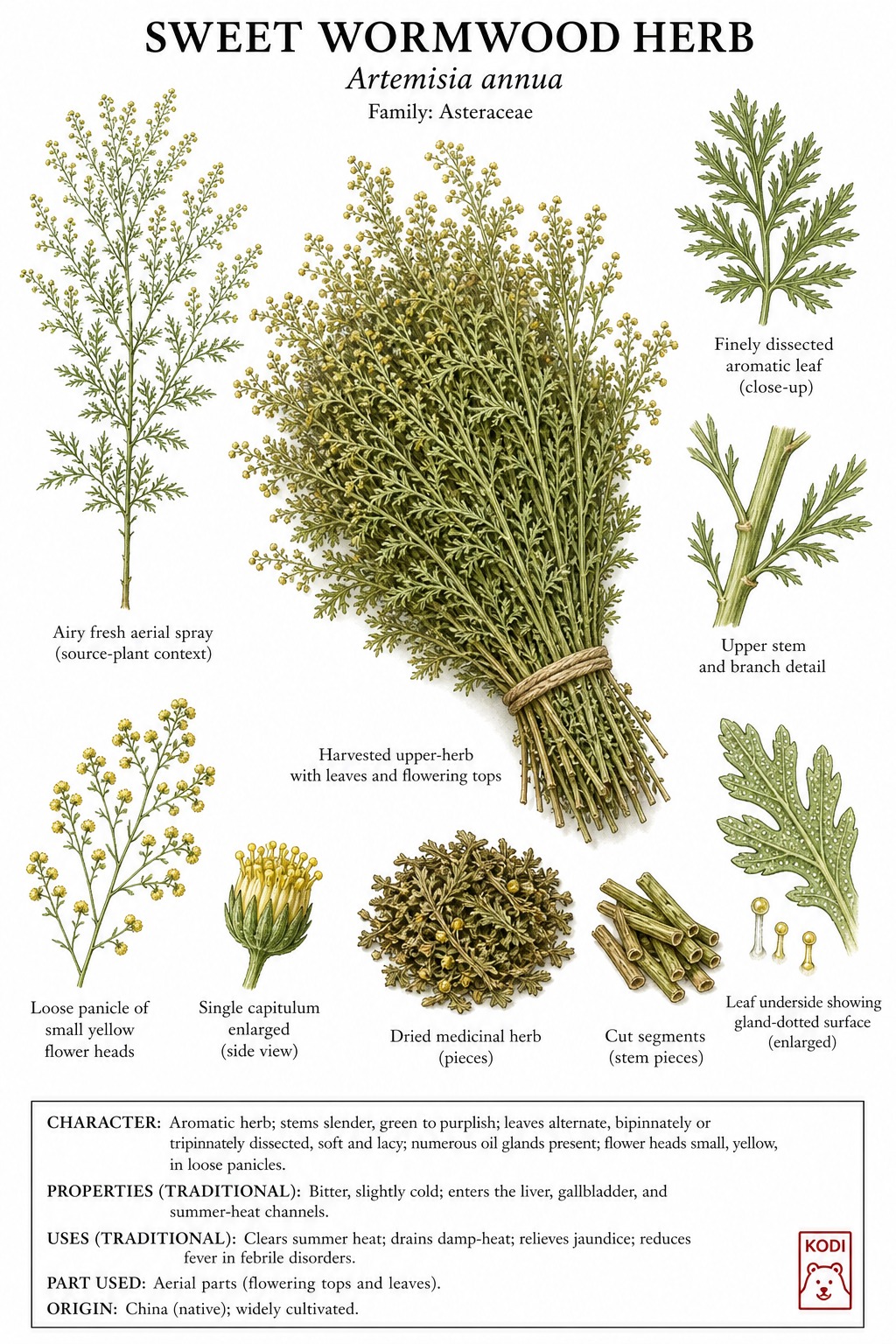
Known in TCM as Qing Hao (青蒿), this bitter and pungent, cold herb enters the Liver, Gallbladder, and Kidney. Traditionally, it clears deficiency heat and cools steaming-bone fever ... Qing Hao is a signature herb for lingering heat after febrile disease, tidal fever, and night sweats from Yin depletion, most often applied for malaria, fever, and night sweats. Modern research has identified Artemisinin among its active constituents.
Part used: Whole herb
Also Known As
Latin: Herba Artemisiae Annuae | Pinyin: Qing Hao | Chinese: 青蒿
TCM Properties
- Taste
- bitter, pungent
- Temperature
- cold
- Channels
- Liver, Gallbladder, Kidney
Traditional Use
Primary Actions
- Clears deficiency heat and cools steaming-bone fever ... Qing Hao is a signature herb for lingering heat after febrile disease, tidal fever, and night sweats from Yin depletion.
- Clears summer-heat and checks malaria ... classical use includes alternating chills and fever, warm-weather febrile disorders, and low-grade heat with thirst and chest oppression.
- Cools heat from the Blood level ... the herb is also used for heat rashes, low-grade fever with internal heat, and other warm-disease patterns where residual heat remains.
Secondary Actions
- This page stays on the clean Qing Hao lane of Artemisia annua and does not repeat the older Huang Hao wording from the already-live all-grass page.
- Qing Hao is best understood as a light, aromatic cold herb whose volatile and heat-labile character matters for preparation.
Classic Formulas
- Qing Hao Bie Jia Tang ... the defining formula for lingering deficiency heat and steaming-bone fever after warm disease.
- Hao Qin Qing Dan Tang ... uses Qing Hao to clear constrained damp-warm and Shaoyang-Gallbladder heat patterns.
- Single-herb malaria use recorded by Ge Hong ... the classic cold-water extraction tradition that later helped guide artemisinin discovery.
Classical References
- Ge Hong's Zhou Hou Bei Ji Fang famously records wringing out the juice of Qing Hao in water for malaria, a preparation detail later cited in the artemisinin discovery story.
- Traditional herbology describes Qing Hao as bitter, pungent, and cold, entering the Liver, Gallbladder, and Kidney to clear deficiency heat and summer-heat.
Modern Research
Active Compounds
- Artemisinin and related sesquiterpene lactones
- Artemisinic acid and related terpenoid precursors
- Flavonoids such as artemetin and related phenolics
- Volatile oils that contribute to the herb's aromatic identity
Studied Effects
- A 2017 review traced the path from Artemisia annua as an ancient herb to artemisinin as a modern drug platform, especially in oncology and antimalarial science (PMID 28254675).
- A 2020 review summarized traditional use, phytochemistry, and broad pharmacology for Artemisia annua, confirming that modern interest now extends far beyond malaria alone (PMID 32758647).
- Extracts of Artemisia annua leaves and seeds induced programmed cell death in Leishmania donovani, showing continuing experimental interest in the whole plant and not only purified artemisinin derivatives (PMID 22956747).
PubMed References
Safety & Interactions
Contraindications
- Spleen-Stomach deficiency cold with chronic loose stools
- Use of crude herb as a substitute for standard malaria treatment
Cautions
- Preparation matters ... prolonged boiling can reduce the volatile and heat-sensitive fraction traditionally associated with Qing Hao.
- The whole herb and purified artemisinin-based medicines are related but not interchangeable.
- Pregnancy safety for unsupervised medicinal use is not established, and artemisinin derivatives carry clearer first-trimester concerns.
Drug Interactions
- Possible interaction with CYP3A4 or CYP2B6 substrate drugs when artemisinin-rich preparations are used repeatedly
Conditions
Frequently Asked Questions
What is Sweet Wormwood Herb used for?
Sweet Wormwood Herb is traditionally used to Clears deficiency heat and cools steaming-bone fever ... Qing Hao is a signature herb for lingering heat after febrile disease, tidal fever, and night sweats from Yin depletion., Clears summer-heat and checks malaria ... classical use includes alternating chills and fever, warm-weather febrile disorders, and low-grade heat with thirst and chest oppression., Cools heat from the Blood level ... the herb is also used for heat rashes, low-grade fever with internal heat, and other warm-disease patterns where residual heat remains.. Research has investigated its effects on: A 2017 review traced the path from Artemisia annua as an ancient herb to artemisinin as a modern drug platform, especially in oncology and antimalarial science (PMID 28254675).; A 2020 review summarized traditional use, phytochemistry, and broad pharmacology for Artemisia annua, confirming that modern interest now extends far beyond malaria alone (PMID 32758647)..
What are other names for Sweet Wormwood Herb?
Sweet Wormwood Herb is also known as Artemisia annua herb, Qinghao, Sweet wormwood. In TCM: 青蒿 (Qing Hao); Herba Artemisiae Annuae.
Is Sweet Wormwood Herb safe during pregnancy?
Sweet Wormwood Herb is not recommended during pregnancy. Pregnancy safety for unsupervised medicinal use is not established, and artemisinin derivatives carry clearer first-trimester concerns.
What are the contraindications for Sweet Wormwood Herb?
Sweet Wormwood Herb should not be used in: Spleen-Stomach deficiency cold with chronic loose stools; Use of crude herb as a substitute for standard malaria treatment. Consult a qualified healthcare provider before use.
Does Sweet Wormwood Herb interact with any medications?
Sweet Wormwood Herb may interact with: Possible interaction with CYP3A4 or CYP2B6 substrate drugs when artemisinin-rich preparations are used repeatedly. Always inform your healthcare provider of any herbal supplements you are taking.