Sucrose
- Chinese
- 蔗糖
- Pinyin
- Zhe Tang
- Latin
- Sucrosum
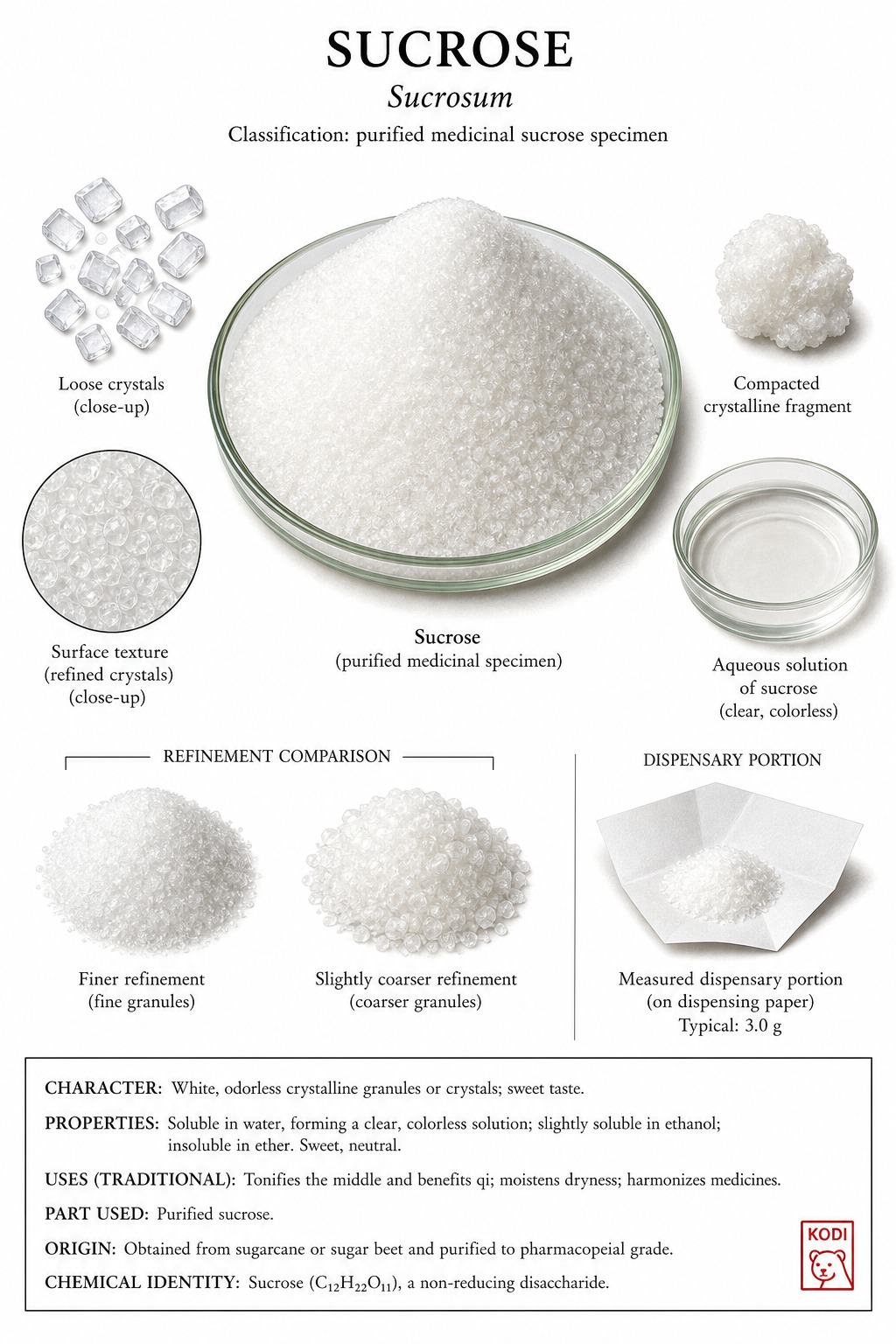
Known in TCM as Zhe Tang (蔗糖), this sweet, neutral herb enters the Lung and Spleen. Traditionally, it harmonizes the middle and eases mild weakness ... sucrose appears in medicinal food practice as a gentle supportive sweet for depleted appetite, mild abdominal discomfort, and recovery states, most often applied for dry cough, cough, and poor appetite. Modern research has identified Sucrose among its active constituents.
Part used: Sucrose
Also Known As
Latin: Sucrosum | Pinyin: Zhe Tang | Chinese: 蔗糖
TCM Properties
- Taste
- sweet
- Temperature
- neutral
- Channels
- Lung, Spleen
Traditional Use
Primary Actions
- Harmonizes the middle and eases mild weakness ... sucrose appears in medicinal food practice as a gentle supportive sweet for depleted appetite, mild abdominal discomfort, and recovery states.
- Moistens dryness and relieves dry cough ... simple syrup-like preparations are used to soothe throat dryness and soften irritating cough.
- Generates fluids and relieves thirst ... sweet water or syrup preparations are a traditional support measure when dryness and heat have mildly depleted fluids.
Secondary Actions
- This page stays documentary and pharmacy-material-forward, sitting beside the already-live granulated-sugar and crystal-sugar pages rather than pretending refined sucrose is a phytochemical herb.
- The medicinal role is supportive, dietetic, and short-course, not a stand-alone treatment strategy.
Classic Formulas
- Simple sugar water ... a traditional convalescent support for thirst, dryness, and mild weakness.
- Pear and sucrose household preparations ... a food-medicine lane for dry throat and dry cough.
- Powder or pill sweetening medium ... sucrose is often a carrier that improves palatability rather than the main active medicinal force.
Classical References
- Traditional summaries place refined sugar among gentle food-medicine supports that moisten dryness and harmonize the middle rather than among forceful crude herbs.
- Its use overlaps strongly with everyday kitchen practice, which is why modern monograph treatment should stay narrow and conservative.
Modern Research
Active Compounds
- Sucrose ... the dominant disaccharide and principal functional constituent
- A simple water-soluble sugar matrix rather than a phytochemical-rich herb profile
- Trace process-dependent mineral residues that are usually negligible in refined material
Studied Effects
- Indexed modern literature on sucrose as a distinct medicinal herb is sparse because the substance is primarily a refined food ingredient and pharmaceutical sweetening vehicle.
- Its present-day relevance in Chinese medicine remains mostly dietetic and formulation-based rather than pharmacologically herb-specific.
- Modern safety discussion centers on glycemic load, dental burden, and overuse rather than on hidden herbal pharmacology.
Safety & Interactions
Contraindications
- Poorly controlled diabetes
- Pronounced damp-phlegm accumulation with sluggish digestion
Cautions
- Medicinal food use still adds meaningful sugar load and may be inappropriate in hyperglycemia, metabolic syndrome, or severe dental disease.
- This record is for refined sucrose as a support ingredient, not for high-dose self-treatment of chronic cough, severe dehydration, or digestive disease.
Conditions
- Dry Cough Traditional ★★☆☆☆ JSON
- Cough Traditional ★☆☆☆☆ JSON
- Poor Appetite Traditional ★☆☆☆☆ JSON
- Abdominal Pain Traditional ★☆☆☆☆ JSON
Frequently Asked Questions
What is Sucrose used for?
Sucrose is traditionally used to Harmonizes the middle and eases mild weakness ... sucrose appears in medicinal food practice as a gentle supportive sweet for depleted appetite, mild abdominal discomfort, and recovery states., Moistens dryness and relieves dry cough ... simple syrup-like preparations are used to soothe throat dryness and soften irritating cough., Generates fluids and relieves thirst ... sweet water or syrup preparations are a traditional support measure when dryness and heat have mildly depleted fluids.. Research has investigated its effects on: Indexed modern literature on sucrose as a distinct medicinal herb is sparse because the substance is primarily a refined food ingredient and pharmaceutical sweetening vehicle.; Its present-day relevance in Chinese medicine remains mostly dietetic and formulation-based rather than pharmacologically herb-specific..
What are other names for Sucrose?
Sucrose is also known as Refined sugar, Sugar. In TCM: 蔗糖 (Zhe Tang); Sucrosum.
Is Sucrose safe during pregnancy?
The safety of Sucrose during pregnancy has not been established. Consult a qualified healthcare provider before use.
What are the contraindications for Sucrose?
Sucrose should not be used in: Poorly controlled diabetes; Pronounced damp-phlegm accumulation with sluggish digestion. Consult a qualified healthcare provider before use.