Spatholobus Stem
- Chinese
- 鸡血藤
- Pinyin
- Ji Xue Teng
- Latin
- Caulis Spatholobi
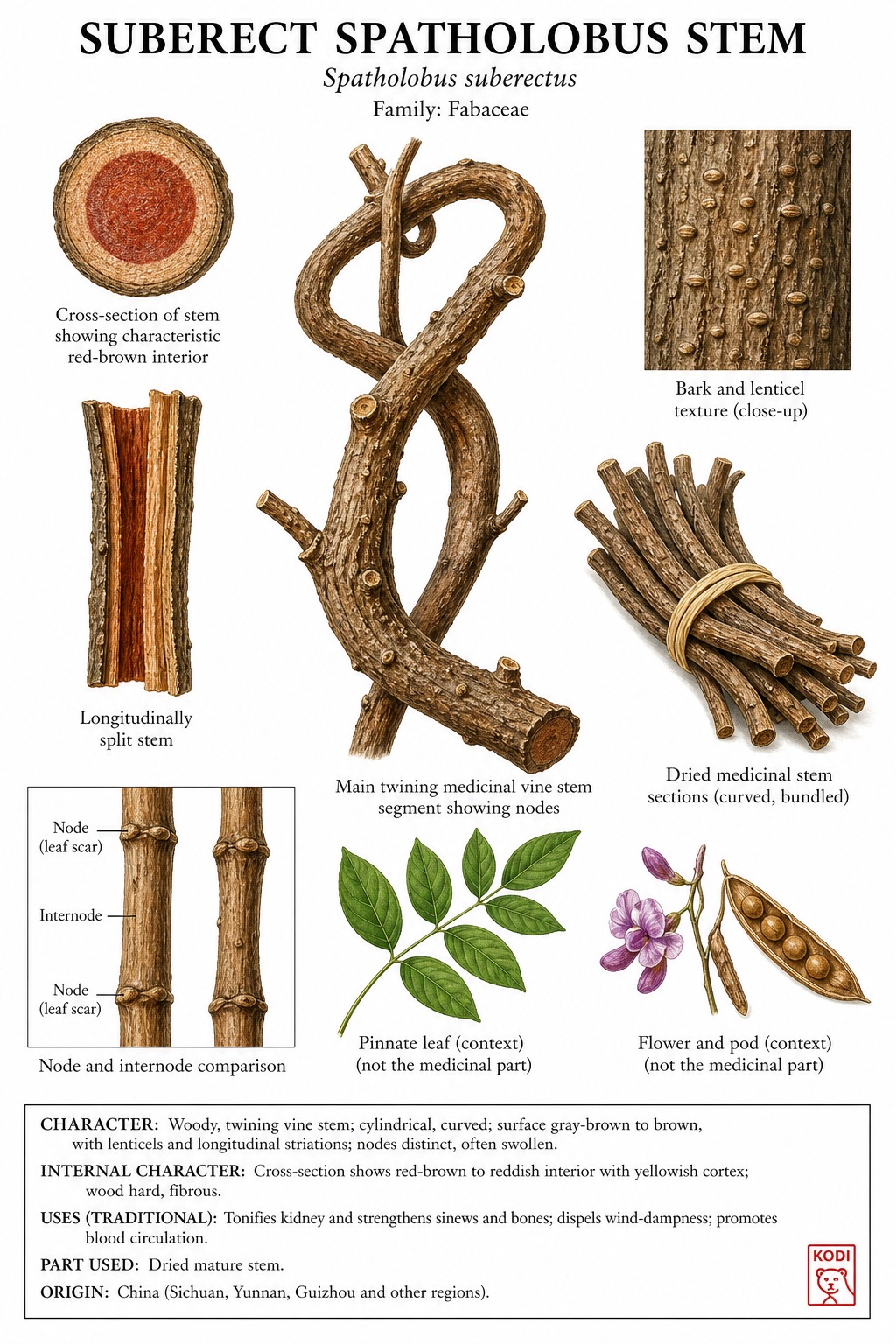
Known in TCM as Ji Xue Teng (鸡血藤), this bitter and sweet, warm herb enters the Heart, Liver, and Kidney. Traditionally, it invigorates Blood and tonifies Blood ... Ji Xue Teng is valued for moving stagnant Blood while still nourishing depleted Blood, especially in menstrual and collateral disorders, most often applied for amenorrhea, dysmenorrhea, and rheumatoid arthritis. Modern research has identified Flavonoids among its active constituents.
Part used: Stem
Also Known As
Latin: Caulis Spatholobi | Pinyin: Ji Xue Teng | Chinese: 鸡血藤
TCM Properties
- Taste
- bitter, sweet
- Temperature
- warm
- Channels
- Heart, Liver, Kidney
Traditional Use
Primary Actions
- Invigorates Blood and tonifies Blood ... Ji Xue Teng is valued for moving stagnant Blood while still nourishing depleted Blood, especially in menstrual and collateral disorders.
- Regulates menstruation and alleviates pain ... it is widely used for painful periods, irregular bleeding patterns, and amenorrhea when Blood deficiency and Blood stasis overlap.
- Relaxes the sinews and unblocks the collaterals ... the vine stem is a classic choice for numbness, weakness, and wind-damp pain in the limbs and joints.
Secondary Actions
- True Ji Xue Teng is the dried vine stem of Spatholobus suberectus and should stay distinct from the many regional substitutes historically sold under the same common name.
- Its hallmark is the red juice and blood-red cross-section, which is why this record stays strongly stem-forward rather than drifting into broader botanical or food descriptions.
Classic Formulas
- Ji Xue Teng with Dang Gui or Bai Shao ... common gynecologic pairing logic when Blood deficiency and Blood stasis coexist.
- Ji Xue Teng with Du Huo or Sang Ji Sheng ... traditional channel-opening and sinew-support strategy for chronic bi pain, numbness, and weakness.
- Modern hematology and menstrual patent formulas ... a common inclusion when the treatment goal is to nourish and move Blood at the same time.
Classical References
- Modern TCM teaching emphasizes Ji Xue Teng as a rare herb that moves without breaking and nourishes without creating stagnation.
- Its accepted pharmacopoeial source is Spatholobus suberectus Dunn, even though older regional trade often mixed other red-sap vines into the Ji Xue Teng name.
Modern Research
Active Compounds
- Flavonoids and isoflavonoids from Spatholobus suberectus stem
- Catechin and procyanidin-type polyphenols
- Phenolic constituents associated with anti-inflammatory and circulation-focused activity
Studied Effects
- A 2023 systematic review summarized the traditional uses, chemistry, pharmacology, and clinical applications of Spatholobi caulis, confirming how central Ji Xue Teng remains in blood and circulation research (PMID 37393029).
- A 2019 study found characteristic constituents from the vine stems of Spatholobus suberectus showed anti-inflammatory activity, supporting one mechanistic layer behind its long use in painful obstruction disorders (PMID 31627460).
- A 2022 experimental study reported that Spatholobus suberectus water extract improved atopic-dermatitis-like inflammation by suppressing proinflammatory chemokines, extending modern interest beyond the herb's classical menstrual and channel-opening indications (PMID 35795574).
PubMed References
- Spatholobi caulis: A systematic review of its traditional uses, chemical constituents, biological activities and clinical applications. (2023)
- Anti-Inflammatory Activity of Some Characteristic Constituents from the Vine Stems of Spatholobus suberectus. (2019)
- Spatholobus suberectus Dunn Water Extract Ameliorates Atopic Dermatitis-Like Symptoms by Suppressing Proinflammatory Chemokine Production In Vivo and In Vitro. (2022)
Safety & Interactions
Contraindications
- Pregnancy
- Active bleeding without Blood stasis
- Loose stools or weak digestion when warm Blood-moving herbs aggravate the pattern
Cautions
- Ji Xue Teng is gentler than harsher Blood invigoration herbs, but it still moves Blood and is not a casual pregnancy-safe tonic.
- Identity matters because the Ji Xue Teng name has a long adulteration history across several unrelated red-sap vines.
Drug Interactions
- Anticoagulants or antiplatelet drugs ... use caution because the herb is traditionally Blood-moving even though direct interaction data are limited
Conditions
- Amenorrhea Traditional ★★★★☆ JSON
- Dysmenorrhea Traditional ★★★★☆ JSON
- Rheumatoid Arthritis Traditional ★★★☆☆ JSON
- Low Back Pain Traditional ★★☆☆☆ JSON
Frequently Asked Questions
What is Spatholobus Stem used for?
Spatholobus Stem is traditionally used to Invigorates Blood and tonifies Blood ... Ji Xue Teng is valued for moving stagnant Blood while still nourishing depleted Blood, especially in menstrual and collateral disorders., Regulates menstruation and alleviates pain ... it is widely used for painful periods, irregular bleeding patterns, and amenorrhea when Blood deficiency and Blood stasis overlap., Relaxes the sinews and unblocks the collaterals ... the vine stem is a classic choice for numbness, weakness, and wind-damp pain in the limbs and joints.. Research has investigated its effects on: A 2023 systematic review summarized the traditional uses, chemistry, pharmacology, and clinical applications of Spatholobi caulis, confirming how central Ji Xue Teng remains in blood and circulation research (PMID 37393029).; A 2019 study found characteristic constituents from the vine stems of Spatholobus suberectus showed anti-inflammatory activity, supporting one mechanistic layer behind its long use in painful obstruction disorders (PMID 31627460)..
What are other names for Spatholobus Stem?
Spatholobus Stem is also known as Chicken Blood Vine, Suberect spatholobus stem, Spatholobi Caulis. In TCM: 鸡血藤 (Ji Xue Teng); Caulis Spatholobi.
Is Spatholobus Stem safe during pregnancy?
Spatholobus Stem is not recommended during pregnancy. Ji Xue Teng is gentler than harsher Blood invigoration herbs, but it still moves Blood and is not a casual pregnancy-safe tonic.
What are the contraindications for Spatholobus Stem?
Spatholobus Stem should not be used in: Pregnancy; Active bleeding without Blood stasis; Loose stools or weak digestion when warm Blood-moving herbs aggravate the pattern. Consult a qualified healthcare provider before use.
Does Spatholobus Stem interact with any medications?
Spatholobus Stem may interact with: Anticoagulants or antiplatelet drugs ... use caution because the herb is traditionally Blood-moving even though direct interaction data are limited. Always inform your healthcare provider of any herbal supplements you are taking.