Stink Bug
- Chinese
- 九香虫
- Pinyin
- Jiu Xiang Chong
- Latin
- Aspongopus chinensis
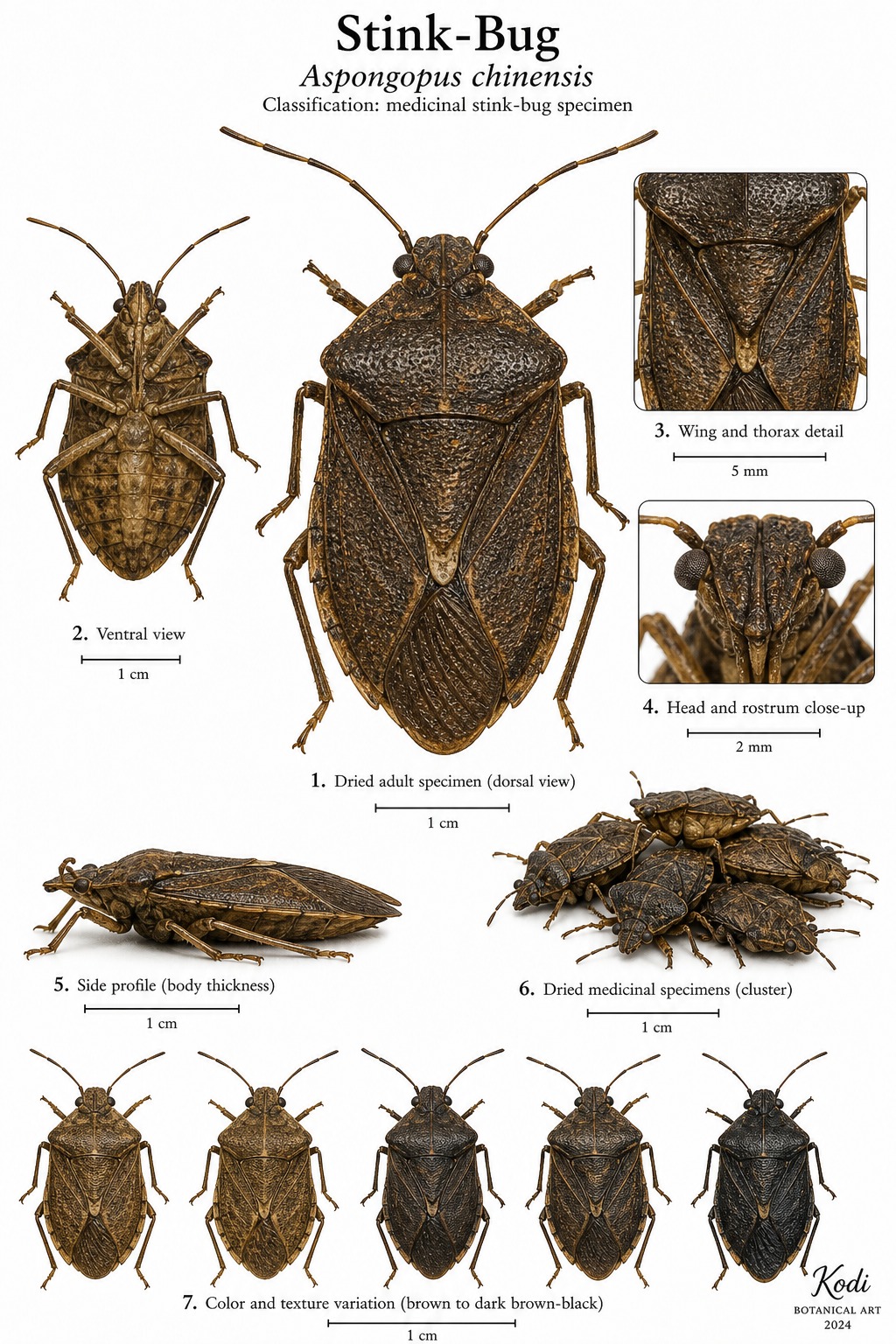
Known in TCM as Jiu Xiang Chong (九香虫), this salty, warm herb enters the Liver, Spleen, and Kidney. Traditionally, it regulates Qi and alleviates pain ... Jiu Xiang Chong is used for epigastric or abdominal pain from cold stagnation and constrained movement of Qi, most often applied for abdominal pain, impotence, and low back pain. Modern research has identified N-acetyldopamine among its active constituents.
Also Known As
Latin: Aspongopus chinensis | Pinyin: Jiu Xiang Chong | Chinese: 九香虫
TCM Properties
- Taste
- salty
- Temperature
- warm
- Channels
- Liver, Spleen, Kidney
Traditional Use
Primary Actions
- Regulates Qi and alleviates pain ... Jiu Xiang Chong is used for epigastric or abdominal pain from cold stagnation and constrained movement of Qi.
- Warms the middle and supports the Kidney ... traditional use extends to lower-back weakness, impotence, and urinary frequency tied to cold deficiency.
- Acts as a compact specimen-style animal medicament rather than a novelty insect page ... the medicinal identity is clinical and warming, not decorative.
Secondary Actions
- This record stays explicitly on Aspongopus chinensis, which is the accepted medicinal stink-bug lane behind Jiu Xiang Chong.
- Compared with stronger dramatic animal medicinals, Jiu Xiang Chong is more about warming, regulating, and relieving pain than about shock-value toxicity.
Classic Formulas
- Cold-abdominal-pain pairings with warming Qi regulators ... a common traditional lane for Jiu Xiang Chong.
- Kidney-warming combinations for low sexual vigor and urinary frequency ... used when cold deficiency is the dominant picture.
- Small-format animal-medicine powders ... a traditional dispensing route for this specimen herb.
Classical References
- Traditional Chinese materia medica places Jiu Xiang Chong among warm animal medicinals that regulate Qi, relieve pain, and support Kidney-related weakness.
- The core identity is a warming abdominal-and-lower-burner specimen herb, not a general-purpose insect tonic.
Modern Research
Active Compounds
- N-acetyldopamine trimers such as aspongamide A
- Additional insect-derived bioactive small molecules
- Fractions studied for anticoagulant and antifibrotic activity
Studied Effects
- A 2025 study investigated anticoagulant effects, active basis, and quality assessment of Aspongopus chinensis, showing that modern analysis of this medicinal insect is becoming more rigorous (PMID 40367136).
- A 2014 compound-isolation paper characterized bioactive compounds from Aspongopus chinensis, confirming that the specimen herb has chemically trackable constituents rather than being a purely folkloric curiosity (PMID 25442305).
- A 2014 study identified aspongamide A from Aspongopus chinensis as an inhibitor of p-Smad3, adding a direct molecular mechanism to modern discussion of the insect's pharmacology (PMID 24383883).
PubMed References
- Anticoagulant effects, substance basis, and quality assessment approach of Aspongopus chinensis Dallas. (2025)
- Bioactive compounds from the insect Aspongopus chinensis. (2014)
- (±)-Aspongamide A, an N-acetyldopamine trimer isolated from the insect Aspongopus chinensis, is an inhibitor of p-Smad3. (2014)
Safety & Interactions
Contraindications
- Heat patterns without cold stagnation
- Known allergy to insect-derived products
Cautions
- Animal-source authentication and contamination control matter for this specimen medicament.
- Modern pharmacology is still early and does not erase the need for conservative use framing.
Conditions
- Abdominal Pain Traditional ★★★☆☆ JSON
- Impotence Traditional ★★☆☆☆ JSON
- Low Back Pain Traditional ★★☆☆☆ JSON
- Frequent Urination Traditional ★★☆☆☆ JSON
Frequently Asked Questions
What is Stink Bug used for?
Stink Bug is traditionally used to Regulates Qi and alleviates pain ... Jiu Xiang Chong is used for epigastric or abdominal pain from cold stagnation and constrained movement of Qi., Warms the middle and supports the Kidney ... traditional use extends to lower-back weakness, impotence, and urinary frequency tied to cold deficiency., Acts as a compact specimen-style animal medicament rather than a novelty insect page ... the medicinal identity is clinical and warming, not decorative.. Research has investigated its effects on: A 2025 study investigated anticoagulant effects, active basis, and quality assessment of Aspongopus chinensis, showing that modern analysis of this medicinal insect is becoming more rigorous (PMID 40367136).; A 2014 compound-isolation paper characterized bioactive compounds from Aspongopus chinensis, confirming that the specimen herb has chemically trackable constituents rather than being a purely folkloric curiosity (PMID 25442305)..
What are other names for Stink Bug?
Stink Bug is also known as Aspongopus, Aspongopus chinensis, Jiu Xiang insect medicament. In TCM: 九香虫 (Jiu Xiang Chong); Aspongopus chinensis.
Is Stink Bug safe during pregnancy?
The safety of Stink Bug during pregnancy has not been established. Consult a qualified healthcare provider before use.
What are the contraindications for Stink Bug?
Stink Bug should not be used in: Heat patterns without cold stagnation; Known allergy to insect-derived products. Consult a qualified healthcare provider before use.