Stephania Tetrandra Root
- Chinese
- 粉防己
- Pinyin
- Fen Fang Ji
- Latin
- Radix Stephaniae Tetrandrae
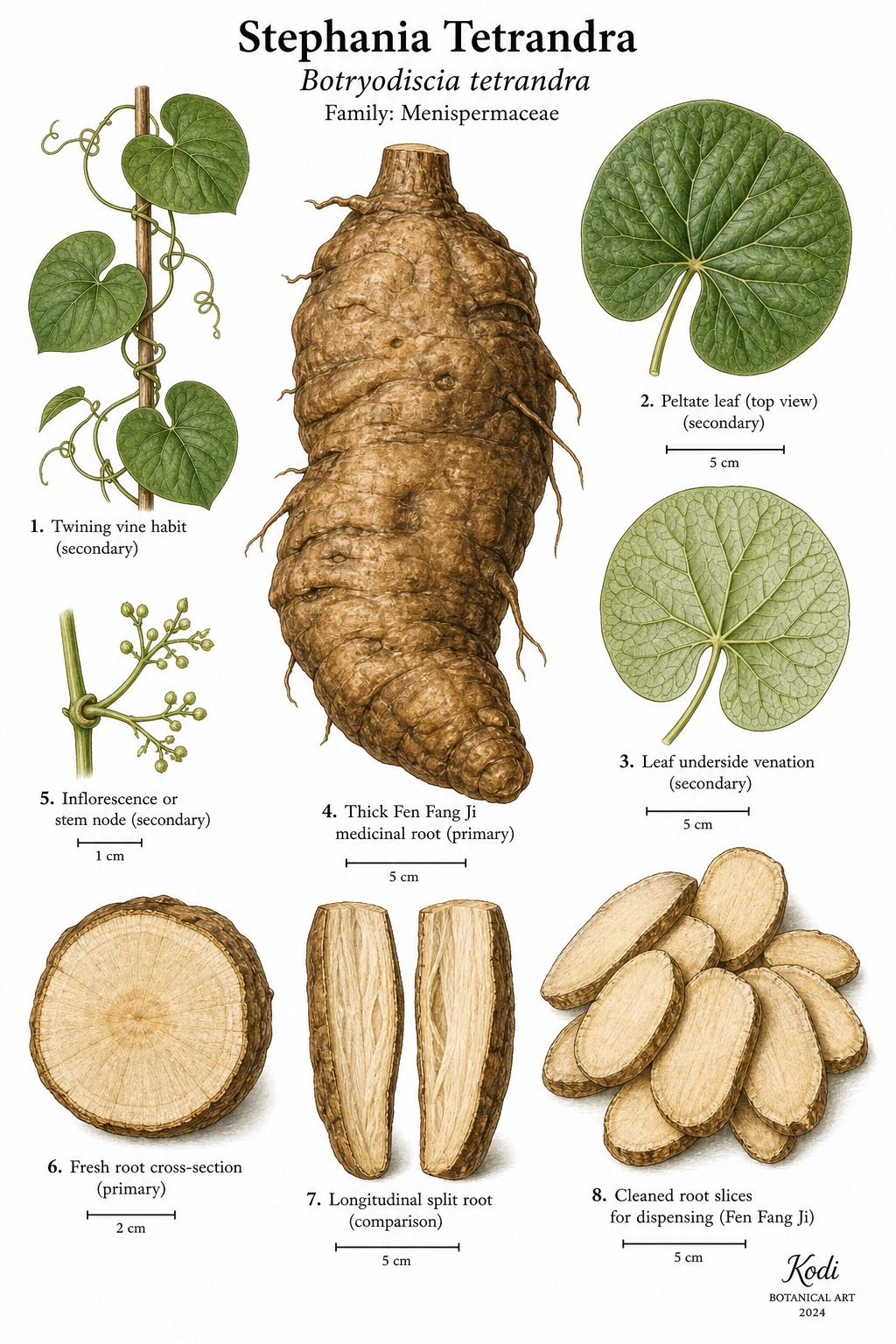
Known in TCM as Fen Fang Ji (粉防己), this bitter and pungent, cold herb enters the Liver, Kidney, and Bladder. Traditionally, it dispels wind-damp and alleviates painful obstruction ... authentic Fang Ji is especially valued for red, swollen, heavy, painful joints when damp-heat predominates, most often applied for edema, joint pain, and rheumatoid arthritis. Modern research has identified Tetrandrine among its active constituents.
Part used: Root
Also Known As
Latin: Radix Stephaniae Tetrandrae | Pinyin: Fen Fang Ji | Chinese: 粉防己
TCM Properties
- Taste
- bitter, pungent
- Temperature
- cold
- Channels
- Liver, Kidney, Bladder
Traditional Use
Primary Actions
- Dispels wind-damp and alleviates painful obstruction ... authentic Fang Ji is especially valued for red, swollen, heavy, painful joints when damp-heat predominates.
- Promotes urination and reduces edema ... it is used for lower-body swelling, difficult urination, and damp accumulation in the lower burner.
- Clears damp-heat from the skin and limbs ... traditional use extends to eczema, damp sores, and painful swelling of the feet and legs.
Secondary Actions
- This page preserves the accepted species-name lane on authentic Fen Fang Ji and should not be confused with Guang Fang Ji or other unsafe substitutions.
- Recent taxonomy accepts the authentic source as `Botryodiscia tetrandra`, while much of the indexed literature remains under `Stephania tetrandra`; both point to the same authenticated medicinal lineage here.
Classic Formulas
- Fang Ji Huang Qi Tang ... classic edema and wind-damp formula in which Fang Ji promotes urination while relieving painful heaviness.
- Fang Ji Fu Ling Tang ... water-damp formula lineage that uses Fang Ji for edema and difficult urination.
- Xuan Bi Tang ... damp-heat bi formula that highlights Fang Ji for hot, swollen, painful joints.
Classical References
- Traditional herbology consistently places Fang Ji in both edema formulas and damp-heat painful-obstruction formulas, especially when swelling and heaviness are prominent.
- Identity is safety-critical because the Fang Ji name has historically been shared across multiple plant lineages, not all of them safe.
Modern Research
Active Compounds
- Tetrandrine
- Fangchinoline
- Cycleanine and related bisbenzylisoquinoline alkaloids
Studied Effects
- A critical 2020 review summarized the traditional uses, phytochemistry, pharmacology, and toxicology of authentic Fang Ji under the literature name Stephania tetrandra, reinforcing its roles in anti-inflammatory and immunomodulatory research (PMID 32336965).
- A second 2020 review focused specifically on the history of uses, phytochemistry, pharmacological activities, quality control, and toxicity of the root of Stephania tetrandra, giving a strong modern overview of the medicinal root itself (PMID 32497674).
- A 2008 authentication study highlighted the importance of differentiating authentic Stephania tetrandra Fang Ji from common adulterants, which remains clinically relevant because naming confusion carries real safety consequences (PMID 18404356).
PubMed References
- A critical review: traditional uses, phytochemistry, pharmacology and toxicology of Stephania tetrandra S. Moore (Fen Fang Ji). (2020)
- History of uses, phytochemistry, pharmacological activities, quality control and toxicity of the root of Stephania tetrandra S. Moore: A review. (2020)
- Authentication of Stephania tetrandra S. Moore (Fang Ji) and differentiation of its common adulterants using microscopy and HPLC analysis. (2008)
Safety & Interactions
Contraindications
- Weak appetite, marked Spleen-Stomach deficiency, or frail constitution without true damp-heat
- Use of unverified Fang Ji products because aristolochia substitution is unacceptable
Cautions
- Verify that the product is authentic Han Fang Ji ... confusion with Guang Fang Ji and other Aristolochia materials carries severe nephrotoxic risk.
- Potent alkaloids such as tetrandrine and fangchinoline give the herb meaningful pharmacologic activity, so supervised dosing is prudent.
- Recent taxonomy changes do not reduce the old substitution hazard ... the main safety question is still source authentication.
Conditions
- Edema Traditional ★★★★☆ JSON
- Joint Pain Traditional ★★★★☆ JSON
- Rheumatoid Arthritis Traditional ★★★☆☆ JSON
- Eczema Traditional ★★☆☆☆ JSON
Frequently Asked Questions
What is Stephania Tetrandra Root used for?
Stephania Tetrandra Root is traditionally used to Dispels wind-damp and alleviates painful obstruction ... authentic Fang Ji is especially valued for red, swollen, heavy, painful joints when damp-heat predominates., Promotes urination and reduces edema ... it is used for lower-body swelling, difficult urination, and damp accumulation in the lower burner., Clears damp-heat from the skin and limbs ... traditional use extends to eczema, damp sores, and painful swelling of the feet and legs.. Research has investigated its effects on: A critical 2020 review summarized the traditional uses, phytochemistry, pharmacology, and toxicology of authentic Fang Ji under the literature name Stephania tetrandra, reinforcing its roles in anti-inflammatory and immunomodulatory research (PMID 32336965).; A second 2020 review focused specifically on the history of uses, phytochemistry, pharmacological activities, quality control, and toxicity of the root of Stephania tetrandra, giving a strong modern overview of the medicinal root itself (PMID 32497674)..
What are other names for Stephania Tetrandra Root?
Stephania Tetrandra Root is also known as Fang Ji Root, Han Fang Ji, Botryodiscia tetrandra. In TCM: 粉防己 (Fen Fang Ji); Radix Stephaniae Tetrandrae.
Is Stephania Tetrandra Root safe during pregnancy?
The safety of Stephania Tetrandra Root during pregnancy has not been established. Consult a qualified healthcare provider before use.
What are the contraindications for Stephania Tetrandra Root?
Stephania Tetrandra Root should not be used in: Weak appetite, marked Spleen-Stomach deficiency, or frail constitution without true damp-heat; Use of unverified Fang Ji products because aristolochia substitution is unacceptable. Consult a qualified healthcare provider before use.