Entada Seed and Stem
- Chinese
- 榼藤子仁
- Pinyin
- Ke Teng Zi Ren
- Latin
- Semen Entadae Phaseoloidis
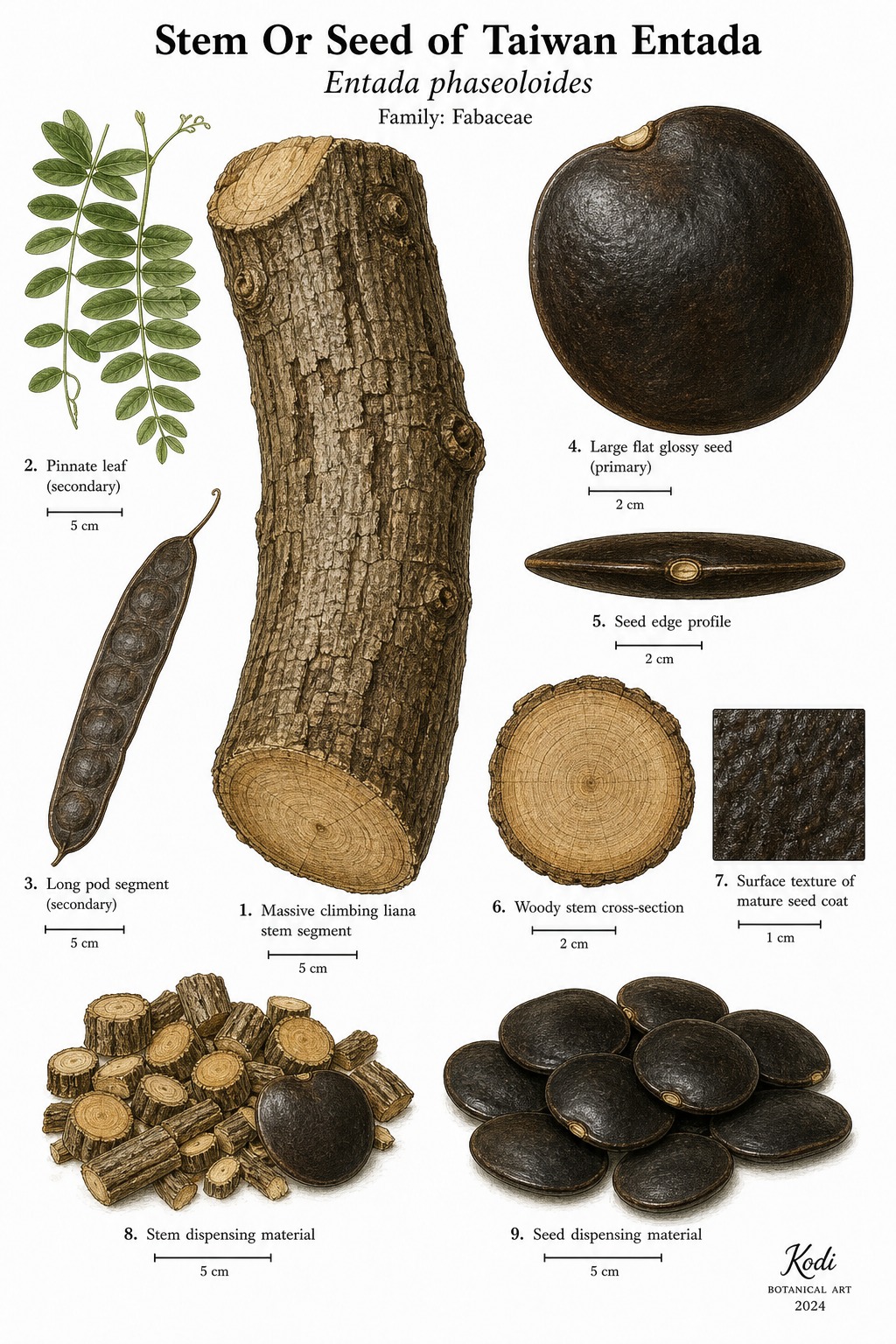
Known in TCM as Ke Teng Zi Ren (榼藤子仁), this slightly bitter, cool herb enters the Liver, Spleen, Stomach, and Kidney. Traditionally, it strengthens the middle and supports recovery from weakness ... many modern Chinese materia-medica summaries describe Ke Teng Zi Ren as helping poor appetite, low intake, and depleted post-illness states, most often applied for poor appetite, joint pain, and low back pain. Modern research has identified Triterpene among its active constituents.
Part used: Seed
Also Known As
Latin: Semen Entadae Phaseoloidis | Pinyin: Ke Teng Zi Ren | Chinese: 榼藤子仁
TCM Properties
- Taste
- slightly bitter
- Temperature
- cool
- Channels
- Liver, Spleen, Stomach, Kidney
Traditional Use
Primary Actions
- Strengthens the middle and supports recovery from weakness ... many modern Chinese materia-medica summaries describe Ke Teng Zi Ren as helping poor appetite, low intake, and depleted post-illness states.
- Dispels wind-damp and relieves pain ... traditional use extends to aching sinews, weak low back, and painful obstruction with a deficiency component.
- Supports sinews and bones in regional practice ... the lane often sits between tonic seed use and tougher liana-stem use rather than belonging purely to one or the other.
Secondary Actions
- This page intentionally balances stem and seed identity because the site's taxonomy notes treat the imported record as a mixed liana-stem and seed lane rather than collapsing it into a giant-seed novelty page.
- Even so, the seed remains the more clearly defined medicinal core in many modern records, so the stem emphasis should stay secondary.
Classic Formulas
- Digestive-support and fatigue combinations ... a regional lane for weak appetite and undernourished states.
- Wind-damp and low-back-pain pairings ... used when deficiency and pain overlap.
- Sinew-and-bone support decoctions ... more common in regional practice than in famous national formulas.
Classical References
- Current Chinese herb summaries often describe Ke Teng Zi Ren as mildly bitter, cool, slightly toxic, and useful for strengthening digestion while relieving wind-damp pain.
- This is not one of the major high-traffic canonical TCM seeds, so conservative documentation is more accurate than pretending there is a huge uniform formula tradition.
Modern Research
Active Compounds
- Triterpene saponins
- Phenolic and tannin-rich fractions
- Additional stem-and-seed anti-inflammatory constituents
Studied Effects
- A 2018 review summarized the biological activity of Entada phaseoloides and Entada rheedei, providing the best broad modern overview for the medicinal Entada lane behind this record (PMID 29124496).
- A 2015 constituent paper identified triterpene saponins with anti-inflammatory activity from the stems of Entada phaseoloides, supporting the site's decision to keep stem material visibly in the record rather than seed-only (PMID 25759122).
- A 2011 experimental study reported anti-inflammatory effects from topical application of Entada phaseoloides seeds as paste and ointment, giving direct seed-lane support on the other side of the mixed record (PMID 22361498).
PubMed References
- Biological activity of Entada phaseoloides and Entada rheedei. (2018)
- Triterpene saponins with anti-inflammatory activity from the stems of Entada phaseoloides. (2015)
- Experimental evaluation of anti-inflammatory effect of topical application of entada phaseoloides seeds as paste and ointment. (2011)
Safety & Interactions
Cautions
- This record bridges seed and stem traditions, so product-part identification matters more than with simpler single-part herbs.
- Some modern summaries describe the medicinal as slightly toxic, so cautious sourcing and dose discipline are appropriate.
Conditions
- Poor Appetite Traditional ★★☆☆☆ JSON
- Joint Pain Traditional ★★☆☆☆ JSON
- Low Back Pain Traditional ★★☆☆☆ JSON
- Fatigue Traditional ★☆☆☆☆ JSON
Frequently Asked Questions
What is Entada Seed and Stem used for?
Entada Seed and Stem is traditionally used to Strengthens the middle and supports recovery from weakness ... many modern Chinese materia-medica summaries describe Ke Teng Zi Ren as helping poor appetite, low intake, and depleted post-illness states., Dispels wind-damp and relieves pain ... traditional use extends to aching sinews, weak low back, and painful obstruction with a deficiency component., Supports sinews and bones in regional practice ... the lane often sits between tonic seed use and tougher liana-stem use rather than belonging purely to one or the other.. Research has investigated its effects on: A 2018 review summarized the biological activity of Entada phaseoloides and Entada rheedei, providing the best broad modern overview for the medicinal Entada lane behind this record (PMID 29124496).; A 2015 constituent paper identified triterpene saponins with anti-inflammatory activity from the stems of Entada phaseoloides, supporting the site's decision to keep stem material visibly in the record rather than seed-only (PMID 25759122)..
What are other names for Entada Seed and Stem?
Entada Seed and Stem is also known as Entada phaseoloides, Ke Teng Zi, Liana stem and seed lane. In TCM: 榼藤子仁 (Ke Teng Zi Ren); Semen Entadae Phaseoloidis.
Is Entada Seed and Stem safe during pregnancy?
The safety of Entada Seed and Stem during pregnancy has not been established. Consult a qualified healthcare provider before use.