Ding Gong Teng Stem
- Chinese
- 丁公藤
- Pinyin
- Ding Gong Teng
- Latin
- Caulis Erycibes
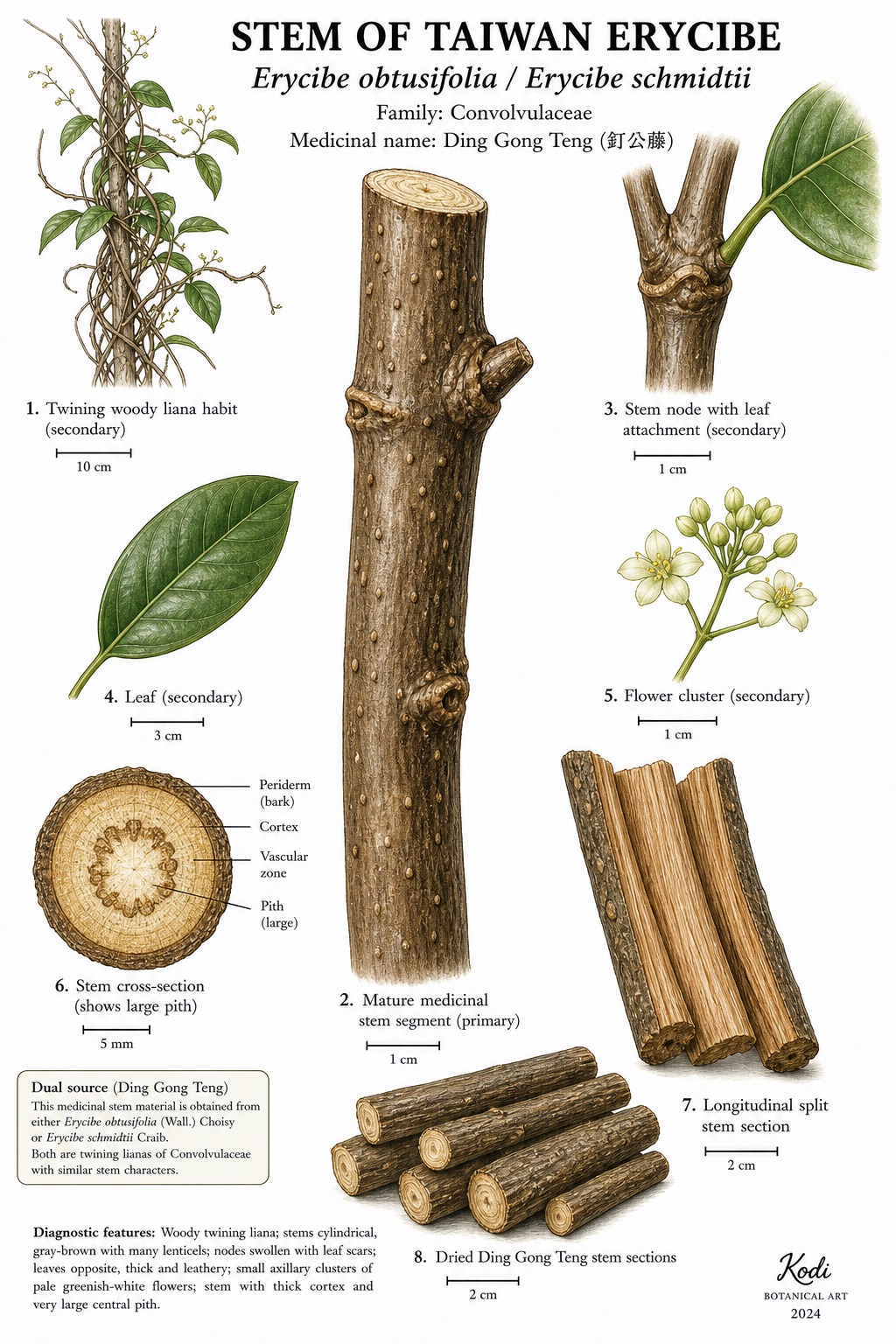
Known in TCM as Ding Gong Teng (丁公藤), this pungent, warm herb enters the Liver, Spleen, and Stomach. Traditionally, it dispels wind-damp and alleviates pain ... Ding Gong Teng is used for painful obstruction, numbness, and limited movement in the limbs and lower back, most often applied for rheumatoid arthritis, joint pain, and traumatic injury. Modern research has identified Scopolin among its active constituents.
Part used: Stem
Also Known As
Latin: Caulis Erycibes | Pinyin: Ding Gong Teng | Chinese: 丁公藤
TCM Properties
- Taste
- pungent
- Temperature
- warm
- Channels
- Liver, Spleen, Stomach
Traditional Use
Primary Actions
- Dispels wind-damp and alleviates pain ... Ding Gong Teng is used for painful obstruction, numbness, and limited movement in the limbs and lower back.
- Unblocks the collaterals ... traditional use extends to chronic rheumatic pain and post-traumatic stiffness where movement has become difficult.
- Has a slightly toxic warm channel-opening profile ... it is chosen more for stubborn obstruction than for frail patients needing gentle support.
Secondary Actions
- This page stays on the conservative dual-source Ding Gong Teng lane because modern literature and trade records commonly discuss both Erycibe obtusifolia and related authenticated sources.
- Compared with colder anti-rheumatic vines, Ding Gong Teng is more warming and more caution-worthy.
Classic Formulas
- Wind-damp painful-obstruction modifications ... especially when chronic pain and stiffness dominate.
- Regional rheumatic pain combinations with channel-opening and blood-moving herbs ... a common traditional lane for difficult bi patterns.
- Trauma and low-back-pain pairings ... used when obstruction lingers after injury.
Classical References
- Traditional herb references describe Ding Gong Teng as a warm pain-relieving vine that dispels wind-damp and frees the collaterals.
- Its mild toxicity and strong channel-opening nature are part of the herb's identity and should not be minimized.
Modern Research
Active Compounds
- Scopolin and related coumarins
- Additional stem-and-root constituents with anti-inflammatory interest
- Bioactive fractions studied for antiviral and analgesic activity
Studied Effects
- A 2009 paper reported that scopolin isolated from Erycibe obtusifolia stems suppressed adjuvant-induced arthritis in rats by inhibiting inflammation and angiogenesis, directly supporting the herb's rheumatic-pain lane (PMID 19327410).
- A 2013 study identified chemical constituents from the roots and stems of Erycibe obtusifolia and found in vitro antiviral activity, showing broader pharmacologic interest in the medicinal stem (PMID 24081686).
- A 1998 toxicology study documented toxic effects of Erycibe obtusifolia in mice, reinforcing that the herb's slightly toxic reputation deserves to stay visible in the modern record (PMID 9741881).
PubMed References
- Scopolin isolated from Erycibe obtusifolia Benth stems suppresses adjuvant-induced rat arthritis by inhibiting inflammation and angiogenesis. (2009)
- Chemical constituents from the roots and stems of Erycibe obtusifolia and their in vitro antiviral activity. (2013)
- Toxic effects of Erycibe obtusifolia, a Chinese medicinal herb, in mice. (1998)
Safety & Interactions
Contraindications
- Pregnancy
- Frailty or deficiency patterns without true obstruction
Cautions
- Ding Gong Teng is regarded as slightly toxic and should be used with sourced, authenticated pharmacy material rather than improvised wild vine substitutes.
- The modern literature includes acute-toxicity signals, so dose discipline matters.
Conditions
- Rheumatoid Arthritis Traditional ★★★☆☆ JSON
- Joint Pain Traditional ★★★☆☆ JSON
- Traumatic Injury Traditional ★★☆☆☆ JSON
- Low Back Pain Traditional ★★☆☆☆ JSON
Frequently Asked Questions
What is Ding Gong Teng Stem used for?
Ding Gong Teng Stem is traditionally used to Dispels wind-damp and alleviates pain ... Ding Gong Teng is used for painful obstruction, numbness, and limited movement in the limbs and lower back., Unblocks the collaterals ... traditional use extends to chronic rheumatic pain and post-traumatic stiffness where movement has become difficult., Has a slightly toxic warm channel-opening profile ... it is chosen more for stubborn obstruction than for frail patients needing gentle support.. Research has investigated its effects on: A 2009 paper reported that scopolin isolated from Erycibe obtusifolia stems suppressed adjuvant-induced arthritis in rats by inhibiting inflammation and angiogenesis, directly supporting the herb's rheumatic-pain lane (PMID 19327410).; A 2013 study identified chemical constituents from the roots and stems of Erycibe obtusifolia and found in vitro antiviral activity, showing broader pharmacologic interest in the medicinal stem (PMID 24081686)..
What are other names for Ding Gong Teng Stem?
Ding Gong Teng Stem is also known as Erycibe obtusifolia stem, Erycibe schmidtii stem, Ding Gong vine. In TCM: 丁公藤 (Ding Gong Teng); Caulis Erycibes.
Is Ding Gong Teng Stem safe during pregnancy?
Ding Gong Teng Stem is not recommended during pregnancy.
What are the contraindications for Ding Gong Teng Stem?
Ding Gong Teng Stem should not be used in: Pregnancy; Frailty or deficiency patterns without true obstruction. Consult a qualified healthcare provider before use.