Manchurian Dutchmanspipe Stem
- Chinese
- 关木通
- Pinyin
- Guan Mu Tong
- Latin
- Caulis Aristolochiae Manshuriensis
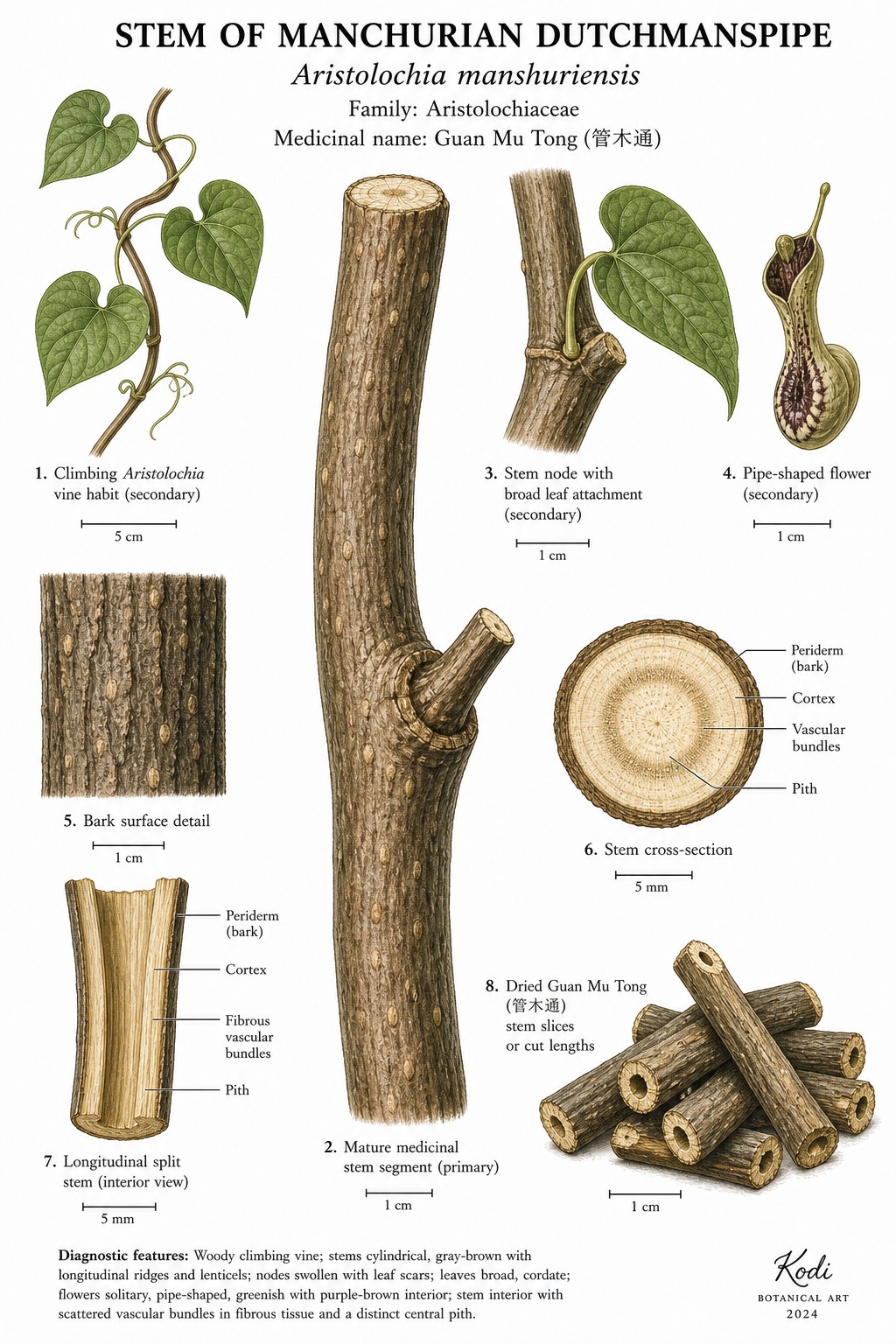
Known in TCM as Guan Mu Tong (关木通), this bitter, cold herb enters the Heart, Small Intestine, and Bladder. Traditionally, it historically cleared Heart fire and drained damp-heat through urination ... older prescribing traditions placed Guan Mu Tong in the broader Mu Tong family for mouth sores, dark painful urine, and heat-strangury patterns, most often applied for urinary tract infection, mouth sores, and insufficient lactation. Modern research has identified Aristolochic among its active constituents.
Part used: Stem
Also Known As
Latin: Caulis Aristolochiae Manshuriensis | Pinyin: Guan Mu Tong | Chinese: 关木通
TCM Properties
- Taste
- bitter
- Temperature
- cold
- Channels
- Heart, Small Intestine, Bladder
Traditional Use
Primary Actions
- Historically cleared Heart fire and drained damp-heat through urination ... older prescribing traditions placed Guan Mu Tong in the broader Mu Tong family for mouth sores, dark painful urine, and heat-strangury patterns.
- Historically promoted urination and unblocked the channels ... it also appeared in older records for edema, lactation problems, and certain painful obstructions.
- The modern meaning of this page is overwhelmingly toxicological ... Guan Mu Tong is preserved here as a documented dangerous historical identity, not as a current routine herb recommendation.
Secondary Actions
- This page must stay sharply distinct from safe Mu Tong substitutes such as Chuan Mu Tong and authenticated Akebia stems because the naming overlap caused real kidney failure and cancer cases.
- The most important clinical lesson is that old formula names containing Mu Tong are not sufficient ... the source species must be verified.
Classic Formulas
- Historical Mu Tong family use in damp-heat strangury and mouth-sore formulas ... documentary context only.
- Dao Chi San and Ba Zheng San style logic ... relevant here only as a reminder that older naming did not reliably protect patients from aristolochia substitution.
- Lactation and amenorrhea applications mirrored the safer Mu Tong substitutes on paper, which is exactly why the historical confusion was so dangerous.
Classical References
- Older materia medica often treated Guan Mu Tong as one Mu Tong source among several without appreciating the full aristolochic-acid risk.
- Modern pharmacognosy now treats this identity as a safety-warning record first and a historical herb record second.
Modern Research
Active Compounds
- Aristolochic acid I
- Aristolochic acid II
- Aristolactam-related metabolites
Studied Effects
- A 2003 rat study showed that the nephrotoxicity of Aristolochia manshuriensis is attributable to its aristolochic acids, anchoring the core toxicology of Guan Mu Tong (PMID 14586714).
- A 2017 study linked chronic aristolochic-acid nephropathy from Caulis Aristolochia manshuriensis to mitochondrial injury, reinforcing that the renal hazard is mechanistically real and not just historical anecdote (PMID 27250112).
- A 2010 case report documented fatal renal failure from the Chinese herb Guan Mu Tong and reviewed the literature, showing how severe the outcome can be when the toxic Aristolochia source is actually used (PMID 20193994).
PubMed References
- The nephrotoxicity of Aristolochia manshuriensis in rats is attributable to its aristolochic acids. (2003)
- Possible role of mitochondrial injury in Caulis Aristolochia manshuriensis-induced chronic aristolochic acid nephropathy. (2017)
- Fatal renal failure due to the Chinese herb "GuanMu Tong" (Aristolochia manshuriensis): autopsy findings and review of literature. (2010)
Safety & Interactions
Contraindications
- Pregnancy
- Any internal use without specialist toxicology-level supervision
- Kidney disease or reduced renal reserve
- Any unverified product labeled only as Mu Tong
Cautions
- Guan Mu Tong contains aristolochic acids associated with irreversible nephropathy and urothelial carcinogenic risk.
- This is a historical high-risk identity record and should not be read as an endorsement for modern routine dispensing.
- Safe Mu Tong practice requires explicit source authentication because older names and inherited formulas are not enough.
Conditions
- Urinary Tract Infection Traditional ★★☆☆☆ JSON
- Mouth Sores Traditional ★★☆☆☆ JSON
- Insufficient Lactation Traditional ★☆☆☆☆ JSON
- Amenorrhea Traditional ★☆☆☆☆ JSON
Frequently Asked Questions
What is Manchurian Dutchmanspipe Stem used for?
Manchurian Dutchmanspipe Stem is traditionally used to Historically cleared Heart fire and drained damp-heat through urination ... older prescribing traditions placed Guan Mu Tong in the broader Mu Tong family for mouth sores, dark painful urine, and heat-strangury patterns., Historically promoted urination and unblocked the channels ... it also appeared in older records for edema, lactation problems, and certain painful obstructions., The modern meaning of this page is overwhelmingly toxicological ... Guan Mu Tong is preserved here as a documented dangerous historical identity, not as a current routine herb recommendation.. Research has investigated its effects on: A 2003 rat study showed that the nephrotoxicity of Aristolochia manshuriensis is attributable to its aristolochic acids, anchoring the core toxicology of Guan Mu Tong (PMID 14586714).; A 2017 study linked chronic aristolochic-acid nephropathy from Caulis Aristolochia manshuriensis to mitochondrial injury, reinforcing that the renal hazard is mechanistically real and not just historical anecdote (PMID 27250112)..
What are other names for Manchurian Dutchmanspipe Stem?
Manchurian Dutchmanspipe Stem is also known as Guan Mu Tong, Aristolochia manshuriensis stem, Toxic Mu Tong lane. In TCM: 关木通 (Guan Mu Tong); Caulis Aristolochiae Manshuriensis.
Is Manchurian Dutchmanspipe Stem safe during pregnancy?
Manchurian Dutchmanspipe Stem is not recommended during pregnancy.
What are the contraindications for Manchurian Dutchmanspipe Stem?
Manchurian Dutchmanspipe Stem should not be used in: Pregnancy; Any internal use without specialist toxicology-level supervision; Kidney disease or reduced renal reserve; Any unverified product labeled only as Mu Tong. Consult a qualified healthcare provider before use.