Chinese Starjasmine Stem
- Chinese
- 络石藤
- Pinyin
- Luo Shi Teng
- Latin
- Caulis Trachelospermi
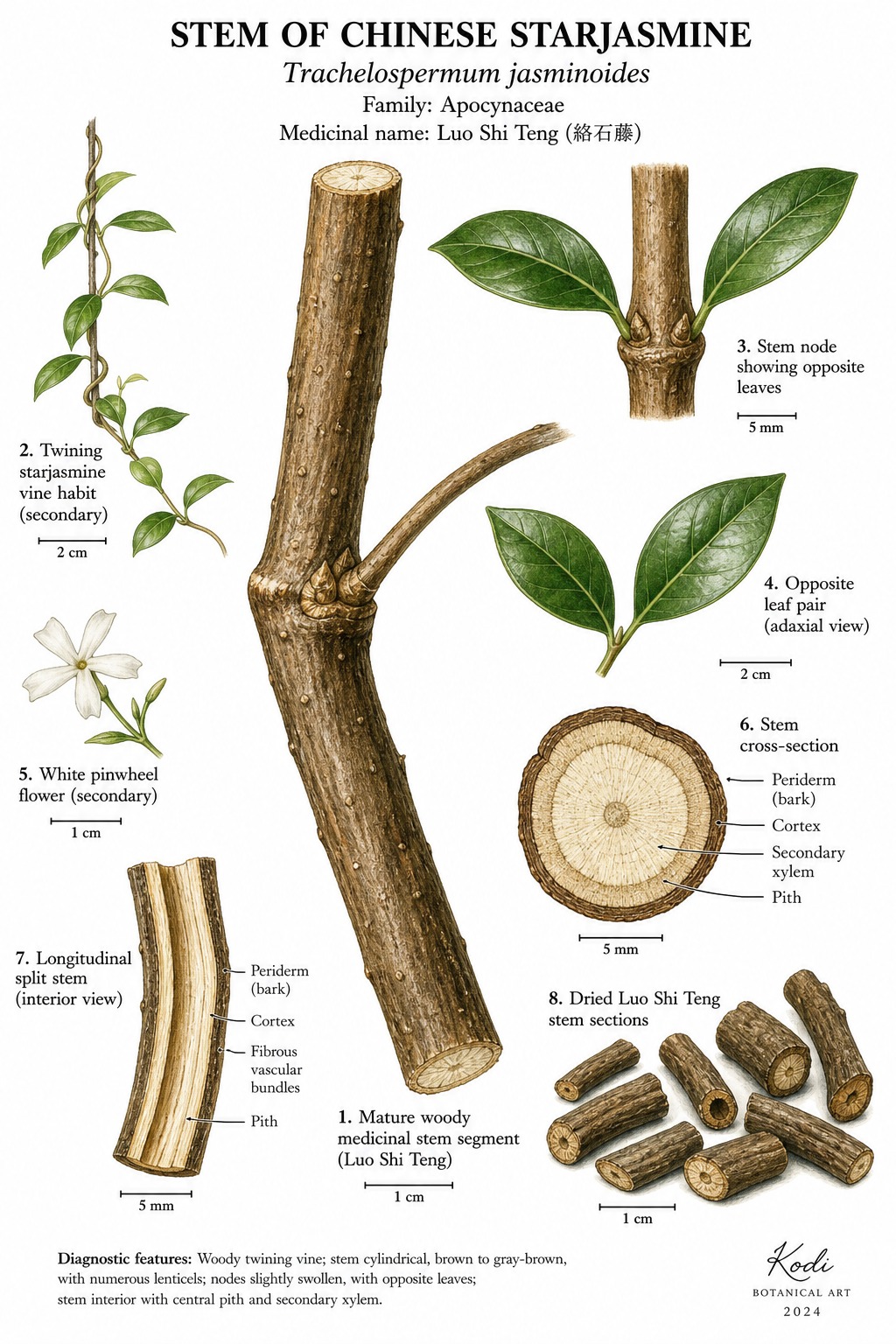
Known in TCM as Luo Shi Teng (络石藤), this bitter, slightly cold herb enters the Heart, Liver, and Kidney. Traditionally, it dispels wind-damp and unblocks the channels ... Luo Shi Teng is used for painful obstruction with stiff, swollen, or difficult-to-bend joints, especially when heat and inflammation are part of the pattern, most often applied for joint pain, rheumatoid arthritis, and traumatic injury. Modern research has identified Tracheloside among its active constituents.
Part used: Stem
Also Known As
Latin: Caulis Trachelospermi | Pinyin: Luo Shi Teng | Chinese: 络石藤
TCM Properties
- Taste
- bitter
- Temperature
- slightly cold
- Channels
- Heart, Liver, Kidney
Traditional Use
Primary Actions
- Dispels wind-damp and unblocks the channels ... Luo Shi Teng is used for painful obstruction with stiff, swollen, or difficult-to-bend joints, especially when heat and inflammation are part of the pattern.
- Cools the blood and reduces swelling ... traditional use extends to red, painful, or inflamed tissues where moving the channels alone is not enough.
- Relaxes the sinews and collaterals ... it is valued when chronic aching, numbness, or limited movement lingers after injury or long-standing damp obstruction.
Secondary Actions
- Compared with warmer wind-damp vines, Luo Shi Teng is chosen more often when redness, irritability, or heat signs accompany joint pain.
- This page stays on the Trachelospermum jasminoides stem lane and should not be flattened into other anti-rheumatic vines simply because the channel-opening role overlaps.
Classic Formulas
- Damp-heat bi modifications ... Luo Shi Teng is commonly added when painful joints are red, swollen, or difficult to extend.
- Channel-unblocking trauma combinations ... the herb is often paired with blood-moving medicinals when stiffness and soreness persist after injury.
- Wind-damp formulas with Qin Jiao or Fang Ji ... a typical pairing logic when both heat-clearing and channel-opening actions are needed.
Classical References
- Traditional Chinese materia medica describes Luo Shi Teng as a cooling vine that dispels wind-damp, frees the channels, and reduces swelling.
- Its main clinical identity is a joint-and-sinew herb for hotter painful-obstruction patterns rather than a general tonic vine.
Modern Research
Active Compounds
- Tracheloside and related lignans
- Anti-inflammatory phenolic constituents
- Additional stem-and-leaf fractions with vascular and immunomodulatory interest
Studied Effects
- A 2025 study reported that tracheloside from Trachelospermi Caulis inhibited rheumatoid-arthritis signaling through IL-17 and MAPK pathways, matching the herb's longstanding inflammatory joint reputation (PMID 39603466).
- A 2022 pharmacology paper found that Trachelospermi caulis extract produced vasorelaxant effects in rat mesenteric resistance arteries, showing that the medicinal stem has measurable vascular activity beyond folk use alone (PMID 36014534).
- A 2022 constituent study isolated anti-inflammatory compounds from Caulis Trachelospermi and reinforced why the herb remains interesting for inflammation-focused research (PMID 34963182).
PubMed References
- Tracheloside, the main constituent of the total lignan extract from Trachelospermi Caulis, inhibited rheumatoid arthritis via IL-17/MAPK signaling pathway. (2025)
- Vasorelaxant Effect of Trachelospermi caulis Extract on Rat Mesenteric Resistance Arteries. (2022)
- Anti-inflammatory Constituents from Caulis Trachelospermi. (2022)
Safety & Interactions
Contraindications
- Cold painful-obstruction without heat or swelling as the main pattern
Cautions
- Modern research is encouraging but still preclinical ... the herb should not be framed as a stand-alone rheumatoid-arthritis treatment.
- Authentication matters because several climbing medicinal stems can look similar once cut and dried.
Conditions
- Joint Pain Traditional ★★★★☆ JSON
- Rheumatoid Arthritis Traditional ★★★☆☆ JSON
- Traumatic Injury Traditional ★★☆☆☆ JSON
- Sore Throat Traditional ★☆☆☆☆ JSON
Frequently Asked Questions
What is Chinese Starjasmine Stem used for?
Chinese Starjasmine Stem is traditionally used to Dispels wind-damp and unblocks the channels ... Luo Shi Teng is used for painful obstruction with stiff, swollen, or difficult-to-bend joints, especially when heat and inflammation are part of the pattern., Cools the blood and reduces swelling ... traditional use extends to red, painful, or inflamed tissues where moving the channels alone is not enough., Relaxes the sinews and collaterals ... it is valued when chronic aching, numbness, or limited movement lingers after injury or long-standing damp obstruction.. Research has investigated its effects on: A 2025 study reported that tracheloside from Trachelospermi Caulis inhibited rheumatoid-arthritis signaling through IL-17 and MAPK pathways, matching the herb's longstanding inflammatory joint reputation (PMID 39603466).; A 2022 pharmacology paper found that Trachelospermi caulis extract produced vasorelaxant effects in rat mesenteric resistance arteries, showing that the medicinal stem has measurable vascular activity beyond folk use alone (PMID 36014534)..
What are other names for Chinese Starjasmine Stem?
Chinese Starjasmine Stem is also known as Trachelospermum stem, Trachelospermi caulis, Starjasmine vine stem. In TCM: 络石藤 (Luo Shi Teng); Caulis Trachelospermi.
Is Chinese Starjasmine Stem safe during pregnancy?
The safety of Chinese Starjasmine Stem during pregnancy has not been established. Consult a qualified healthcare provider before use.
What are the contraindications for Chinese Starjasmine Stem?
Chinese Starjasmine Stem should not be used in: Cold painful-obstruction without heat or swelling as the main pattern. Consult a qualified healthcare provider before use.