Starwort Root
- Chinese
- 银柴胡
- Pinyin
- Yin Chai Hu
- Latin
- Radix Stellariae
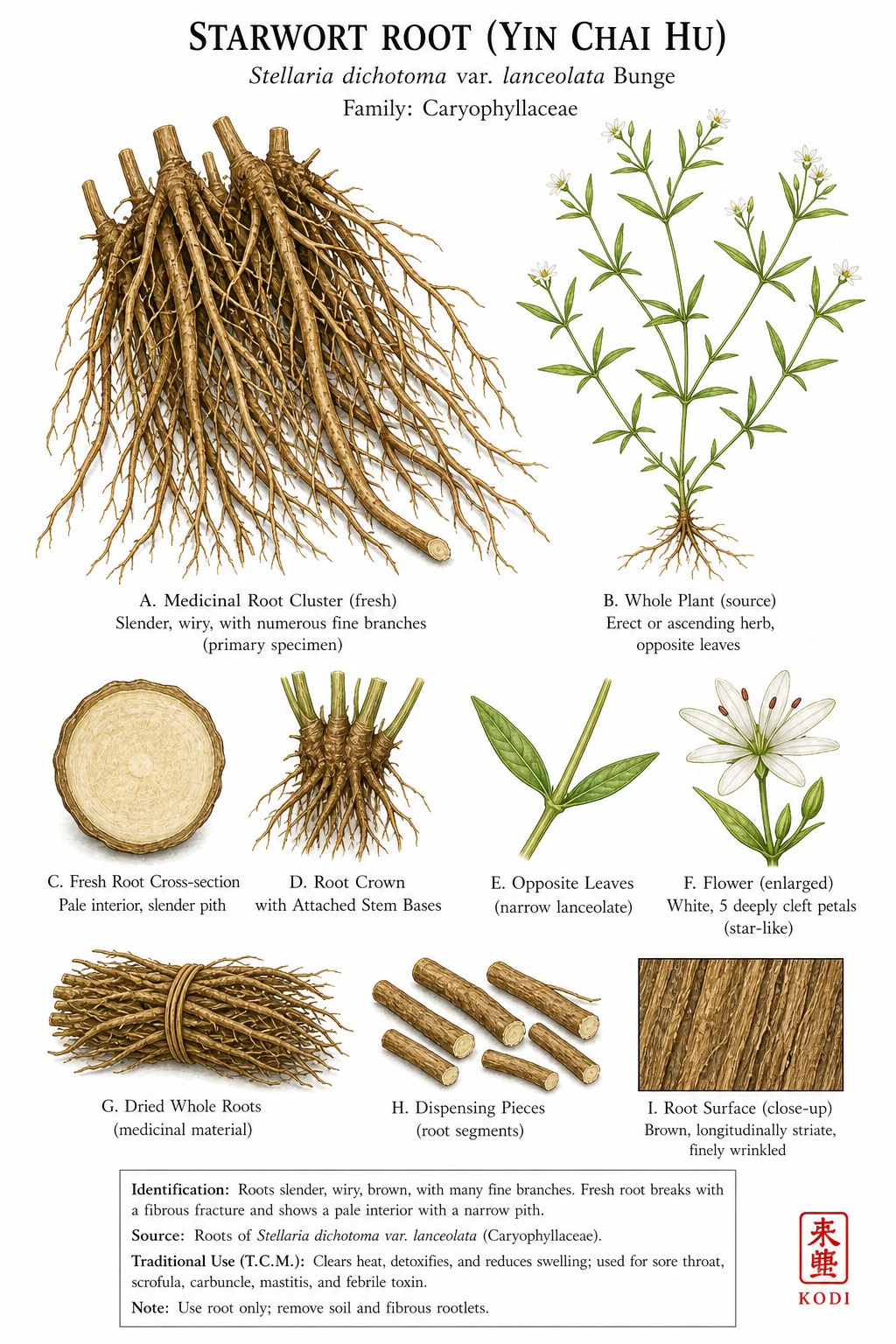
Known in TCM as Yin Chai Hu (银柴胡), this sweet, slightly cold herb enters the Liver and Stomach. Traditionally, it clears deficiency heat ... Yin Chai Hu is classically used for steaming-bone fever, lingering low-grade heat, and post-illness deficiency heat patterns, most often applied for night sweats, eczema, and anxiety. Modern research has identified Dichotomine among its active constituents.
Part used: Root
Also Known As
Latin: Radix Stellariae | Pinyin: Yin Chai Hu | Chinese: 银柴胡
TCM Properties
- Taste
- sweet
- Temperature
- slightly cold
- Channels
- Liver, Stomach
Traditional Use
Primary Actions
- Clears deficiency heat ... Yin Chai Hu is classically used for steaming-bone fever, lingering low-grade heat, and post-illness deficiency heat patterns.
- Clears childhood gan-heat and nutritional impairment heat ... this is one of the defining traditional use lanes of the herb.
- Cools without strongly draining qi ... it is chosen when chronic deficiency heat is present but the patient is already somewhat depleted.
Secondary Actions
- This page must stay distinct from Bupleurum `Chai Hu` ... the name resemblance is real, but the clinical role is very different.
- The accepted source lane here is Stellaria dichotoma var. lanceolata rather than unrelated Chai Hu-like lookalikes.
Classic Formulas
- Qing Gu San ... classic deficiency-heat and steaming-bone formula.
- Qin Jiao Bie Jia San ... lingering post-illness deficiency heat and hidden fever pattern.
- Pediatric gan-heat pairings with Hu Huang Lian or Bai Wei ... traditional child-malnutrition heat strategy.
Classical References
- Traditional herbology places Yin Chai Hu among the herbs that clear deficiency heat rather than among the qi-moving or exterior-releasing Chai Hu family.
- Its pediatric gan-heat use is one of the major clues that this herb belongs to a different therapeutic world than Bupleurum.
Modern Research
Active Compounds
- Dichotomine alkaloids
- Polysaccharides
- Phenylpropanoid and glycosidic constituents
Studied Effects
- A 2024 study found that supercritical CO2 extract from Stellariae Radix improved atopic-dermatitis changes through AMPK-linked macrophage effects, extending the herb's modern anti-inflammatory profile (PMID 38356236).
- Dichotomine B from Stellariae Radix attenuated neuroinflammatory responses through TLR4/MyD88-mTOR signaling in BV2 cells, supporting a mechanistic bridge to anti-inflammatory deficiency-heat discussions (PMID 37010732).
- A 2023 rat study reported anxiolytic effects from Stellariae Radix polysaccharides through monoamine, HPA-axis, and ECS/ERK/CREB/BDNF-related pathways (PMID 37739234).
PubMed References
- Supercritical CO(2) fluid extract from Stellariae Radix ameliorates 2,4-dinitrochlorobenzene-induced atopic dermatitis by inhibit M1 macrophages polarization via AMPK activation. (2024)
- Dichotomine B Attenuates Neuroinflammatory Responses by Regulating TLR4/MyD88-mTOR Signaling Pathway in BV2 Cells. (2023)
- The Anxiolytic Effect of Polysaccharides from Stellariae Radix through Monoamine Neurotransmitters, HPA Axis, and ECS/ERK/CREB/BDNF Signaling Pathway in Stress-induced Male Rats. (2023)
Safety & Interactions
Contraindications
- Obvious excess-cold disorders without deficiency heat
- Use as a substitute for Bupleurum Chai Hu when a true exterior-releasing herb is required
Cautions
- Most modern evidence remains preclinical even though the anti-inflammatory signal is growing.
- The main practical caution is identity confusion ... Yin Chai Hu is not ordinary Chai Hu.
Conditions
Frequently Asked Questions
What is Starwort Root used for?
Starwort Root is traditionally used to Clears deficiency heat ... Yin Chai Hu is classically used for steaming-bone fever, lingering low-grade heat, and post-illness deficiency heat patterns., Clears childhood gan-heat and nutritional impairment heat ... this is one of the defining traditional use lanes of the herb., Cools without strongly draining qi ... it is chosen when chronic deficiency heat is present but the patient is already somewhat depleted.. Research has investigated its effects on: A 2024 study found that supercritical CO2 extract from Stellariae Radix improved atopic-dermatitis changes through AMPK-linked macrophage effects, extending the herb's modern anti-inflammatory profile (PMID 38356236).; Dichotomine B from Stellariae Radix attenuated neuroinflammatory responses through TLR4/MyD88-mTOR signaling in BV2 cells, supporting a mechanistic bridge to anti-inflammatory deficiency-heat discussions (PMID 37010732)..
What are other names for Starwort Root?
Starwort Root is also known as Stellaria root, Yin Chai Hu, Stellaria. In TCM: 银柴胡 (Yin Chai Hu); Radix Stellariae.
Is Starwort Root safe during pregnancy?
The safety of Starwort Root during pregnancy has not been established. Consult a qualified healthcare provider before use.
What are the contraindications for Starwort Root?
Starwort Root should not be used in: Obvious excess-cold disorders without deficiency heat; Use as a substitute for Bupleurum Chai Hu when a true exterior-releasing herb is required. Consult a qualified healthcare provider before use.