Xiao Tong Cao
- Chinese
- 小通草
- Pinyin
- Xiao Tong Cao
- Latin
- Medulla Stachyuri et Helwingiae
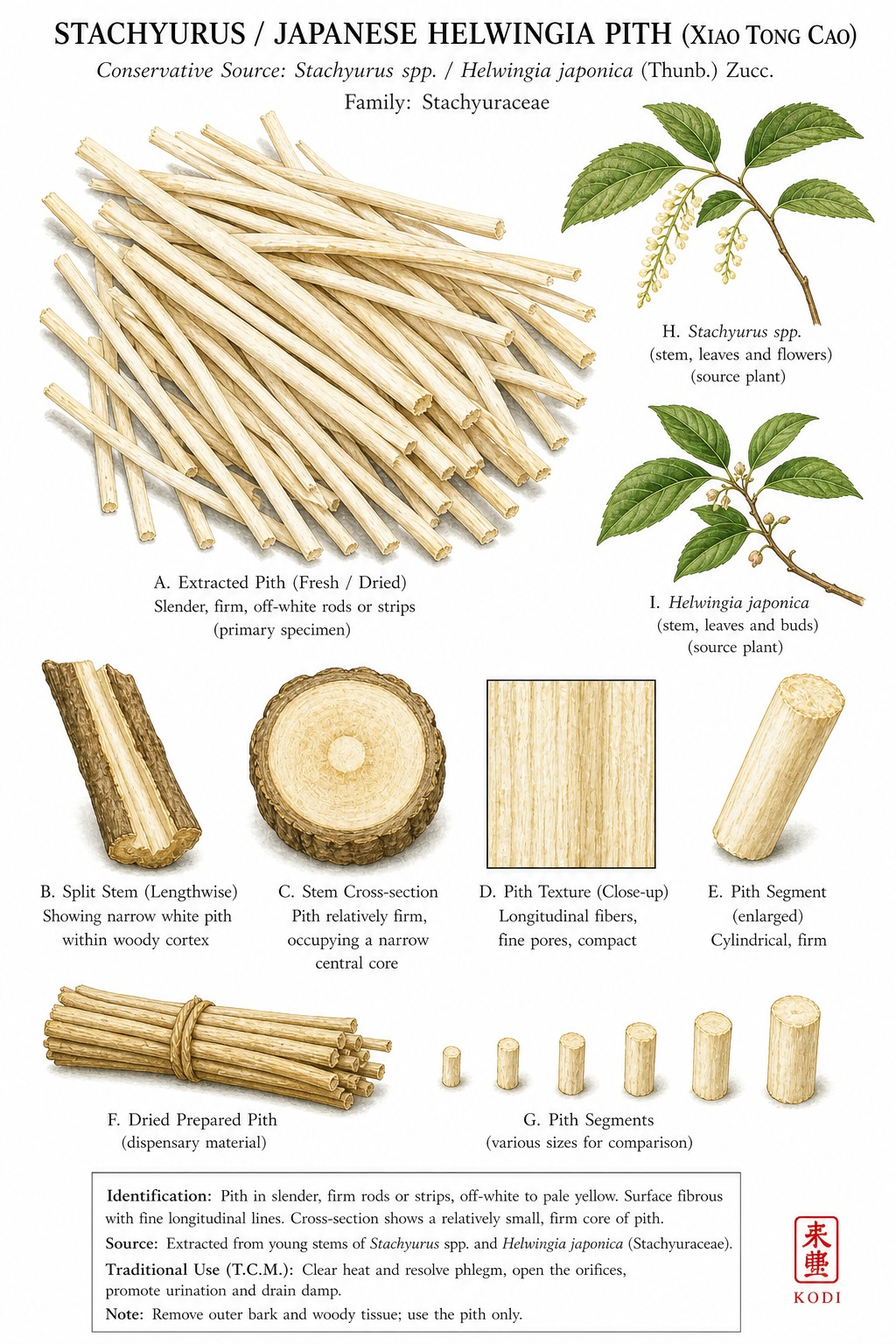
Known in TCM as Xiao Tong Cao (小通草), this sweet and bland, slightly cold herb enters the Lung and Stomach. Traditionally, it promotes urination and clears mild damp-heat ... Xiao Tong Cao is used when urinary difficulty is present but a gentler pith herb is desired, most often applied for insufficient lactation, urinary tract infection, and edema.
Part used: Pith
Also Known As
Latin: Medulla Stachyuri et Helwingiae | Pinyin: Xiao Tong Cao | Chinese: 小通草
TCM Properties
- Taste
- sweet, bland
- Temperature
- slightly cold
- Channels
- Lung, Stomach
Traditional Use
Primary Actions
- Promotes urination and clears mild damp-heat ... Xiao Tong Cao is used when urinary difficulty is present but a gentler pith herb is desired.
- Unblocks lactation ... its postpartum use overlaps with Tong Cao-type logic when breast channels are constrained and milk flow is scant.
- Acts as a narrower substitute lane related to Tong Cao ... useful for fluid movement, but not identical to Medulla Tetrapanacis.
Secondary Actions
- This page should stay distinct from the already-live `pith-of-ricepaperplant` page ... Tong Cao and Xiao Tong Cao are recurrently confused in trade and reference works.
- Botanical-origin surveys show that commercial Tong Cao materials have long mixed multiple pith sources, which is why this identity record matters.
Classic Formulas
- Postpartum lactation-opening pairings with Wang Bu Liu Xing and Luo Lu ... practical galactagogue logic.
- Mild heat-strangury combinations with Hua Shi or Che Qian Zi ... urinary-opening strategy.
- Tong Cao-family fluid-moving use in breast and bladder constraints ... the realistic classical lane for Xiao Tong Cao.
Classical References
- Traditional summaries describe Xiao Tong Cao as sweet, bland, and slightly cold, entering the Lung and Stomach to promote urination and lactation.
- Commercial and botanical surveys show that Tong Cao names have historically covered more than one pith source, so this narrower Xiao Tong Cao page should remain identity-conscious.
Modern Research
Studied Effects
- Indexed modern literature on Xiao Tong Cao is sparse and is dominated more by source-identification and market-survey work than by rich herb-specific pharmacology.
- A 1997 survey of Tong Cao botanical origin and commercial products remains a useful identity reference for distinguishing true Tong Cao from substitute or confused pith materials (PMID 11038909).
PubMed References
Safety & Interactions
Contraindications
- Clear deficiency-cold with profuse urination and no heat or constraint pattern
Cautions
- Correct identification matters because Tong Cao names have historically covered multiple different pith materials.
- Evidence for Xiao Tong Cao is much thinner than for better studied modern botanicals, so claims should stay conservative.
Conditions
- Insufficient Lactation Traditional ★★★☆☆ JSON
- Urinary Tract Infection Traditional ★★☆☆☆ JSON
- Edema Traditional ★☆☆☆☆ JSON
Frequently Asked Questions
What is Xiao Tong Cao used for?
Xiao Tong Cao is traditionally used to Promotes urination and clears mild damp-heat ... Xiao Tong Cao is used when urinary difficulty is present but a gentler pith herb is desired., Unblocks lactation ... its postpartum use overlaps with Tong Cao-type logic when breast channels are constrained and milk flow is scant., Acts as a narrower substitute lane related to Tong Cao ... useful for fluid movement, but not identical to Medulla Tetrapanacis.. Research has investigated its effects on: Indexed modern literature on Xiao Tong Cao is sparse and is dominated more by source-identification and market-survey work than by rich herb-specific pharmacology.; A 1997 survey of Tong Cao botanical origin and commercial products remains a useful identity reference for distinguishing true Tong Cao from substitute or confused pith materials (PMID 11038909)..
What are other names for Xiao Tong Cao?
Xiao Tong Cao is also known as Stachyurus / Japanese Helwingia Pith, Stachyurus pith, Japanese helwingia pith. In TCM: 小通草 (Xiao Tong Cao); Medulla Stachyuri et Helwingiae.
Is Xiao Tong Cao safe during pregnancy?
The safety of Xiao Tong Cao during pregnancy has not been established. Consult a qualified healthcare provider before use.
What are the contraindications for Xiao Tong Cao?
Xiao Tong Cao should not be used in: Clear deficiency-cold with profuse urination and no heat or constraint pattern. Consult a qualified healthcare provider before use.