St John's Wort
- Chinese
- 贯叶连翘
- Pinyin
- Guan Ye Lian Qiao
- Latin
- Herba Hyperici Perforati
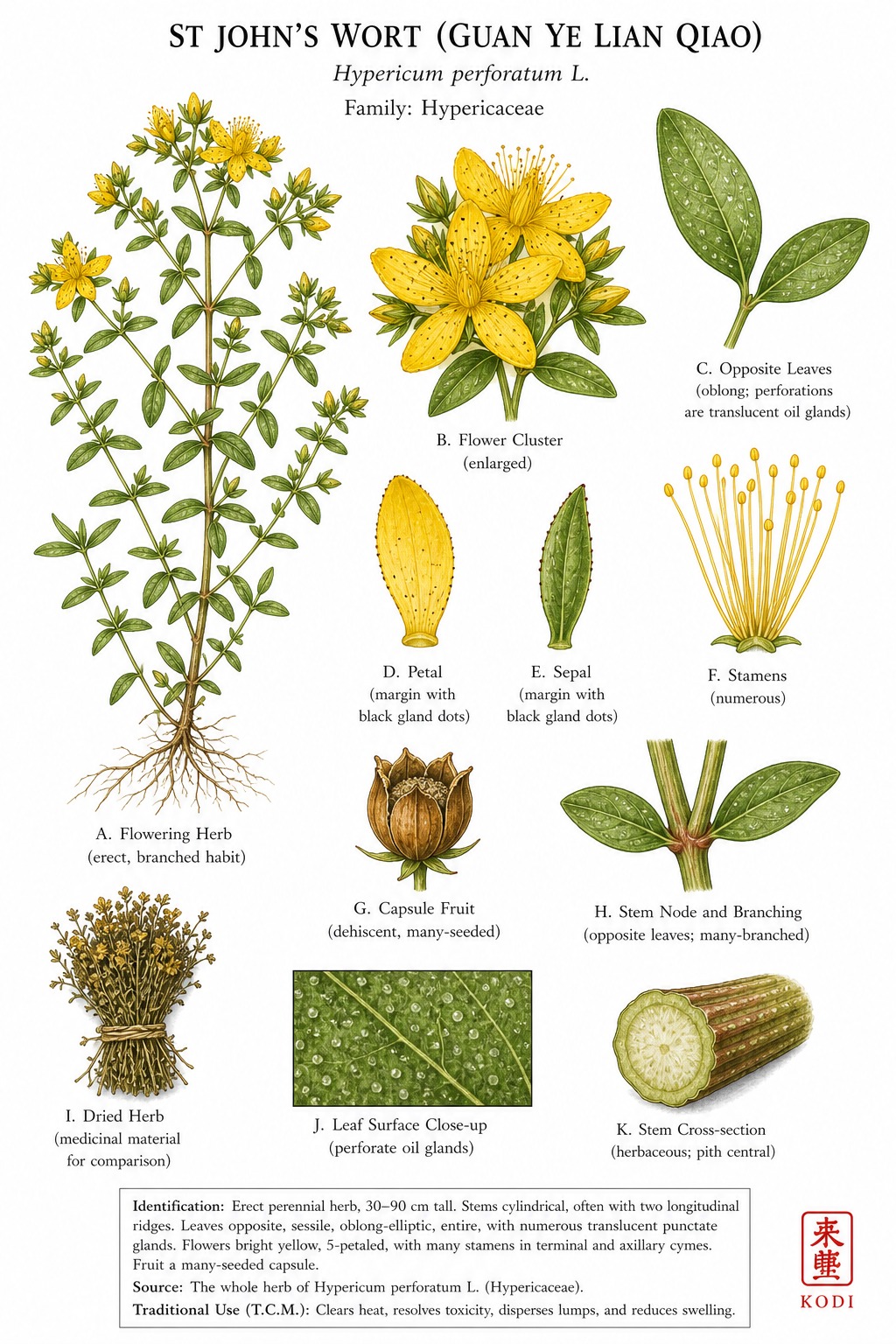
Known in TCM as Guan Ye Lian Qiao (贯叶连翘), this bitter and acrid, cool herb enters the Liver and Heart. Traditionally, it supports mood regulation in modern phytotherapy ... St John's Wort is best known internationally for mild-to-moderate depressive symptoms rather than for classical Chinese formula use, most often applied for depression and anxiety. Modern research has identified Hyperforin among its active constituents.
Part used: Whole herb
Also Known As
Latin: Herba Hyperici Perforati | Pinyin: Guan Ye Lian Qiao | Chinese: 贯叶连翘
TCM Properties
- Taste
- bitter, acrid
- Temperature
- cool
- Channels
- Liver, Heart
Traditional Use
Primary Actions
- Supports mood regulation in modern phytotherapy ... St John's Wort is best known internationally for mild-to-moderate depressive symptoms rather than for classical Chinese formula use.
- Calms irritability and emotional tension in cross-tradition herbal practice ... it is often discussed as a nervine and mood herb rather than a canonical TCM shen herb.
- Has a secondary external-use lane in Western herbalism for superficial bruising, nerve irritation, and minor tissue discomfort.
Secondary Actions
- This page is specifically Hypericum perforatum and must stay separate from the already-live `all-grass-of-japanese-st-johnswort` pages on Hypericum japonicum.
- Guan Ye Lian Qiao is better understood as a modern imported or cross-tradition herb name in Chinese-language materia medica, not as a core classical TCM staple.
Classic Formulas
- Standardized Hypericum extract monotherapy ... the main modern clinical lane rather than a classical decoction formula tradition.
- Modern Western herbal combinations for low mood and nervous tension ... more representative than famous premodern formulas.
- Topical infused-oil use for bruising and nerve discomfort ... the main traditional external route in European herbalism.
Classical References
- Modern Chinese herb references distinguish Guan Ye Lian Qiao from Di Er Cao because Hypericum perforatum and Hypericum japonicum are different species with very different interaction profiles.
- The herb's most important modern identity point is not a channel nuance but its extensive drug-interaction burden.
Modern Research
Active Compounds
- Hyperforin
- Hypericin and pseudohypericin
- Flavonoids such as hyperoside and rutin
Studied Effects
- A foundational review summarized the chemistry, pharmacology, and clinical properties of Hypericum perforatum, anchoring its modern reputation as a mood herb (PMID 11370698).
- A 2019 review clarified how hyperforin content drives many of St John's Wort's clinically important drug interactions, which is the single biggest practical safety issue for this herb (PMID 29411879).
- A 2017 clinical-risk review detailed the hazards of co-administration with conventional medicines, reinforcing that this herb's interaction burden is unusually consequential (PMID 28885074).
PubMed References
- St John's wort (Hypericum perforatum L.): a review of its chemistry, pharmacology and clinical properties. (2001)
- Understanding drug interactions with St John's wort (Hypericum perforatum L.): impact of hyperforin content. (2019)
- Clinical risks of St John's Wort (Hypericum perforatum) co-administration. (2017)
Safety & Interactions
Contraindications
- Concomitant use with medicines where reduced drug exposure or serotonergic toxicity would be dangerous
- Bipolar-spectrum mood instability without supervision
- Pregnancy
Cautions
- Memorial Sloan Kettering and major pharmacology reviews warn that St John's Wort can reduce effectiveness of oral contraceptives, transplant drugs, HIV drugs, anticoagulants, and many other medicines through enzyme and transporter induction.
- Photosensitivity and agitation are possible, especially at higher doses or in susceptible patients.
- The herb should not be treated as a casual wellness supplement when complex medication regimens are present.
Drug Interactions
St John's Wort has a high overall interaction risk. It can lower the effectiveness of transplant medicines, oral contraceptives, antiretrovirals, warfarin, digoxin, benzodiazepines, and many other drugs, while combining it with serotonergic medicine can raise the risk of serotonin toxicity.
- SSRIs, SNRIs, MAO inhibitors, triptans, and other serotonergic medicines … Additive serotonergic effects can produce potentially dangerous serotonin toxicity. (Major) Source: NCCIH Herb-Drug Interactions
- Cyclosporine, tacrolimus, and other transplant immunosuppressants … CYP enzyme and P-glycoprotein induction can reduce drug exposure and create a treatment-failure risk. (Major) Source: NCCIH Herb-Drug Interactions
- Oral contraceptives … Enzyme induction can reduce hormone exposure and contraceptive reliability. (Major) Source: NCCIH Herb-Drug Interactions
- Antiretroviral medicines … Clinically significant reductions in exposure have been documented with medicines including indinavir. (Major) Source: NCCIH Herb-Drug Interactions
- Warfarin, digoxin, benzodiazepines, and other CYP or P-glycoprotein substrates … Strong enzyme and transporter induction can reduce drug concentrations and therapeutic effect. (Major) Source: NCCIH Herb-Drug Interactions
Conditions
- Depression Research ★★★★☆ JSON
- Anxiety Traditional ★★☆☆☆ JSON
Frequently Asked Questions
What is St John's Wort used for?
St John's Wort is traditionally used to Supports mood regulation in modern phytotherapy ... St John's Wort is best known internationally for mild-to-moderate depressive symptoms rather than for classical Chinese formula use., Calms irritability and emotional tension in cross-tradition herbal practice ... it is often discussed as a nervine and mood herb rather than a canonical TCM shen herb., Has a secondary external-use lane in Western herbalism for superficial bruising, nerve irritation, and minor tissue discomfort.. Research has investigated its effects on: A foundational review summarized the chemistry, pharmacology, and clinical properties of Hypericum perforatum, anchoring its modern reputation as a mood herb (PMID 11370698).; A 2019 review clarified how hyperforin content drives many of St John's Wort's clinically important drug interactions, which is the single biggest practical safety issue for this herb (PMID 29411879)..
What are other names for St John's Wort?
St John's Wort is also known as Hypericum perforatum, Western St John's Wort, Hypericum. In TCM: 贯叶连翘 (Guan Ye Lian Qiao); Herba Hyperici Perforati.
Is St John's Wort safe during pregnancy?
St John's Wort is not recommended during pregnancy.
What are the contraindications for St John's Wort?
St John's Wort should not be used in: Concomitant use with medicines where reduced drug exposure or serotonergic toxicity would be dangerous; Bipolar-spectrum mood instability without supervision; Pregnancy. Consult a qualified healthcare provider before use.
Does St John's Wort interact with any medications?
St John's Wort may interact with: SSRIs, SNRIs, MAO inhibitors, triptans, and other serotonergic medicines - Additive serotonergic effects can produce potentially dangerous serotonin toxicity. - (Major severity); Cyclosporine, tacrolimus, and other transplant immunosuppressants - CYP enzyme and P-glycoprotein induction can reduce drug exposure and create a treatment-failure risk. - (Major severity); Oral contraceptives - Enzyme induction can reduce hormone exposure and contraceptive reliability. - (Major severity); Antiretroviral medicines - Clinically significant reductions in exposure have been documented with medicines including indinavir. - (Major severity). Always inform your healthcare provider of any herbal supplements you are taking.