Japanese Climbing Fern Spore
- Chinese
- 海金沙
- Pinyin
- Hai Jin Sha
- Latin
- Spora Lygodii
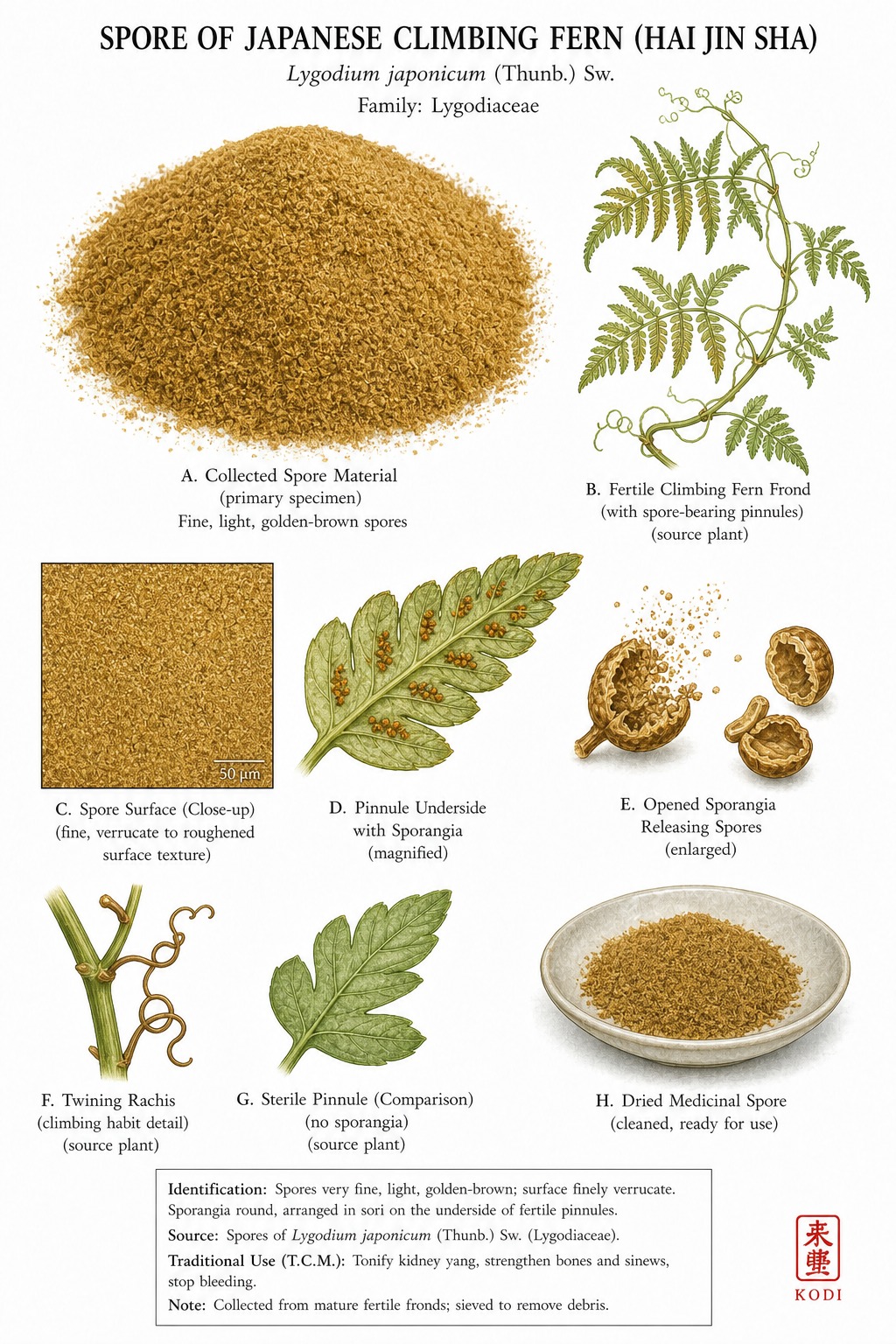
Known in TCM as Hai Jin Sha (海金沙), this sweet, cold herb enters the Bladder and Small Intestine. Traditionally, it clears damp-heat and relieves painful urinary dysfunction ... Hai Jin Sha is a classic herb for hot strangury, burning urination, and urinary irritation, most often applied for urolithiasis, urinary tract infection, and hematuria. Modern research has identified Polysaccharides among its active constituents.
Part used: Spore
Also Known As
Latin: Spora Lygodii | Pinyin: Hai Jin Sha | Chinese: 海金沙
TCM Properties
- Taste
- sweet
- Temperature
- cold
- Channels
- Bladder, Small Intestine
Traditional Use
Primary Actions
- Clears damp-heat and relieves painful urinary dysfunction ... Hai Jin Sha is a classic herb for hot strangury, burning urination, and urinary irritation.
- Expels stones and gravel ... it is especially associated with sand-like urine, stone-type obstruction, and hematuria related to lower-burner heat.
- Promotes smooth urination without being as harsh as saline mineral purgatives ... this gives it a central role in stone-oriented prescriptions.
Secondary Actions
- Because the medicinal is a fine spore material, it is traditionally wrapped for decoction rather than simply boiled loose.
- Hai Jin Sha is often paired with Jin Qian Cao and Ji Nei Jin when stone and damp-heat patterns dominate.
Classic Formulas
- Shi Lin Tong and related stone-strangury formulas ... classic use for urinary calculi and painful urination.
- San Jin style pairings with Jin Qian Cao and Ji Nei Jin ... recurrent clinical logic for gravel and stone obstruction.
- Lower-burner damp-heat combinations with Qu Mai and Bian Xu ... heat-strangury strategy.
Classical References
- Traditional herbology describes Hai Jin Sha as sweet and cold, entering the Bladder and Small Intestine to clear damp-heat and facilitate urination.
- Its reputation as a stone herb is one of the most stable and widely repeated parts of its classical identity.
Modern Research
Active Compounds
- Polysaccharides
- Fatty-acid-rich fractions
- Flavonoids and phenolic constituents
Studied Effects
- Ethanol extract of Lygodium japonicum spores inhibited ethylene-glycol-induced kidney calculi in rats, directly supporting the traditional stone-expelling indication (PMID 24972555).
- A 2017 study found anti-inflammatory effects of Lygodium japonicum spore extracts in murine macrophages through inhibition of NF-kappaB and p38 signaling (PMID 29067444).
- A 2025 study structurally characterized polysaccharides from Lygodium japonicum and reported inhibitory activity relevant to calcium-oxalate renal stone formation (PMID 40318530).
PubMed References
- The inhibitory effect of an ethanol extract of the spores of Lygodium japonicum on ethylene glycol-induced kidney calculi in rats. (2014)
- Anti-inflammatory effects on murine macrophages of ethanol extracts of Lygodium japonicum spores via inhibition of NF-κB and p38. (2017)
- Structural characterization of polysaccharides from Lygodium japonicum (Thunb.) Sw. and its inhibition ability in calcium oxalate renal stone. (2025)
Safety & Interactions
Contraindications
- Deficiency-cold patterns without damp-heat
- Urinary difficulty caused by severe qi deficiency or fluid depletion rather than heat
Cautions
- Fine spore material is traditionally bagged for decoction to avoid gritty sediment.
- Stone symptoms with fever, complete obstruction, or severe uncontrolled pain need conventional medical evaluation.
Conditions
- Urolithiasis Research ★★★★☆ JSON
- Urinary Tract Infection Traditional ★★★☆☆ JSON
- Hematuria Traditional ★★☆☆☆ JSON
- Jaundice Traditional ★☆☆☆☆ JSON
Frequently Asked Questions
What is Japanese Climbing Fern Spore used for?
Japanese Climbing Fern Spore is traditionally used to Clears damp-heat and relieves painful urinary dysfunction ... Hai Jin Sha is a classic herb for hot strangury, burning urination, and urinary irritation., Expels stones and gravel ... it is especially associated with sand-like urine, stone-type obstruction, and hematuria related to lower-burner heat., Promotes smooth urination without being as harsh as saline mineral purgatives ... this gives it a central role in stone-oriented prescriptions.. Research has investigated its effects on: Ethanol extract of Lygodium japonicum spores inhibited ethylene-glycol-induced kidney calculi in rats, directly supporting the traditional stone-expelling indication (PMID 24972555).; A 2017 study found anti-inflammatory effects of Lygodium japonicum spore extracts in murine macrophages through inhibition of NF-kappaB and p38 signaling (PMID 29067444)..
What are other names for Japanese Climbing Fern Spore?
Japanese Climbing Fern Spore is also known as Spore of Japanese Climbing Fern, Lygodii Spora, Lygodium. In TCM: 海金沙 (Hai Jin Sha); Spora Lygodii.
Is Japanese Climbing Fern Spore safe during pregnancy?
The safety of Japanese Climbing Fern Spore during pregnancy has not been established. Consult a qualified healthcare provider before use.
What are the contraindications for Japanese Climbing Fern Spore?
Japanese Climbing Fern Spore should not be used in: Deficiency-cold patterns without damp-heat; Urinary difficulty caused by severe qi deficiency or fluid depletion rather than heat. Consult a qualified healthcare provider before use.