Chinese Honeylocust Spine
- Chinese
- 皂刺
- Pinyin
- Zao Ci
- Latin
- Spina Gleditsiae
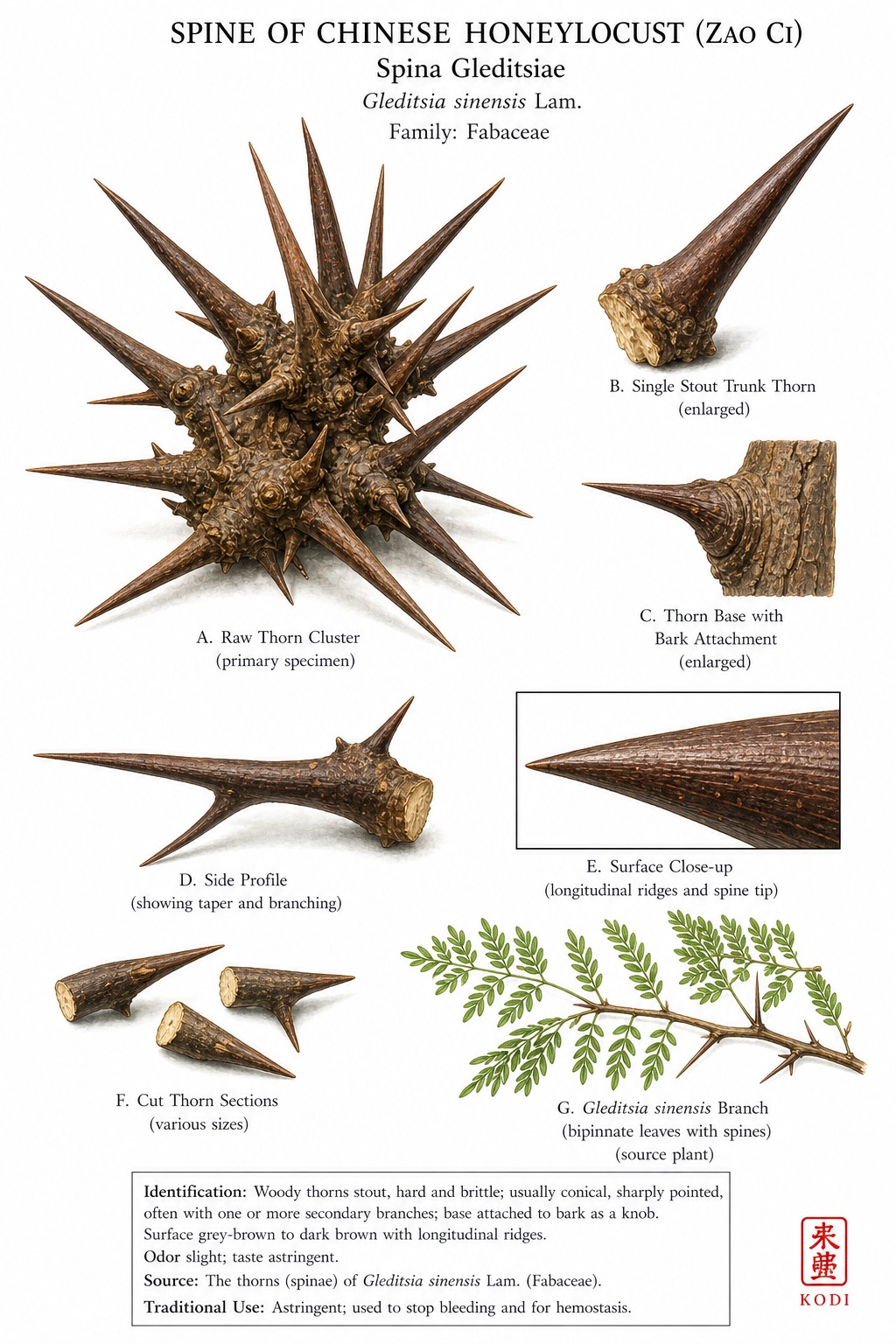
Known in TCM as Zao Ci (皂刺), this acrid, warm herb enters the Liver and Stomach. Traditionally, it reduces swelling and expels pus ... Zao Ci is classically used for sores, carbuncles, breast abscesses, and nodules that are slow to ripen or drain, most often applied for abscess, breast abscess, and scrofula. Modern research has identified Triterpenes among its active constituents.
Part used: Spine
Also Known As
Latin: Spina Gleditsiae | Pinyin: Zao Ci | Chinese: 皂刺
TCM Properties
- Taste
- acrid
- Temperature
- warm
- Channels
- Liver, Stomach
Traditional Use
Primary Actions
- Reduces swelling and expels pus ... Zao Ci is classically used for sores, carbuncles, breast abscesses, and nodules that are slow to ripen or drain.
- Dispels wind and opens the collaterals in older usage ... some traditions extend the thorn to stubborn wind-damp pain and surface obstruction.
- Disperses phlegm and resolves scrofula-type nodules ... the thorn is sharper and more outward-moving than many softer detoxifying herbs.
Secondary Actions
- This shorter-name raw-thorn lane should stay aligned with the more canonical `spine-of-chinese-honeylocust-2` sibling rather than treated as a different plant.
- Modern conservation-era substitution discussions sometimes mention Zao Jiao Ci as a plant alternative where older suppuration formulas once used pangolin materials.
Classic Formulas
- Tou Nong San ... classical suppuration-promoting formula logic for chronic abscesses and pus that will not vent.
- Breast-abscess pairings with Gua Lou and Pu Gong Ying ... traditional detoxifying and opening strategy.
- Scrofula and hard-swelling combinations with heat-toxin-clearing herbs ... older external and internal use lane.
Classical References
- Traditional herbology describes Zao Ci as sharp, warm, and suppuration-promoting, especially for swellings that have not yet opened.
- The thorn record should be kept separate from the Chinese honeylocust fruit because the fruit and spine do not share the same clinical center of gravity.
Modern Research
Active Compounds
- Triterpenes
- Flavonoids
- Phenolic constituents
- Gleditsia spine aqueous extract fractions
Studied Effects
- A 2016 mini-review summarized traditional usage, chemistry, and pharmacologic evidence for Spina Gleditsiae, supporting its modern relevance as an anti-inflammatory and detumescence-oriented medicinal (PMID 27433183).
- Experimental work found anti-inflammatory effects from aqueous extract of Zao-Jiao-Ci in vitro and in vivo, providing a mechanism-facing bridge to the classic swelling and abscess use (PMID 27401288).
- A 2021 metabolomic study explored the basis of antidepressant effects attributed to Gleditsiae spina, showing how modern research on the thorn now extends beyond its classic detoxifying use (PMID 34094035).
PubMed References
- From Traditional Usage to Pharmacological Evidence: A Systematic Mini-Review of Spina Gleditsiae. (2016)
- In vivo and in vitro anti-inflammatory effects of Zao-Jiao-Ci (the spine of Gleditsia sinensis Lam.) aqueous extract and its mechanisms of action. (2016)
- Investigating the basis for the antidepressant effects of Gleditsiae spina using an integrated metabolomic strategy. (2021)
Safety & Interactions
Contraindications
- Pregnancy
- Weak patients without clear swelling, toxin, or hard-nodule indication
Cautions
- The thorn is more dispersing and suppuration-promoting than gentle tonic herbs, so it should be used purposefully.
- Abscess or breast infection with systemic illness still requires appropriate medical evaluation.
Conditions
- Abscess Traditional ★★★★☆ JSON
- Breast Abscess Traditional ★★★☆☆ JSON
- Scrofula Traditional ★★☆☆☆ JSON
- Rheumatism Traditional ★☆☆☆☆ JSON
Frequently Asked Questions
What is Chinese Honeylocust Spine used for?
Chinese Honeylocust Spine is traditionally used to Reduces swelling and expels pus ... Zao Ci is classically used for sores, carbuncles, breast abscesses, and nodules that are slow to ripen or drain., Dispels wind and opens the collaterals in older usage ... some traditions extend the thorn to stubborn wind-damp pain and surface obstruction., Disperses phlegm and resolves scrofula-type nodules ... the thorn is sharper and more outward-moving than many softer detoxifying herbs.. Research has investigated its effects on: A 2016 mini-review summarized traditional usage, chemistry, and pharmacologic evidence for Spina Gleditsiae, supporting its modern relevance as an anti-inflammatory and detumescence-oriented medicinal (PMID 27433183).; Experimental work found anti-inflammatory effects from aqueous extract of Zao-Jiao-Ci in vitro and in vivo, providing a mechanism-facing bridge to the classic swelling and abscess use (PMID 27401288)..
What are other names for Chinese Honeylocust Spine?
Chinese Honeylocust Spine is also known as Zao Jiao Ci, Spine of Chinese Honeylocust, Gleditsia spine. In TCM: 皂刺 (Zao Ci); Spina Gleditsiae.
Is Chinese Honeylocust Spine safe during pregnancy?
Chinese Honeylocust Spine is not recommended during pregnancy.
What are the contraindications for Chinese Honeylocust Spine?
Chinese Honeylocust Spine should not be used in: Pregnancy; Weak patients without clear swelling, toxin, or hard-nodule indication. Consult a qualified healthcare provider before use.