Southern Fang Ji Root
- Chinese
- 广防己
- Pinyin
- Guang Fang Ji
- Latin
- Radix Aristolochiae Fangchi
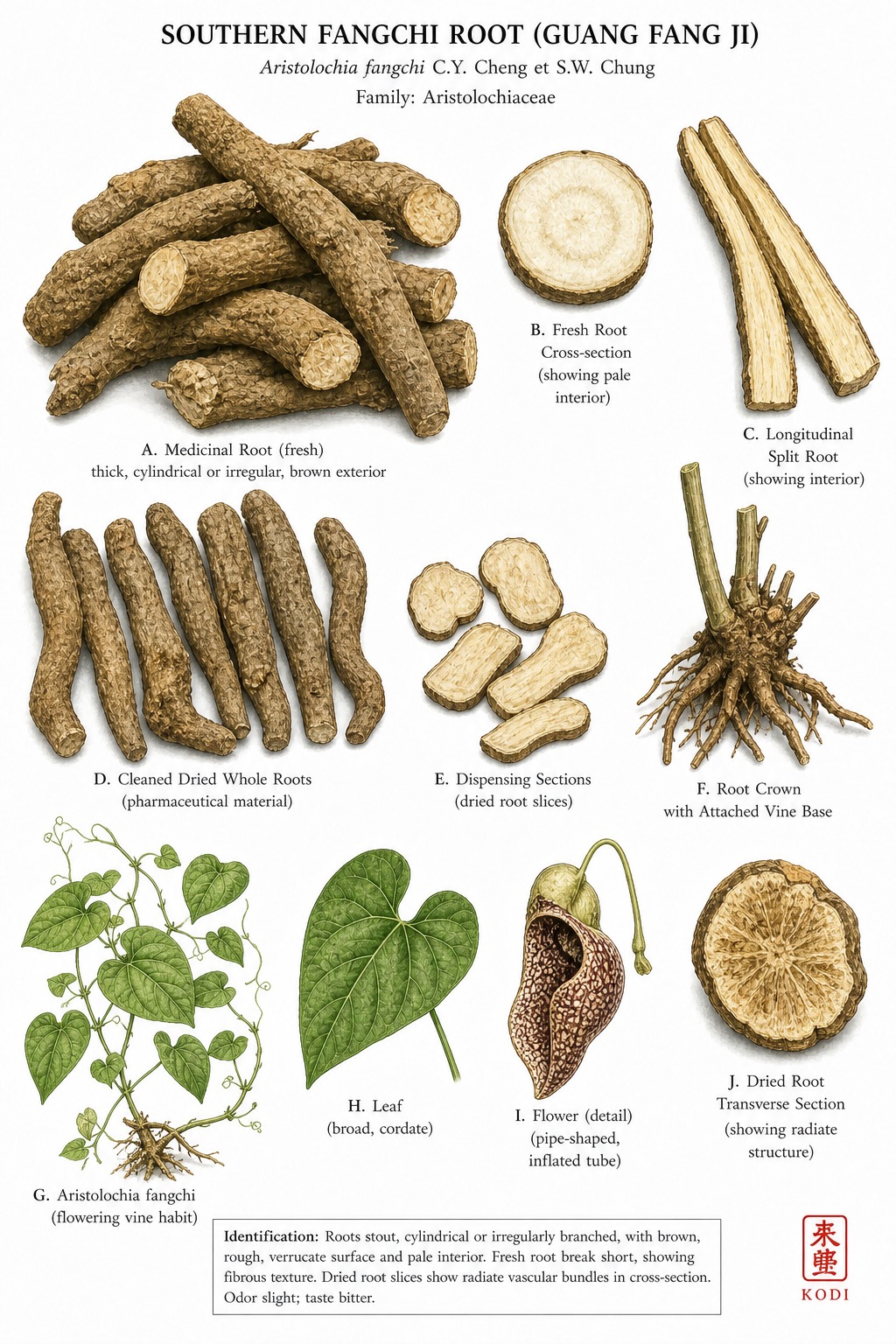
Known in TCM as Guang Fang Ji (广防己), this bitter and acrid, cold herb enters the Liver, Kidney, and Bladder. Traditionally, it historically dispelled wind-damp and alleviated painful obstruction ... older materia medica placed Guang Fang Ji in the broader Fang Ji family for swollen painful joints and damp-heat bi, most often applied for edema, joint pain, and rheumatism. Modern research has identified Aristolochic among its active constituents.
Part used: Root
Also Known As
Latin: Radix Aristolochiae Fangchi | Pinyin: Guang Fang Ji | Chinese: 广防己
TCM Properties
- Taste
- bitter, acrid
- Temperature
- cold
- Channels
- Liver, Kidney, Bladder
Traditional Use
Primary Actions
- Historically dispelled wind-damp and alleviated painful obstruction ... older materia medica placed Guang Fang Ji in the broader Fang Ji family for swollen painful joints and damp-heat bi.
- Historically promoted urination and reduced edema ... it was used for lower-body swelling, difficult urination, and damp accumulation.
- The modern clinical meaning of this record is now overwhelmingly toxicological ... Guang Fang Ji is preserved here as a high-risk historical identity, not as a routine current-use recommendation.
Secondary Actions
- Guang Fang Ji must be distinguished from authentic Han Fang Ji derived from Stephania tetrandra or Botryodiscia tetrandra ... the substitution problem is safety-critical, not academic.
- This page should remain on the documented Aristolochia fangchi lane even though modern safe practice centers on avoiding it.
Classic Formulas
- Historical Fang Ji family use in edema and wind-damp formulas ... preserved here as documentary context only.
- Fang Ji Huang Qi Tang lineage ... relevant only as a reminder that older naming practice did not reliably separate safe and unsafe Fang Ji sources.
- Damp-heat painful-obstruction applications mirrored authentic Fang Ji on paper, which is exactly why substitution caused so much harm.
Classical References
- Older herb lists often treated Guang Fang Ji as a Fang Ji source for edema and painful obstruction before aristolochic-acid toxicity was fully recognized.
- Modern pharmacognosy treats the identity distinction from authentic Han Fang Ji as essential because the traditional name overlap caused real nephropathy and urothelial malignancy cases.
Modern Research
Active Compounds
- Aristolochic acid I
- Aristolochic acid II
- Aristolactam-related metabolites
Studied Effects
- Modern indexed literature on Guang Fang Ji is dominated by authentication and toxicology, including work differentiating authentic Stephania tetrandra from nephrotoxic Aristolochia fangchi (PMID 26632529).
- A 2019 review reinforced the recognition of aristolochic acid toxicity, including the now well-established association with nephropathy and urothelial cancer risk (PMID 30548302).
- Dose-related progression of Chinese herb nephropathy after Aristolochia fangchi exposure was documented clinically as early as 2002, making this one of the clearest danger records in the materia medica naming-confusion literature (PMID 11865085).
PubMed References
- Differentiation between two "fang ji" herbal medicines, Stephania tetrandra and the nephrotoxic Aristolochia fangchi, using hyperspectral imaging. (2016)
- Recognition of the toxicity of aristolochic acid. (2019)
- Progression rate of Chinese herb nephropathy: impact of Aristolochia fangchi ingested dose. (2002)
Safety & Interactions
Contraindications
- Pregnancy
- Any unsupervised internal use
- Kidney disease or reduced renal reserve
- Any product sold simply as Fang Ji without verified authenticated sourcing
Cautions
- Guang Fang Ji is associated with aristolochic acid nephropathy and urothelial carcinogenic risk.
- This is a historical toxic identity record and should not be read as an endorsement for routine clinical use.
- The major safety lesson is source authentication ... authentic Han Fang Ji and Guang Fang Ji are not interchangeable.
Conditions
- Edema Traditional ★★☆☆☆ JSON
- Joint Pain Traditional ★★☆☆☆ JSON
- Rheumatism Traditional ★★☆☆☆ JSON
Frequently Asked Questions
What is Southern Fang Ji Root used for?
Southern Fang Ji Root is traditionally used to Historically dispelled wind-damp and alleviated painful obstruction ... older materia medica placed Guang Fang Ji in the broader Fang Ji family for swollen painful joints and damp-heat bi., Historically promoted urination and reduced edema ... it was used for lower-body swelling, difficult urination, and damp accumulation., The modern clinical meaning of this record is now overwhelmingly toxicological ... Guang Fang Ji is preserved here as a high-risk historical identity, not as a routine current-use recommendation.. Research has investigated its effects on: Modern indexed literature on Guang Fang Ji is dominated by authentication and toxicology, including work differentiating authentic Stephania tetrandra from nephrotoxic Aristolochia fangchi (PMID 26632529).; A 2019 review reinforced the recognition of aristolochic acid toxicity, including the now well-established association with nephropathy and urothelial cancer risk (PMID 30548302)..
What are other names for Southern Fang Ji Root?
Southern Fang Ji Root is also known as Southern Fangchi Root, Aristolochia fangchi root, Aristolochia. In TCM: 广防己 (Guang Fang Ji); Radix Aristolochiae Fangchi.
Is Southern Fang Ji Root safe during pregnancy?
Southern Fang Ji Root is not recommended during pregnancy.
What are the contraindications for Southern Fang Ji Root?
Southern Fang Ji Root should not be used in: Pregnancy; Any unsupervised internal use; Kidney disease or reduced renal reserve; Any product sold simply as Fang Ji without verified authenticated sourcing. Consult a qualified healthcare provider before use.